
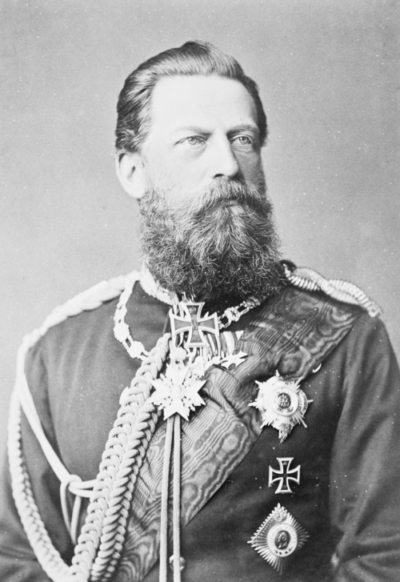
Frederick III, German Emperor
Frederick III, German Emperor was an as King of Prussia German Emperor. Born October 18, 1831, in New Palace. Died June 15, 1888, in New Palace. Positions held include German Emperor (1888) and King of Prussia (1888). Educated at University of Bonn. Awards include Pour le Mérite, Knight of the Order of the Golden Fleece and Order of the Black Eagle.
Facts
42 facts · 2 confirmed by two sources · 9 cited · 31 from one source
Where this comes from
Papalocal keeps its own record. It started from these sources; what each one said is kept here as it was copied, so a change on their side never changes this page by itself. Tap one to read its version.
What Wikidata says · copied November 16, 2026 · revision 2565530213
- Described as
- as King of Prussia German Emperor (1831–1888)
- Other names
- Kronprinz Friedrich Wilhelm, Friedrich Wilhelm Nikolaus Karl, Friedrich III, Friedrich III of Germany, Frederick III of Germany, King Frederick III of Prussia
- Born
- October 18, 1831 · 7 references
- Died
- June 15, 1888 · 8 references
- Born in
- New Palace · 1 reference
- Died in
- New Palace · 1 reference
- Buried in
- Church of Peace
- Cause of death
- laryngeal cancer
- Name at birth
- Friedrich Wilhelm Nikolaus Karl von Preußen
- Citizen of
- Kingdom of Prussia; German Empire
- Occupation
- politician
- Positions held
- German Emperor (1888) · 1 reference; King of Prussia (1888) · 1 reference
- Education
- University of Bonn
- Awards
- Pour le Mérite; Knight of the Order of the Golden Fleece; Order of the Black Eagle; Knight in the Order of the Holy Sepulchre; Order of St. Andrew; Order of St. George, 4th class; Knight Grand Cross of the Military Order of William (1878); Order of Saint Alexander Nevsky; Order of the Red Eagle 1st Class; Order of St. George, 2nd class; Order of Saint Stanislaus, 1st class; Order of the Redeemer · 1 reference; Order of Saint Stephen of Hungary · 1 reference; Military Order of Maria Theresa · 1 reference
- Spouse
- Victoria, Princess Royal (1858–1888) · 2 references
- Children
- Wilhelm II · 1 reference; Princess Charlotte of Prussia · 1 reference; Prince Henry of Prussia; Prince Sigismund of Prussia; Princess Viktoria of Prussia · 1 reference; Prince Waldemar of Prussia; Sophia of Prussia; Princess Margaret of Prussia
- Father
- Wilhelm I · 1 reference
- Mother
- Augusta of Saxe-Weimar-Eisenach
- Siblings
- Princess Louise of Prussia
- Religion
- Prussian Union of Churches; Reformed Christianity
- Military rank
- Generalfeldmarschall
- Wikipedias with a page
- 76
Wikidata item Q58600 (wikidata.org/wiki/Q58600), public domain (CC0). Copied November 16, 2026.
What Wikipedia says · copied November 16, 2026 · revision 1382987918
Frederick III (Friedrich Wilhelm Nikolaus Karl; 18 October 1831 – 15 June 1888), or Friedrich III, was German Emperor and King of Prussia for 99 days from 9 March 1888 until his death in June that year, during the Year of the Three Emperors.
Known informally as "Fritz", he was the only son of Emperor Wilhelm I and was raised in his family's tradition of military service. Following the unification of Germany in 1871 his father, then King of Prussia, became German Emperor. Upon Wilhelm's death at the age of ninety on 9 March 1888, the thrones passed to Frederick, who had been German Crown Prince for seventeen years and Crown Prince of Prussia for twenty-seven years. Frederick was suffering from cancer of the larynx when he died at the age of 56, following unsuccessful medical treatments for his condition.
Frederick married Victoria, Princess Royal, the oldest child of Queen Victoria of the United Kingdom. The couple were well-matched; their shared liberal ideology led them to support progressive and democratic reform. Despite his family's conservative and militaristic background, Frederick had developed liberal tendencies as a result of his ties with Britain and his studies at the University of Bonn. As crown prince, he often opposed the conservative Chancellor Otto von Bismarck, particularly in speaking out against Bismarck's policy of uniting Germany through force, and in urging that the power of the executive be curbed to the benefit of the Reichstag. Liberals in both Germany and Great Britain hoped that as emperor, Frederick would move to institute democratic reforms in the German Empire.
Frederick and Victoria were great admirers of Prince Albert, Queen Victoria's husband. They planned to rule as joint monarchs and to reform what they saw as flaws in the government. Fredrick planned to institute responsible government, transforming the Empire into a liberal constitutional monarchy inspired by Britain, with ministers bound to the instructions of the Reichstag, rather than the Emperor. However, Frederick's illness prevented him from effectively establishing policies and measures to achieve this, and such moves as he was able to make were later abandoned by his son and successor, Wilhelm II. The timing of Frederick's death and the brevity of his reign are important topics among historians. His premature demise is considered a potential turning point in German history; whether or not he would have made the Empire more liberal if he had lived longer is still a popular discussion among historians.
- Born, in its opening lines
- October 18, 1831
- Died, in its opening lines
- June 15, 1888
From the Wikipedia article “Frederick III, German Emperor” (en.wikipedia.org/wiki/Frederick_III,_German_Emperor), by its contributors, under CC BY-SA 4.0 (creativecommons.org/licenses/by-sa/4.0/). Copied November 16, 2026; not changed.
Confirmed Two sources agree. Cited One source, and it names where it got it. One source One source, without a reference of its own. Sources disagree The sources disagree. We show the best-supported value and keep theirs below.
