
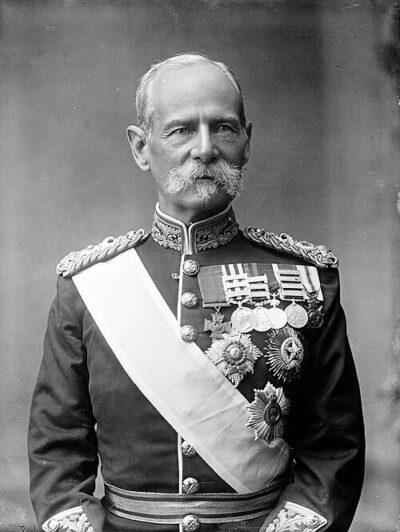
Frederick Roberts, 1st Earl Roberts
Frederick Roberts, 1st Earl Roberts was a British general. Born September 30, 1832, in Kanpur. Died November 14, 1914, in Saint-Omer. Positions held include Member of the Privy Council of Ireland, Member of the Privy Council of the United Kingdom and member of the House of Lords. Educated at Eton College and Royal Military College, Sandhurst. Awards include Victoria Cross, Knight Grand Cross of the Order of the Bath and Order of the Garter.
Facts
32 facts · 2 confirmed by two sources · 11 cited · 19 from one source
Where this comes from
Papalocal keeps its own record. It started from these sources; what each one said is kept here as it was copied, so a change on their side never changes this page by itself. Tap one to read its version.
What Wikidata says · copied November 16, 2026 · revision 2557885467
- Described as
- British general (1832–1914)
- Other names
- Field Marshal Frederick Sleigh Roberts, 1st Earl Roberts, Lord Roberts, Frederick Sleigh Roberts
- Born
- September 30, 1832 · 8 references
- Died
- November 14, 1914 · 8 references
- Born in
- Kanpur · 1 reference
- Died in
- Saint-Omer
- Buried in
- St Paul's Cathedral
- Cause of death
- pneumonia
- Name at birth
- Frederick Sleigh Roberts
- Citizen of
- United Kingdom of Great Britain and Ireland
- Occupation
- politician · 1 reference; Generalfeldmarschall · 1 reference
- Positions held
- Member of the Privy Council of Ireland; Member of the Privy Council of the United Kingdom; member of the House of Lords
- Education
- Eton College; Royal Military College, Sandhurst; Addiscombe Military Seminary
- Awards
- Victoria Cross; Knight Grand Cross of the Order of the Bath; Order of the Garter · 1 reference; Honorary Fellow of the Royal College of Surgeons (1901) · 1 reference
- Spouse
- Nora Henrietta Bews (1859–) · 2 references
- Children
- Aileen Roberts, 2nd Countess Roberts; Nora Frederica Roberts · 1 reference; Eveleen Sautelle Roberts · 1 reference; Frederick Henry Roberts · 1 reference; Frederick Hugh Sherston Roberts · 1 reference; Ada Edwina Stewart Roberts, Countess Roberts · 1 reference
- Father
- Abraham Roberts · 1 reference
- Mother
- Isabella Bunbury · 1 reference
- Military branch
- British Army (1851–1904)
- Military rank
- field marshal
- Lived in
- Englemere House (1903–1914)
- Wikipedias with a page
- 30
Wikidata item Q335008 (wikidata.org/wiki/Q335008), public domain (CC0). Copied November 16, 2026.
What Wikipedia says · copied November 16, 2026 · revision 1384336817
Field Marshal Frederick Sleigh Roberts, 1st Earl Roberts (30 September 1832 – 14 November 1914), was a British Victorian era general who became one of the most successful British military commanders of his time. Born in India to an Anglo-Irish family, Roberts joined the East India Company Army and served as a young officer in the Indian Rebellion during which he was awarded the Victoria Cross for gallantry. He was then transferred to the British Army and fought in the Expedition to Abyssinia and the Second Anglo-Afghan War, in which his exploits earned him widespread fame. Roberts would go on to serve as the Commander-in-Chief, India, before leading British forces for a year during the Second Boer War. He also became the last Commander-in-Chief of the Forces before the post was abolished in 1904.
A man of small stature, Roberts was affectionately known to his troops and the wider British public as "Bobs" and revered as one of Britain's leading military figures at a time when the British Empire reached the height of its power. He became a symbol for the British Army and in later life became an influential proponent of stronger defence in response to the increasing threat that the German Empire posed to Britain in the lead-up to the First World War.
- Born, in its opening lines
- September 30, 1832
- Died, in its opening lines
- November 14, 1914
From the Wikipedia article “Frederick Roberts, 1st Earl Roberts” (en.wikipedia.org/wiki/Frederick_Roberts,_1st_Earl_Roberts), by its contributors, under CC BY-SA 4.0 (creativecommons.org/licenses/by-sa/4.0/). Copied November 16, 2026; not changed.
Confirmed Two sources agree. Cited One source, and it names where it got it. One source One source, without a reference of its own. Sources disagree The sources disagree. We show the best-supported value and keep theirs below.
