
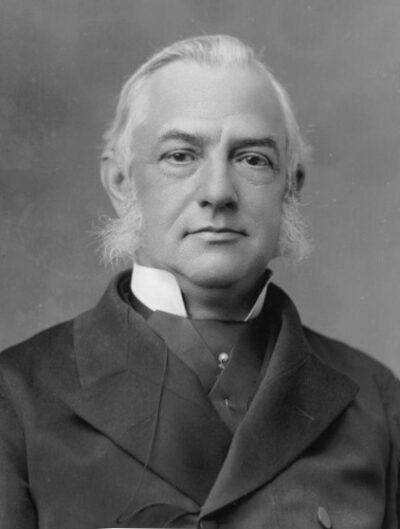
Friedrich Max Müller
Friedrich Max Müller was a German-born British philologist, orientalist and indologist. Born December 6, 1823, in Dessau. Died October 28, 1900, in Oxford. Positions held include Member of the Privy Council of the United Kingdom, professor (1850–) and fellow (1858–). Educated at Leipzig University and Alte Nikolaischule (Leipzig). Awards include Volney Prize (2 times), Pour le Mérite for Sciences and Arts order and Bavarian Maximilian Order for Science and Art.
Facts
53 facts · 2 confirmed by two sources · 38 cited · 13 from one source
Where this comes from
Papalocal keeps its own record. It started from these sources; what each one said is kept here as it was copied, so a change on their side never changes this page by itself. Tap one to read its version.
What Wikidata says · copied November 16, 2026 · revision 2563991593
- Described as
- German-born British philologist, orientalist and indologist (1823–1900)
- Other names
- Rt. Hon. Friedrich Max Muller, Professor Friedrich Max-Muller, F. Max Müller, F. M. M., Max Muller, Friedrich Maximilian Müller
- Born
- December 6, 1823 · 7 references
- Died
- October 28, 1900 · 9 references
- Born in
- Dessau · 4 references
- Died in
- Oxford · 4 references
- Name at birth
- Friedrich Max Müller · 2 references
- Citizen of
- Anhalt-Dessau · 1 reference; United Kingdom of Great Britain and Ireland · 1 reference
- Occupation
- linguist · 2 references; librarian · 1 reference; historian of religion; translator; university teacher · 1 reference; mythographer; writer · 1 reference; philologist · 1 reference
- Positions held
- Member of the Privy Council of the United Kingdom; professor (1850–) · 1 reference; fellow (1858–) · 1 reference; librarian (1865–1866)
- Worked for
- University of Oxford · 1 reference
- Education
- Leipzig University (–1843) · 1 reference; Alte Nikolaischule (Leipzig) (1835–1841) · 1 reference
- Member of
- Göttingen Academy of Sciences and Humanities in Lower Saxony; American Academy of Arts and Sciences; Hungarian Academy of Sciences; Royal Prussian Academy of Sciences · 1 reference; Royal Netherlands Academy of Arts and Sciences · 1 reference; Leipzig Fraternity Germania · 1 reference; Academy of Sciences of Turin (1859–) · 1 reference; Académie des Inscriptions et Belles-Lettres (1859–) · 3 references; Romanian Academy; Bavarian Academy of Sciences and Humanities · 1 reference
- Awards
- Volney Prize (2 times) (1849, 1862); Pour le Mérite for Sciences and Arts order (1874) · 2 references; Bavarian Maximilian Order for Science and Art (1875); Honorary Fellow of the Royal Society Te Apārangi (1878–) · 1 reference; Doctor honoris causa of the University of Dublin · 1 reference; honorary doctor of the University of Edinburgh · 1 reference; honorary member · 1 reference
- Field
- philology · 1 reference; oriental studies · 1 reference; religious studies · 1 reference; Indology · 1 reference
- Spouse
- Georgina Adelaide Grenfell (1859–) · 3 references; Georgina Müller · 1 reference
- Children
- Beatrice Stanley Muller · 2 references; Mary Emily Müller · 1 reference; William G. Max Muller · 1 reference
- Father
- Wilhelm Müller · 3 references
- Mother
- Adelheid Müller · 1 reference
- Lived in
- Paris (1845–1846) · 1 reference; London (1846–) · 1 reference; Oxford (1848–) · 1 reference
- Wikipedias with a page
- 72
Wikidata item Q60074 (wikidata.org/wiki/Q60074), public domain (CC0). Copied November 16, 2026.
What Wikipedia says · copied November 16, 2026 · revision 1385462033
Friedrich Max Müller (German: [ˈfʁiːdʁɪç ˈmaks ˈmʏlɐ]; 6 December 1823 – 28 October 1900) was a German-born British comparative philologist and Orientalist. He was one of the founders of the Western academic disciplines of Indology and religious studies. Müller wrote both scholarly and popular works on the subject of Indology. He directed the preparation of the Sacred Books of the East, a 50-volume set of English translations which continued after his death. He was also the first major scholar to compile the Rigveda Samhita along with the Sāyanācarya commentary, in six volumes entitled Rig-Veda-Sanhita, The Sacred Hymns Of The Brahmans.
Müller became a professor at Oxford University, first of modern languages, then of comparative philology in a position founded for him, and which he held for the rest of his life. Early in his career he held strong views on India, believing that it needed to be transformed by Christianity. Later, his view became more nuanced, championing ancient Sanskrit literature and India more generally. He became involved in several controversies during his career: he was accused of being anti-Christian; he disagreed with Darwinian evolution, favouring theistic evolution; he raised interest in Aryan culture, opposing the racial misuse of the term ‘Aryan’, which later developed into the racist Aryan ideology of the 20th century; and he promoted the idea of a 'Turanian' family of languages.
Among his honours and distinctions, he was made an associé étranger of the French Académie des Inscriptions et Belles-Lettres; he was awarded the Bavarian Maximilian Order for Science and Art; and he was made a member of the Privy Council of the United Kingdom.
- Born, in its opening lines
- December 6, 1823
- Died, in its opening lines
- October 28, 1900
From the Wikipedia article “Max Müller” (en.wikipedia.org/wiki/Max_Müller), by its contributors, under CC BY-SA 4.0 (creativecommons.org/licenses/by-sa/4.0/). Copied November 16, 2026; not changed.
Confirmed Two sources agree. Cited One source, and it names where it got it. One source One source, without a reference of its own. Sources disagree The sources disagree. We show the best-supported value and keep theirs below.
