
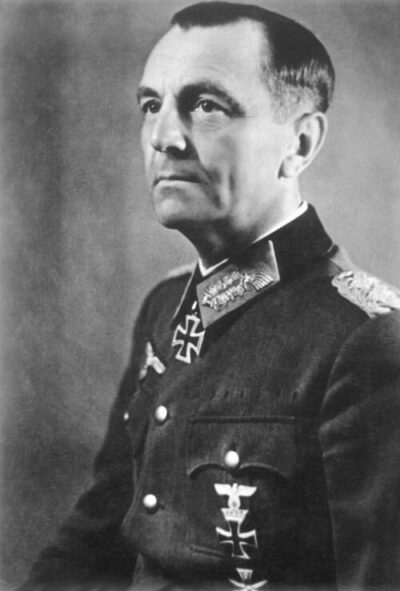
Friedrich Paulus
Friedrich Paulus was a German general. Born September 23, 1890, in Guxhagen. Died February 1, 1957, in Dresden. Educated at University of Marburg. Awards include Military Merit Cross III. Class, Knight's Cross of the Iron Cross with Oak Leaves and Order of Michael the Brave, 1st class.
Facts
38 facts · 2 confirmed by two sources · 5 cited · 31 from one source
What’s different
- Born: we show September 23, 1890 (Confirmed). Wikidata also lists September 21, 1890
Where this comes from
Papalocal keeps its own record. It started from these sources; what each one said is kept here as it was copied, so a change on their side never changes this page by itself. Tap one to read its version.
What Wikidata says · copied November 16, 2026 · revision 2569004037
- Described as
- German general (1890–1957)
- Other names
- Friedrich Wilhelm Ernst Paulus, Paulus, Friedrich
- Born
- September 23, 1890 · 2 references; September 21, 1890 · 1 reference
- Died
- February 1, 1957 · 12 references
- Born in
- Guxhagen
- Died in
- Dresden · 3 references
- Buried in
- Baden-Baden
- Cause of death
- amyotrophic lateral sclerosis
- Citizen of
- German Empire; Weimar Republic; Nazi Germany; East Germany
- Occupation
- military officer · 1 reference; Generalfeldmarschall · 1 reference
- Education
- University of Marburg
- Member of
- National Committee for a Free Germany
- Awards
- Military Merit Cross III. Class; Knight's Cross of the Iron Cross with Oak Leaves (1943); Order of Michael the Brave, 1st class; Military Merit Order (Bavaria); Honour Cross of the World War 1914/1918; Wound Badge (1939) in Black · 1 reference; Sudetenland Medal; Eastern Medal; Anschluss Medal; Cross of Liberty, 1st Class; Order of the Zähringer Lion; Wehrmacht Long Service Award; Iron Cross, 1st class; Iron Cross, 2nd class; Military Merit Cross · 1 reference
- Spouse
- Elena Rosetti-Solescu
- Father
- Ernst Paulus · 1 reference
- Mother
- Bertha Nettelbeck · 1 reference
- Religion
- Catholic Church
- Military branch
- Imperial German Army (1910–1919); German Army; German Army
- Military rank
- Generalfeldmarschall
- Lived in
- Dresden (1953–1956)
- Wikipedias with a page
- 69
Wikidata item Q57160 (wikidata.org/wiki/Q57160), public domain (CC0). Copied November 16, 2026.
What Wikipedia says · copied November 16, 2026 · revision 1382110422
Friedrich Wilhelm Ernst Paulus (23 September 1890 – 1 February 1957) was a German Generalfeldmarschall (Field Marshal) during World War II who is best known for being the commander of the German 6th Army during the Battle of Stalingrad (July 1942 to February 1943). The battle ended in disaster for the Wehrmacht when Soviet forces encircled the Germans within the city, leading to the ultimate death or capture of most of the 265,000-strong 6th Army, their Axis allies, and collaborators.
Paulus fought in World War I and saw action in France and the Balkans. He was considered a promising officer; by the time World War II broke out, he had been promoted to major general. Paulus took part in the invasions of Poland and the Low Countries, after which he was named deputy chief of the German Army General Staff. In that capacity, Paulus helped plan the invasion of the Soviet Union.
In 1942, Paulus was given command of the 6th Army. He led the drive to Stalingrad but was cut off and surrounded in the subsequent Soviet counter-offensive. Adolf Hitler prohibited attempts to break out or capitulate, and the German defense was gradually worn down. Paulus surrendered in Stalingrad on 31 January 1943, the day after he was informed of his promotion to field marshal by Hitler. Hitler expected Paulus to take his own life, repeating to his staff that there was no precedent of a German field marshal being captured alive.
While in Soviet captivity during the war, Paulus became a vocal critic of the Nazi regime and joined the Soviet-sponsored National Committee for a Free Germany. In 1953, Paulus moved to East Germany, where he worked in military history research. He lived out the rest of his life in Dresden.
- Born, in its opening lines
- September 23, 1890
- Died, in its opening lines
- February 1, 1957
From the Wikipedia article “Friedrich Paulus” (en.wikipedia.org/wiki/Friedrich_Paulus), by its contributors, under CC BY-SA 4.0 (creativecommons.org/licenses/by-sa/4.0/). Copied November 16, 2026; not changed.
Confirmed Two sources agree. Cited One source, and it names where it got it. One source One source, without a reference of its own. Sources disagree The sources disagree. We show the best-supported value and keep theirs below.
