
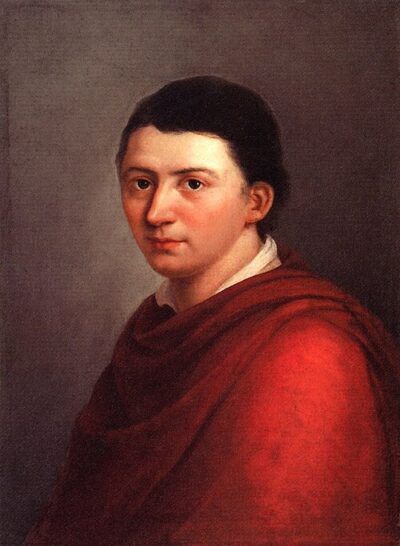
Friedrich Schlegel
Friedrich Schlegel was a German poet, critic and scholar, editor. Born March 10, 1772, in Hanover. Died January 12, 1829, in Dresden. Educated at University of Göttingen. Awards include Supreme Order of Christ.
Facts
29 facts · 2 confirmed by two sources · 9 cited · 18 from one source
What’s different
- Died: we show January 12, 1829 (Confirmed). Wikidata also lists January 11, 1829
Where this comes from
Papalocal keeps its own record. It started from these sources; what each one said is kept here as it was copied, so a change on their side never changes this page by itself. Tap one to read its version.
What Wikidata says · copied November 16, 2026 · revision 2566065320
- Described as
- German poet, critic and scholar, editor
- Other names
- Karl Friedrich von Schlegel, Karl Wilhelm Friedrich Schlegel, Friedrich von Schlegel, Friedrich Karl Wilhelm von Schlegel, Karl Wilhelm Friedrich
- Born
- March 10, 1772 · 12 references
- Died
- January 12, 1829 · 13 references; January 11, 1829 · 1 reference
- Born in
- Hanover · 5 references
- Died in
- Dresden · 3 references
- Buried in
- Alter Katholischer Friedhof
- Cause of death
- stroke
- Citizen of
- Kingdom of Hanover; Electorate of Hanover
- Occupation
- philosopher · 3 references; translator; writer · 2 references; novelist; literary critic · 1 reference; university teacher; poet; editor · 1 reference
- Worked for
- TU Dresden; University of Jena; University of Cologne
- Education
- University of Göttingen
- Member of
- Schlegel brothers
- Genre
- essay
- Awards
- Supreme Order of Christ
- Spouse
- Dorothea von Schlegel (1799–) · 2 references
- Father
- Johann Adolf Schlegel · 1 reference
- Mother
- Johanna Christiane Erdmuthe Schlegel
- Siblings
- August Wilhelm von Schlegel · 1 reference; Karl August Moritz Schlegel · 1 reference
- Religion
- Catholic Church
- Wikipedias with a page
- 75
Wikidata item Q157271 (wikidata.org/wiki/Q157271), public domain (CC0). Copied November 16, 2026.
What Wikipedia says · copied November 16, 2026 · revision 1385019965
Karl Wilhelm Friedrich von Schlegel ( SHLAY-gəl; German: [ˈfʁiːdʁɪç ˈʃleːɡl̩]; 10 March 1772 – 12 January 1829) was a German literary critic, philosopher, and Indologist. With his older brother, August Wilhelm Schlegel, he was one of the main figures of Jena Romanticism.
Born into a fervently Protestant family, Schlegel rejected religion as a young man in favor of atheism and individualism. He entered university to study law but instead focused on classical literature. He began a career as a writer and lecturer, and founded journals such as Athenaeum. In 1808, Schlegel returned to Christianity as a married man with both him and his wife being baptized into the Catholic Church. This conversion ultimately led to his estrangement from family and old friends. He moved to the Austrian Empire in 1809, where he became a diplomat and journalist in service of Klemens von Metternich, the Foreign Minister of the Austrian Empire. Schlegel died in 1829, at the age of 56.
Schlegel was a promoter of the Romantic movement and inspired Samuel Taylor Coleridge, Adam Mickiewicz and Kazimierz Brodziński. The first to notice what became known as Grimm's law, Schlegel was a pioneer in Indo-European studies, comparative linguistics, and morphological typology, publishing in 1819 the first theory linking the Indo-Iranian and German languages under the Aryan group. Some of his works were set to music by Schubert, Mendelssohn and Schumann.
- Born, in its opening lines
- March 10, 1772
- Died, in its opening lines
- January 12, 1829
From the Wikipedia article “Friedrich Schlegel” (en.wikipedia.org/wiki/Friedrich_Schlegel), by its contributors, under CC BY-SA 4.0 (creativecommons.org/licenses/by-sa/4.0/). Copied November 16, 2026; not changed.
Confirmed Two sources agree. Cited One source, and it names where it got it. One source One source, without a reference of its own. Sources disagree The sources disagree. We show the best-supported value and keep theirs below.
