
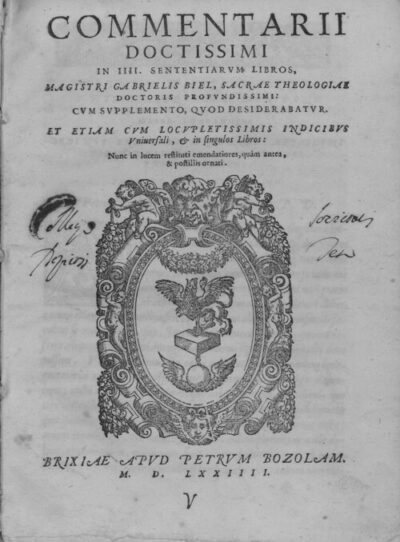
Gabriel Biel
Gabriel Biel was a German theologian and philosopher. Born 1418, in Speyer. Died December 7, 1495, in Tübingen. Educated at Heidelberg University and University of Erfurt.
Facts
14 facts · 0 confirmed by two sources · 7 cited · 7 from one source
Where this comes from
Papalocal keeps its own record. It started from these sources; what each one said is kept here as it was copied, so a change on their side never changes this page by itself. Tap one to read its version.
What Wikidata says · copied November 17, 2026 · revision 2569839439
- Described as
- German theologian and philosopher
- Born
- 1418 · 5 references
- Died
- December 7, 1495 · 2 references
- Born in
- Speyer · 2 references
- Died in
- Tübingen · 1 reference
- Citizen of
- Holy Roman Empire
- Occupation
- theologian; philosopher · 1 reference; university teacher · 1 reference; Catholic priest · 1 reference
- Worked for
- University of Tübingen; Heidelberg University · 1 reference
- Education
- Heidelberg University; University of Erfurt · 1 reference
- Religion
- Catholic Church
- Wikipedias with a page
- 25
Wikidata item Q61369 (wikidata.org/wiki/Q61369), public domain (CC0). Copied November 17, 2026.
What Wikipedia says · copied November 17, 2026 · revision 1374744547
Gabriel Biel (German: [biːl]; 1420 to 1425 – 7 December 1495) was a German scholastic philosopher and member of the Canons Regular of the Congregation of Windesheim, who were the clerical counterpart to the Brethren of the Common Life. Because of his reliance on the scholastic tradition, as well as nominalist views, he is credited an "articulate spokesman of the via moderna and … a discerning user of the thought of via antiqua" (Oberman, 11). He has been called ultimus scholasticorum, the last of the schoolmen.
From the Wikipedia article “Gabriel Biel” (en.wikipedia.org/wiki/Gabriel_Biel), by its contributors, under CC BY-SA 4.0 (creativecommons.org/licenses/by-sa/4.0/). Copied November 17, 2026; not changed.
Confirmed Two sources agree. Cited One source, and it names where it got it. One source One source, without a reference of its own. Sources disagree The sources disagree. We show the best-supported value and keep theirs below.
