
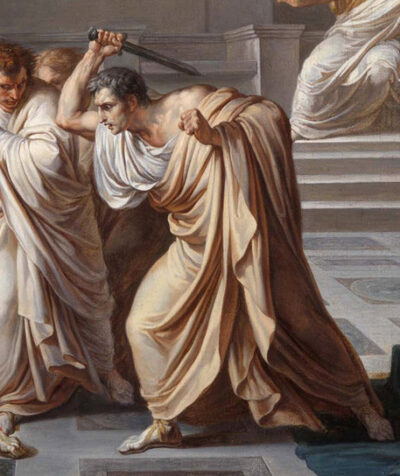
Gaius Cassius Longinus
Gaius Cassius Longinus was an ancient Roman politician, known for his role in the assassination of Julius Caesar. Born 82 BC, in Ancient Rome. Died 42 BC, in Philippi. Positions held include tribune of the plebs (-50), quaestor (-53) and praetors (-44).
Facts
18 facts · 0 confirmed by two sources · 6 cited · 12 from one source
Where this comes from
Papalocal keeps its own record. It started from these sources; what each one said is kept here as it was copied, so a change on their side never changes this page by itself. Tap one to read its version.
What Wikidata says · copied November 16, 2026 · revision 2557889214
- Described as
- ancient Roman politician, known for his role in the assassination of Julius Caesar
- Other names
- Cassius, Caius Cassius
- Born
- 82 BC · 1 reference
- Died
- 42 BC · 2 references
- Born in
- Ancient Rome
- Died in
- Philippi
- Cause of death
- exsanguination
- Citizen of
- Ancient Rome
- Occupation
- politician; military personnel
- Positions held
- tribune of the plebs (-50); quaestor (-53); praetors (-44); Roman governor; moneyer (-43–-42) · 1 reference
- Spouse
- Junia Tertia · 2 references
- Children
- Cassius
- Father
- Gaius Cassius Longinus · 2 references
- Siblings
- Lucius Cassius Longinus · 2 references; Quintus Cassius Longinus
- Wikipedias with a page
- 48
Wikidata item Q207370 (wikidata.org/wiki/Q207370), public domain (CC0). Copied November 16, 2026.
What Wikipedia says · copied November 16, 2026 · revision 1385518935
Gaius Cassius Longinus (Classical Latin: [ˈɡaːi.ʊs ˈkassi.ʊs ˈlɔŋɡɪnʊs]; c. 86 BC – 3 October 42 BC) was a Roman senator and general best known as a leading instigator of the plot to assassinate Julius Caesar on 15 March 44 BC. He was the brother-in-law of Brutus, another leader of the conspiracy. He commanded troops with Brutus during the Battle of Philippi against the combined forces of Mark Antony and Octavius, Caesar's former supporters, and died by suicide after being defeated by Mark Antony.
Cassius was elected as tribune of the plebs in 49 BC. He opposed Caesar, and eventually he commanded a fleet against him during Caesar's Civil War: after Caesar defeated Pompey in the Battle of Pharsalus, Caesar overtook Cassius and forced him to surrender. After Caesar's death, Cassius fled to the east to Syria, where he amassed an army of twelve legions. He was supported and made governor by the Senate. Later he and Brutus marched west against the allies of the Second Triumvirate.
Cassius followed the teachings of the philosopher Epicurus, although scholars debate whether or not these beliefs affected his political life. Cassius is a main character in William Shakespeare's play Julius Caesar that depicts the assassination of Caesar and its aftermath. He is also shown in the lowest circle of Hell in Dante's Inferno as punishment for betraying and killing Caesar.
From the Wikipedia article “Gaius Cassius Longinus” (en.wikipedia.org/wiki/Gaius_Cassius_Longinus), by its contributors, under CC BY-SA 4.0 (creativecommons.org/licenses/by-sa/4.0/). Copied November 16, 2026; not changed.
Confirmed Two sources agree. Cited One source, and it names where it got it. One source One source, without a reference of its own. Sources disagree The sources disagree. We show the best-supported value and keep theirs below.
