
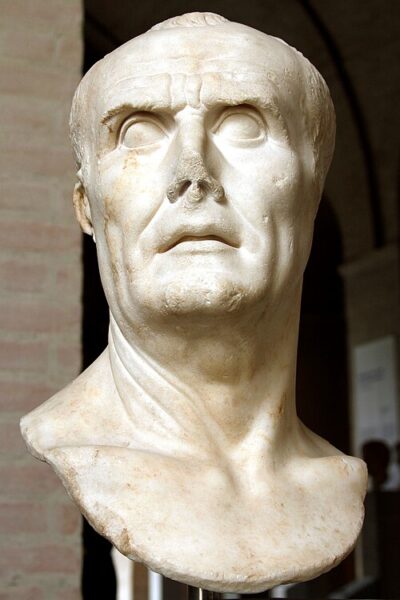
Gaius Marius
Gaius Marius was a Roman general, statesman and military reformer. Born 157 BC, in Arpino. Died January 13, 86 BC, in Rome. Positions held include tribune of the plebs (-119), praetors (-115) and ancient Roman senator (–-86).
Facts
27 facts · 0 confirmed by two sources · 14 cited · 12 from one source · 1 where the sources disagree
What’s different
- Born: we show 157 BC (Sources disagree). Wikidata also lists 158 BC
Where this comes from
Papalocal keeps its own record. It started from these sources; what each one said is kept here as it was copied, so a change on their side never changes this page by itself. Tap one to read its version.
What Wikidata says · copied November 16, 2026 · revision 2557889256
- Described as
- Roman general, statesman and military reformer (157-86 BC)
- Other names
- Caius Marius
- Born
- 157 BC · 2 references; 158 BC · 1 reference
- Died
- January 13, 86 BC
- Born in
- Arpino
- Died in
- Rome · 1 reference
- Citizen of
- Ancient Rome
- Occupation
- ancient Roman priest; politician · 2 references; military personnel; military leader · 2 references
- Positions held
- tribune of the plebs (-119) · 1 reference; praetors (-115) · 1 reference; ancient Roman senator (–-86) · 1 reference; Roman consul (3 times) (-107–-86) · 2 references; quaestor; Roman governor (2 times) (-115–-105); augur (-97–-86)
- Member of
- populares
- Spouse
- Julia · 3 references
- Children
- Gaius Marius the Younger · 3 references
- Father
- Gaius Marius · 3 references
- Mother
- Fulcinia · 3 references
- Siblings
- Marcus Marius · 3 references; Maria · 3 references; Maria · 3 references
- Military branch
- Roman army · 1 reference
- Military rank
- military tribune; legatus legionis (-109–-108)
- Wikipedias with a page
- 72
Wikidata item Q177975 (wikidata.org/wiki/Q177975), public domain (CC0). Copied November 16, 2026.
What Wikipedia says · copied November 16, 2026 · revision 1382591054
Gaius Marius (Latin: [ˈɡaːiʊs ˈmariʊs]; c. 157 BC – 13 January 86 BC) was a Roman general and statesman. Marius held the office of consul seven times, more than any other Roman in the Republican period. Rising from a family of smallholders in a village called Ceraetae in the district of Arpinum, Marius acquired his initial military experience serving under Scipio Aemilianus at the Siege of Numantia in 134 BC. He won election as tribune of the plebs in 119 BC and passed a law limiting aristocratic interference in elections. Barely elected praetor in 115 BC, he next became the governor of Further Spain where he campaigned against bandits.
Marius attained his first consulship in 107 BC and became the commander of Roman forces in Numidia, where he brought an end to the Jugurthine War. By 105 BC Rome faced an invasion by the Cimbri and Teutones, and the comitia centuriata elected Marius consul for a second time to face this new threat. Marius was consul every year from 104 to 100 BC, defeating the Teutones at Aquae Sextiae and the Cimbri at Vercellae. Marius suffered political setbacks during his sixth consulship in 100 BC and subsequently withdrew from active public life.
The Roman Republic entered a period of crisis with the outbreak of the Social War in 91 BC, in which Marius held a command with limited success. He became embroiled in a conflict with the Roman general Sulla which resulted in his exile to Africa in 88 BC. Marius returned to Italy from Carthage during the War of Octavius, seized Rome, and conducted a purge of political opponents, after which he was elected consul for the seventh time. He died within weeks of assuming this seventh consulship in 86 BC.
In the nineteenth century, Marius was credited with the Marian reforms, including the transition from militia levies to a professional soldiery, modifications to the pilum (a kind of javelin), and changes to the logistical structure of the Roman army. Twenty-first-century historians generally characterise this attribution as "a construct of modern scholarship".
From the Wikipedia article “Gaius Marius” (en.wikipedia.org/wiki/Gaius_Marius), by its contributors, under CC BY-SA 4.0 (creativecommons.org/licenses/by-sa/4.0/). Copied November 16, 2026; not changed.
Confirmed Two sources agree. Cited One source, and it names where it got it. One source One source, without a reference of its own. Sources disagree The sources disagree. We show the best-supported value and keep theirs below.
