
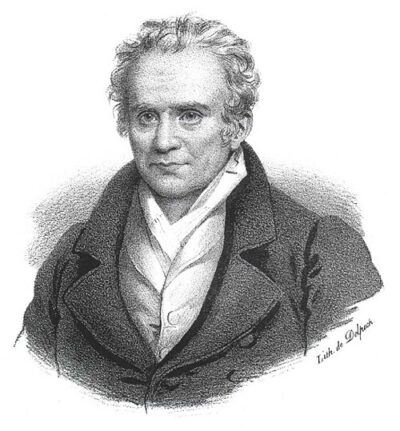
Gaspard Monge
Gaspard Monge was a French mathematician, inventor of descriptive geometry and father of differential geometry. Born May 9, 1746, in Beaune. Died July 28, 1818, in Paris. Positions held include Member of the Council of Five Hundred (1798–1799), member of the Sénat conservateur (1799–1814) and Peer of France (1815–). Known for Geometrie descriptive and Monge's theorem. Educated at Fénelon - La Trinité School. Awards include Grand Officer of the Legion of Honour, Knight Grand Cross of the Order of the Reunion and Order of the Iron Crown (Kingdom of Italy).
Facts
45 facts · 2 confirmed by two sources · 26 cited · 17 from one source
Where this comes from
Papalocal keeps its own record. It started from these sources; what each one said is kept here as it was copied, so a change on their side never changes this page by itself. Tap one to read its version.
What Wikidata says · copied November 16, 2026 · revision 2567361629
- Described as
- French mathematician, inventor of descriptive geometry and father of differential geometry (1746-1818)
- Other names
- Gaspard, Comte de Péluse Monge, Gaspard, comte de Peluse Monge, Gaspard Monge Péluse, Gaspard Monge Peluse
- Born
- May 9, 1746 · 6 references
- Died
- July 28, 1818 · 16 references
- Born in
- Beaune · 2 references
- Died in
- Paris · 3 references
- Buried in
- Panthéon (1989–) · 1 reference; Père Lachaise Cemetery (1818–1989) · 2 references
- Citizen of
- France
- Occupation
- mathematician · 1 reference; politician · 1 reference; physicist · 1 reference; university teacher (1780) · 1 reference; engineer; chemist · 2 references; teacher (1763–) · 1 reference
- Positions held
- Member of the Council of Five Hundred (1798–1799) · 1 reference; member of the Sénat conservateur (1799–1814) · 1 reference; Peer of France (1815–) · 1 reference; president (1806–1807); director (1797–1800); Minister of the French Navy (1792–1793) · 1 reference; president of the French Academy of Sciences (1802)
- Political party
- Society of 1789 (1790–) · 1 reference
- Worked for
- École polytechnique (1794–1809) · 1 reference; École royale du génie de Mézières (1765–1783); Institut d'Égypte (1798–) · 1 reference
- Education
- Fénelon - La Trinité School (1762–1764) · 1 reference
- Member of
- Société Philomathique de Paris · 1 reference; French Academy of Sciences (1772–1816) · 1 reference; Royal Prussian Academy of Sciences (1812–) · 1 reference; Freemasonry · 1 reference; Academy of Sciences of Turin (1770–) · 1 reference
- Known for
- Geometrie descriptive; Monge's theorem
- Awards
- Grand Officer of the Legion of Honour (1803); Knight Grand Cross of the Order of the Reunion (1813) · 1 reference; Order of the Iron Crown (Kingdom of Italy) (1805); 72 names on the Eiffel Tower · 1 reference
- Field
- differential geometry
- Spouse
- Marie-Catherine Monge (1777–) · 1 reference
- Children
- Emilie Monge; Louise Monge
- Father
- Jacques Monge
- Mother
- Jeanne Rousseau
- Siblings
- Louis Monge; Jean Monge
- Wikipedias with a page
- 60
Wikidata item Q206832 (wikidata.org/wiki/Q206832), public domain (CC0). Copied November 16, 2026.
What Wikipedia says · copied November 16, 2026 · revision 1373949075
Gaspard Monge, Comte de Péluse (French: [ɡaspaʁ mɔ̃ʒ kɔ̃t də pelyz]; 9 May 1746 – 28 July 1818) was a French mathematician, commonly presented as the inventor of descriptive geometry, (the mathematical basis of) technical drawing, and the father of differential geometry.
He contributed alongside chemist Claude Louis Berthollet, chemist and physician Jean-Antoine Chaptal, and polymath Pierre-Simon Laplace to the establishment of Arts et Métiers ParisTech.
During the French Revolution he served as the Minister of the Marine, and was involved in the reform of the French educational system, helping to found, with Lamblardie and Lazare Carnot, the École Polytechnique, France's most prestigious engineering school.
- Born, in its opening lines
- May 9, 1746
- Died, in its opening lines
- July 28, 1818
From the Wikipedia article “Gaspard Monge” (en.wikipedia.org/wiki/Gaspard_Monge), by its contributors, under CC BY-SA 4.0 (creativecommons.org/licenses/by-sa/4.0/). Copied November 16, 2026; not changed.
Confirmed Two sources agree. Cited One source, and it names where it got it. One source One source, without a reference of its own. Sources disagree The sources disagree. We show the best-supported value and keep theirs below.
