
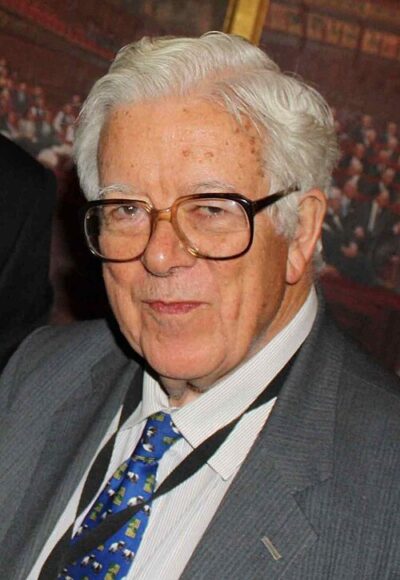
Geoffrey Howe
Geoffrey Howe was a British politician. Born December 20, 1926, in Port Talbot. Died October 9, 2015, in Idlicote. Positions held include Deputy Prime Minister of the United Kingdom (1989–1990), Leader of the House of Commons (1989–1990) and Lord President of the Council (1989–1990). Educated at Trinity Hall and Winchester College. Awards include Knight Bachelor.
Facts
41 facts · 2 confirmed by two sources · 18 cited · 21 from one source
Where this comes from
Papalocal keeps its own record. It started from these sources; what each one said is kept here as it was copied, so a change on their side never changes this page by itself. Tap one to read its version.
What Wikidata says · copied November 16, 2026 · revision 2562746023
- Described as
- British politician (1926–2015)
- Other names
- Richard Edward Geoffrey Howe, Baron Howe of Aberavon, Sir Geoffrey Howe, The Lord Howe, Baron Howe of Aberavon
- Born
- December 20, 1926 · 11 references
- Died
- October 9, 2015 · 7 references
- Born in
- Port Talbot · 3 references
- Died in
- Idlicote · 1 reference
- Cause of death
- myocardial infarction · 1 reference
- Citizen of
- United Kingdom · 1 reference
- Occupation
- jurist; politician · 2 references; diplomat; minister · 1 reference; lawyer · 1 reference; barrister · 1 reference
- Positions held
- Deputy Prime Minister of the United Kingdom (1989–1990); Leader of the House of Commons (1989–1990); Lord President of the Council (1989–1990); Secretary of State for Foreign and Commonwealth Affairs (1983–1989); Chancellor of the Exchequer (1979–1983); Shadow Chancellor of the Exchequer (1975–1979); Solicitor General for England and Wales (1970–1972); Minister of State for Trade (1972–1974); member of the House of Lords (1992–2015); Member of the Privy Council of the United Kingdom; Shadow Secretary of State for Health and Social Care (1974–1975); member of the 50th Parliament of the United Kingdom (1987–1992) · 1 reference; member of the 49th Parliament of the United Kingdom (1983–1987) · 1 reference; member of the 48th Parliament of the United Kingdom (1979–1983) · 1 reference; member of the 47th Parliament of the United Kingdom (1974–1979) · 1 reference
- Political party
- Conservative Party
- Education
- Trinity Hall; Winchester College; Abberley Hall School
- Awards
- Knight Bachelor · 1 reference
- Field
- international relations · 1 reference
- Spouse
- Elspeth Howe, Baroness Howe of Idlicote (1953–) · 1 reference
- Children
- Caroline Howe · 1 reference; Alexander Edward Thomson Howe · 1 reference; Amanda Howe · 1 reference
- Father
- Benjamin Edward Howe · 1 reference
- Mother
- E. F. Thomson · 1 reference
- Military branch
- British Army
- Lived in
- Neath Port Talbot
- Wikipedias with a page
- 32
Wikidata item Q332323 (wikidata.org/wiki/Q332323), public domain (CC0). Copied November 16, 2026.
What Wikipedia says · copied November 16, 2026 · revision 1379240686
Richard Edward Geoffrey Howe, Baron Howe of Aberavon (20 December 1926 – 9 October 2015), known from 1970 to 1992 as Sir Geoffrey Howe, was a British barrister and politician who served as chancellor of the Exchequer from 1979 to 1983, and Deputy Prime Minister of the United Kingdom from 1989 to 1990. A member of the Conservative Party, he was Margaret Thatcher's longest-serving Cabinet minister, successively holding the posts of chancellor of the Exchequer, foreign secretary, then leader of the House of Commons, deputy prime minister and lord president of the Council. His resignation from Cabinet on 1 November 1990 is widely considered to have precipitated the leadership challenge that led to Thatcher's resignation three weeks later.
Born in Port Talbot, Wales, Howe was educated at Bridgend Preparatory School, Abberley Hall School, Winchester College, and – after serving in the army as a lieutenant – Trinity Hall, Cambridge, where he read law. He was called to the bar in 1952 and practised in Wales, after which he was elected as the Conservative member of Parliament (MP) for Bebington in 1964, but lost his seat in 1966, returning to the bar. Howe became an MP again at the 1970 general election and represented various constituencies in the House of Commons until 1992. In Edward Heath's government, he was solicitor general and a minister of state; after Labour's victory in 1974, Howe became the shadow chancellor of the Exchequer in Margaret Thatcher's shadow cabinet.
Howe became Chancellor of the Exchequer upon Thatcher's victory in the 1979 general election, with his tenure characterised by a programme of radical policies with the stated intent to restore the public finances, reduce inflation and liberalise the economy. As chancellor, Howe delivered five budgets. After the 1983 general election, Howe was appointed foreign secretary, serving six years. In 1989, Thatcher replaced Howe with John Major, giving Howe the role of deputy prime minister. He resigned from the government on 1 November 1990; in his resignation letter, he criticised Thatcher's handling of relations with the EEC and further attacked Thatcher in his resignation speech to the Commons on 13 November. The speech was widely seen as the key catalyst for the leadership challenge mounted by Michael Heseltine a few days later, which led to Thatcher's resignation and her replacement by Major.
Howe retired as an MP in 1992 and was made a life peer in June of that year. Following his retirement from the Commons, Howe took on several non-executive directorships in business and advisory posts in law and academia. He retired from the House of Lords in May 2015 and died in October of the same year, aged 88.
- Born, in its opening lines
- December 20, 1926
- Died, in its opening lines
- October 9, 2015
From the Wikipedia article “Geoffrey Howe” (en.wikipedia.org/wiki/Geoffrey_Howe), by its contributors, under CC BY-SA 4.0 (creativecommons.org/licenses/by-sa/4.0/). Copied November 16, 2026; not changed.
Confirmed Two sources agree. Cited One source, and it names where it got it. One source One source, without a reference of its own. Sources disagree The sources disagree. We show the best-supported value and keep theirs below.
