
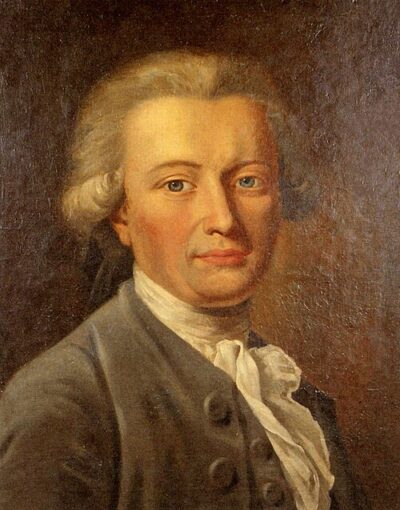
Georg Forster
Georg Forster was a German naturalist, ethnologist, travel writer, journalist, and revolutionary. Born November 27, 1754, in Mokry Dwór. Died January 10, 1794, in Paris. Educated at Saint Peter's School. Awards include Fellow of the Royal Society.
Facts
40 facts · 2 confirmed by two sources · 15 cited · 23 from one source
Where this comes from
Papalocal keeps its own record. It started from these sources; what each one said is kept here as it was copied, so a change on their side never changes this page by itself. Tap one to read its version.
What Wikidata says · copied November 16, 2026 · revision 2569077335
- Described as
- German naturalist, ethnologist, travel writer, journalist, and revolutionary (1754-1794)
- Other names
- Johann Georg Adam Forster, G.Forst., Johann George Adam Forster, Johann Georg Forster
- Born
- November 27, 1754 · 4 references
- Died
- January 10, 1794 · 7 references
- Born in
- Mokry Dwór · 1 reference
- Died in
- Paris · 3 references
- Cause of death
- stroke
- Citizen of
- Polish–Lithuanian Commonwealth; Royal Prussia; Republic of Mainz; Germany · 1 reference
- Occupation
- explorer; anthropologist; ethnologist · 2 references; pteridologist; librarian · 2 references; writer; translator · 2 references; ornithologist
- Worked for
- Johannes Gutenberg University Mainz; Vilnius University (1784–1787) · 1 reference
- Education
- Saint Peter's School
- Member of
- Royal Society of London (1777–) · 2 references; German Academy of Sciences Leopoldina (1780–) · 1 reference; Royal Prussian Academy of Sciences; Göttingen Academy of Sciences and Humanities in Lower Saxony (1777–) · 1 reference; Freemasonry · 2 references
- Awards
- Fellow of the Royal Society
- Field
- botany; ethnography · 1 reference; natural science · 1 reference; geography · 1 reference; travel · 1 reference; translation · 1 reference
- Spouse
- Therese Huber (1785–) · 2 references
- Children
- Therese Forster; Clara Forster · 1 reference
- Father
- Johann Reinhold Forster · 1 reference
- Siblings
- Virginia Viktoria Forster; Justina Forster; Antonia Forster · 1 reference
- Website
- https://www.uni-kassel.de/fb02/institute/germanistik/fachgebiete/neuere-deutsche-literaturwissenschaft/prof-dr-stefan-greif/georg-forster-gesellschaft.html
- Wikipedias with a page
- 53
Wikidata item Q58062 (wikidata.org/wiki/Q58062), public domain (CC0). Copied November 16, 2026.
What Wikipedia says · copied November 16, 2026 · revision 1384856640
Johann George Adam Forster, also known as Georg Forster (German: [ˈɡeːɔʁk ˈfɔʁstɐ]; 27 November 1754 – 10 January 1794), was a German geographer, naturalist, ethnologist, travel writer, journalist and revolutionary. At an early age, he accompanied his father, Johann Reinhold Forster, on several scientific expeditions, including James Cook's second voyage to the Pacific. His report of that journey, A Voyage Round the World, contributed significantly to the ethnology of the people of Polynesia and remains a respected work. As a result of the report, Forster, who was admitted to the Royal Society at the early age of twenty-two, came to be considered one of the founders of modern scientific travel literature.
After returning to continental Europe, Forster turned toward academia. He taught natural history at the Collegium Carolinum in the Ottoneum, Kassel (1778–84), and later at the Academy of Vilna (Vilnius University) (1784–87). In 1788, he became head librarian at the University of Mainz. Most of his scientific work during this time consisted of essays on botany and ethnology, but he also prefaced and translated many books about travel and exploration, including a German translation of Cook's diaries.
Forster was a central figure of the Enlightenment in Germany, and corresponded with most of its adherents, including his close friend Georg Christoph Lichtenberg. His ideas, travelogues and personality influenced Alexander von Humboldt, one of the great scientists of the 19th century who hailed Forster as the founder of both comparative ethnology (Völkerkunde) and regional geography (Länderkunde). When the French took control of Mainz in 1792, Forster played a leading role in the Mainz Republic, the earliest republican state in Germany. During July 1793 and while he was in Paris as a delegate of the young Mainz Republic, Prussian and Austrian coalition forces regained control of the city and Forster was declared an outlaw. Unable to return to Germany and separated from his friends and family, he died in Paris of illness in early 1794, not yet 40.
The standard author abbreviation G.Forst. is used to indicate this person as the author when citing a botanical name.
- Born, in its opening lines
- November 27, 1754
- Died, in its opening lines
- January 10, 1794
From the Wikipedia article “Georg Forster” (en.wikipedia.org/wiki/Georg_Forster), by its contributors, under CC BY-SA 4.0 (creativecommons.org/licenses/by-sa/4.0/). Copied November 16, 2026; not changed.
Confirmed Two sources agree. Cited One source, and it names where it got it. One source One source, without a reference of its own. Sources disagree The sources disagree. We show the best-supported value and keep theirs below.
