
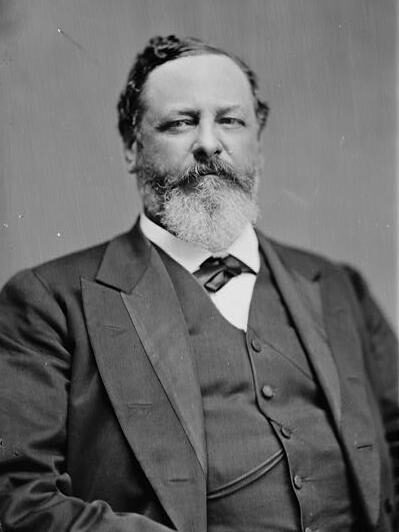
George H. Pendleton
George H. Pendleton was an American lawyer, politician and businessman. Born July 19, 1825, in Cincinnati. Died November 24, 1889, in Brussels metropolitan area. Positions held include United States representative (1857–1865), ambassador and United States senator (1879–1885). Educated at University of Cincinnati and Heidelberg University.
Facts
19 facts · 2 confirmed by two sources · 2 cited · 15 from one source
Where this comes from
Papalocal keeps its own record. It started from these sources; what each one said is kept here as it was copied, so a change on their side never changes this page by itself. Tap one to read its version.
What Wikidata says · copied November 18, 2026 · revision 2558170081
- Described as
- American lawyer, politician and businessman (1825-1889)
- Other names
- George Hunt Pendleton, George Pendleton, G. H. Pendleton, G. Pendleton
- Born
- July 19, 1825 · 2 references
- Died
- November 24, 1889 · 3 references
- Born in
- Cincinnati
- Died in
- Brussels metropolitan area
- Buried in
- Spring Grove Cemetery
- Citizen of
- United States
- Occupation
- politician · 2 references; lawyer; diplomat
- Positions held
- United States representative (1857–1865); ambassador; United States senator (1879–1885) · 1 reference; member of the State Senate of Ohio
- Political party
- Democratic Party
- Education
- University of Cincinnati; Heidelberg University
- Spouse
- Alice Key Pendleton
- Children
- Francis Key Pendleton
- Father
- Nathanael G. Pendleton
- Wikipedias with a page
- 15
Wikidata item Q552459 (wikidata.org/wiki/Q552459), public domain (CC0). Copied November 18, 2026.
What Wikipedia says · copied November 18, 2026 · revision 1367217265
George Hunt Pendleton (July 19, 1825 – November 24, 1889) was an American politician, lawyer and diplomat. He represented Ohio in both houses of Congress and was the Democratic nominee for Vice President of the United States in 1864.
After studying at the University of Cincinnati and Heidelberg University in Europe, Pendleton practiced law in his hometown of Cincinnati, Ohio. He was the son of Congressman Nathanael G. Pendleton and the son-in-law of poet Francis Scott Key. After serving in the Ohio Senate, Pendleton was elected to the United States House of Representatives. During the Civil War, he emerged as a leader of the Copperheads, a group of Democrats who favored peace with the Confederacy. After the war, he opposed the Thirteenth Amendment and the Civil Rights Act of 1866.
The 1864 Democratic National Convention nominated a ticket of George B. McClellan, who favored continuing the war, and Pendleton, who opposed it. The ticket lost to the National Union ticket of Abraham Lincoln and Andrew Johnson, and Pendleton's term as a Congressman expired shortly thereafter. Pendleton was a strong contender for the presidential nomination at the 1868 Democratic National Convention, but was defeated by New York Governor Horatio Seymour. After Pendleton lost the 1869 Ohio gubernatorial election, he temporarily left politics.
He served as the president of the Kentucky Central Railroad before returning to Congress. Pendleton was elected to the U.S. Senate in 1879 and served a single term, becoming Chairman of the Senate Democratic Conference. After the assassination of President James A. Garfield, he wrote and helped pass the Pendleton Civil Service Reform Act of 1883. The act required that many civil service hirings be based on merit rather than political connections. Passage of the act lost him support in Ohio and he was not nominated for a second Senate term. President Grover Cleveland appointed him ambassador to the German Empire. He served in that position until 1889, dying later that year.
- Born, in its opening lines
- July 19, 1825
- Died, in its opening lines
- November 24, 1889
From the Wikipedia article “George H. Pendleton” (en.wikipedia.org/wiki/George_H._Pendleton), by its contributors, under CC BY-SA 4.0 (creativecommons.org/licenses/by-sa/4.0/). Copied November 18, 2026; not changed.
Confirmed Two sources agree. Cited One source, and it names where it got it. One source One source, without a reference of its own. Sources disagree The sources disagree. We show the best-supported value and keep theirs below.
