
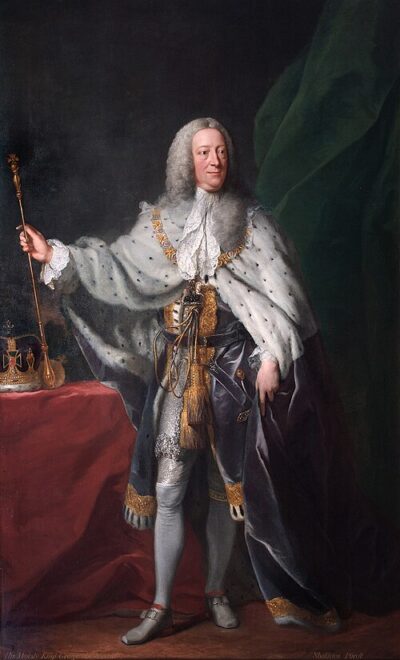
George II of Great Britain
George II of Great Britain was a King of Great Britain and Ireland from 1727 to 1760. Born November 10, 1683, in Herrenhausen. Died October 25, 1760, in London. Positions held include Monarch of Great Britain (1727–1760), King of Ireland (1727–1760) and Prince-Elector (1727–1760). Awards include Knight of the Garter and Knight Companion of the Order of the Thistle.
Facts
36 facts · 1 confirmed by two sources · 13 cited · 21 from one source · 1 where the sources disagree
What’s different
- Born: we show November 10, 1683 (Sources disagree). Wikipedia says November 9, 1683
Where this comes from
Papalocal keeps its own record. It started from these sources; what each one said is kept here as it was copied, so a change on their side never changes this page by itself. Tap one to read its version.
What Wikidata says · copied November 16, 2026 · revision 2568734057
- Described as
- King of Great Britain and Ireland from 1727 to 1760 (1683–1760)
- Other names
- George II, Elector of Hanover, George II, King of Great Britain, George Augustus, George Augustus, Prince of Wales, George II, George Augustus Hanover, George Hanover, Georg II
- Born
- November 10, 1683 · 3 references
- Died
- October 25, 1760 · 7 references
- Born in
- Herrenhausen · 1 reference
- Died in
- London · 1 reference
- Buried in
- Westminster Abbey
- Cause of death
- aortic dissection
- Citizen of
- Kingdom of Great Britain · 2 references; Electorate of Hanover
- Occupation
- monarch; aristocrat
- Positions held
- Monarch of Great Britain (1727–1760); King of Ireland (1727–1760); Prince-Elector (1727–1760); Duke of Brunswick-Lüneburg (1727–1760); Duke of Cambridge (1706–1727) · 1 reference
- Member of
- Royal Society of London
- Awards
- Knight of the Garter (1706) · 1 reference; Knight Companion of the Order of the Thistle (1727)
- Spouse
- Caroline of Ansbach (1705–1737) · 2 references
- Children
- Frederick, Prince of Wales · 1 reference; Anne, Princess Royal and Princess of Orange; Princess Amelia of Great Britain; Princess Caroline of Great Britain; Prince George William of Great Britain; Prince William, Duke of Cumberland · 1 reference; Princess Mary of Great Britain · 1 reference; Louise of Great Britain · 1 reference; Johann Ludwig, Imperial Count of Wallmoden-Gimborn · 1 reference; stillborn son Hanover · 1 reference; Princess Augusta of Great Britain
- Father
- George I of Great Britain · 1 reference
- Mother
- Sophia Dorothea of Celle · 1 reference
- Siblings
- Melusina von der Schulenburg, Countess of Walsingham; Sophia Dorothea of Hanover; Frederick, Prince of Wales
- Religion
- Protestantism
- Wikipedias with a page
- 89
Wikidata item Q131981 (wikidata.org/wiki/Q131981), public domain (CC0). Copied November 16, 2026.
What Wikipedia says · copied November 16, 2026 · revision 1383583703
George II (George Augustus; German: Georg August; 30 October / 9 November 1683 – 25 October 1760) was King of Great Britain and Ireland, Duke of Brunswick-Lüneburg (Hanover) and a prince-elector of the Holy Roman Empire from 11 June 1727 (O.S.) until his death in 1760.
Born and brought up in northern Germany, George is the most recent British monarch born outside Great Britain. The Act of Settlement 1701 and the Acts of Union 1707 positioned his grandmother Sophia of Hanover and her Protestant descendants to inherit the British throne. In 1705, George married Princess Caroline of Brandenburg-Ansbach, with whom he had eight children. After the deaths of George's grandmother and Anne, Queen of Great Britain, George's father, the Elector of Hanover, ascended the British throne as George I in 1714. In the first years of his father's reign as king, Prince George was associated with opposition politicians until they rejoined the governing party.
As king from 1727, George exercised little control over British domestic policy, which was largely controlled by the Parliament of Great Britain. As elector he spent twelve summers in Hanover, where he had more direct control over government policy. He had a difficult relationship with his eldest son, Frederick, who supported the parliamentary opposition. During the War of the Austrian Succession, George participated at the Battle of Dettingen, and thus became the most recent British monarch to lead an army in battle. Supporters of the Stuart claimant to the British throne, James, attempted and failed to depose George in the Jacobite rising of 1745 led by James's son. Prince Frederick died suddenly in 1751, before his father, and George was succeeded by Frederick's eldest son, George III.
For two centuries after George II's death, historians tended to view him with disdain, concentrating on his mistresses, short temper, and boorishness. Since then, reassessment of his legacy has led scholars to conclude that he exercised more influence in foreign policy and military appointments than previously thought.
- Born, in its opening lines
- November 9, 1683
- Died, in its opening lines
- October 25, 1760
From the Wikipedia article “George II of Great Britain” (en.wikipedia.org/wiki/George_II_of_Great_Britain), by its contributors, under CC BY-SA 4.0 (creativecommons.org/licenses/by-sa/4.0/). Copied November 16, 2026; not changed.
Confirmed Two sources agree. Cited One source, and it names where it got it. One source One source, without a reference of its own. Sources disagree The sources disagree. We show the best-supported value and keep theirs below.
