
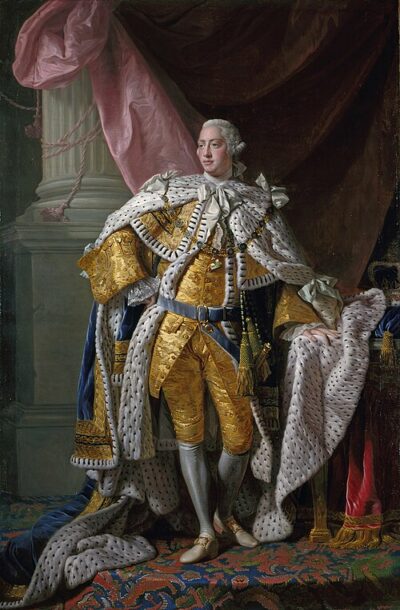
George III of Great Britain
George III of Great Britain was a King of Great Britain and Ireland from 1760 to 1820. Born May 24, 1738, in Norfolk House. Died January 29, 1820, in Windsor Castle. Positions held include Monarch of Great Britain (1760–1801), King of Ireland (1760–1801) and monarch of the United Kingdom of Great Britain and Ireland (1801–1820). Awards include Knight of the Garter and Knight Companion of the Order of the Thistle.
Facts
51 facts · 1 confirmed by two sources · 21 cited · 28 from one source · 1 where the sources disagree
What’s different
- Born: we show May 24, 1738 (Sources disagree). Wikipedia says June 4, 1738
Where this comes from
Papalocal keeps its own record. It started from these sources; what each one said is kept here as it was copied, so a change on their side never changes this page by itself. Tap one to read its version.
What Wikidata says · copied November 16, 2026 · revision 2567828890
- Described as
- King of Great Britain and Ireland from 1760 to 1820 (1738–1820)
- Other names
- George William Frederick, George III, King of Great Britain, George William Frederick Hanover, Prince George William Frederick of Great Britain, Prince George William Frederick, George III, Elector and King of Hanover, Prince George of Great Britain, George III of the United Kingdom, Koning van Groot-Britannië en Hannover George III Willem Frederik, Georg Wilhelm Friedrich, King George III, George, Prince of Wales
- Born
- May 24, 1738 · 5 references
- Died
- January 29, 1820 · 9 references
- Born in
- Norfolk House
- Died in
- Windsor Castle · 1 reference
- Buried in
- St George's Chapel, Windsor
- Cause of death
- disease
- Citizen of
- Kingdom of Great Britain · 1 reference; United Kingdom of Great Britain and Ireland
- Occupation
- art collector · 1 reference; patron of the arts · 1 reference; ruler; politician · 1 reference; aristocrat; monarch
- Positions held
- Monarch of Great Britain (1760–1801); King of Ireland (1760–1801); monarch of the United Kingdom of Great Britain and Ireland (1801–1820); King of Hanover (1814–1820); Prince-Elector (1760–1806); Duke of Brunswick-Lüneburg (1760–1814); Duke of Edinburgh (1751–1760) · 1 reference; heir apparent (1751–1760)
- Member of
- Royal Society of London
- Awards
- Knight of the Garter (1749) · 1 reference; Knight Companion of the Order of the Thistle (1760)
- Spouse
- Charlotte of Mecklenburg-Strelitz (1761–) · 2 references; Hannah Lightfoot (1759–) · 1 reference
- Children
- George IV of the United Kingdom · 1 reference; Prince Frederick, Duke of York and Albany · 1 reference; William IV · 1 reference; Charlotte, Princess Royal · 1 reference; Prince Edward, Duke of Kent and Strathearn · 1 reference; Princess Augusta Sophia of the United Kingdom; Princess Elizabeth of the United Kingdom; Ernest Augustus, King of Hanover · 1 reference; Prince Augustus Frederick, Duke of Sussex · 1 reference; Prince Adolphus, Duke of Cambridge · 1 reference; Princess Mary of the United Kingdom · 2 references; Princess Sophia of the United Kingdom
- Father
- Frederick, Prince of Wales · 1 reference
- Mother
- Princess Augusta of Saxe-Gotha · 1 reference
- Siblings
- Princess Augusta of Great Britain · 1 reference; Prince Edward, Duke of York and Albany; Princess Elizabeth of Great Britain; Prince William Henry, Duke of Gloucester and Edinburgh · 1 reference; Prince Henry, Duke of Cumberland and Strathearn; Princess Louisa of Great Britain; Prince Frederick of Great Britain; Caroline Matilda of Great Britain
- Religion
- Anglicanism; Lutheranism · 1 reference
- Wikipedias with a page
- 108
Wikidata item Q127318 (wikidata.org/wiki/Q127318), public domain (CC0). Copied November 16, 2026.
What Wikipedia says · copied November 16, 2026 · revision 1385149789
George III (George William Frederick; 4 June 1738 – 29 January 1820) was King of Great Britain and Ireland from 25 October 1760 until his death in 1820. He was concurrently duke and prince-elector of Hanover in the Holy Roman Empire before becoming King of Hanover on 12 October 1814. He was the first monarch of the House of Hanover who was born in Great Britain, spoke English as his first language, and never visited Hanover.
George was born during the reign of his paternal grandfather, King George II, as the first son of Frederick, Prince of Wales, and Princess Augusta of Saxe-Gotha. Following his father's death in 1751, Prince George became heir apparent and Prince of Wales. He succeeded to the throne on George II's death in 1760. The following year, he married Princess Charlotte of Mecklenburg-Strelitz, with whom he had 15 children. George III's life and reign were marked by a series of military conflicts involving his kingdoms, much of the rest of Europe, and places farther afield in Africa, the Americas and Asia. Early in his reign, Great Britain defeated France in the Seven Years' War, becoming the dominant European power in North America and India. However, Britain lost 13 of its North American colonies in the American War of Independence. Further wars against revolutionary and Napoleonic France from 1793 concluded in the defeat of Napoleon at the Battle of Waterloo in 1815. The Acts of Union 1800 merged the separate kingdoms of Great Britain and Ireland into the United Kingdom of Great Britain and Ireland. In 1807, the transatlantic slave trade was banned from the British Empire.
In the later part of his life, George had recurrent and eventually permanent mental illness. The exact nature of George's illness is not known definitively, but historians and medical experts have suggested that his symptoms and behaviour traits were consistent with either bipolar disorder or porphyria. In 1810, George suffered a final relapse, and his eldest son, George, Prince of Wales, was named Prince Regent the following year. The King died aged 81, at which time the Regent succeeded him as George IV. George III reigned during much of the Georgian and Regency eras. At the time of his death, he was the longest-lived and longest-reigning British monarch, having reigned for 59 years and 96 days; he remains the longest-lived and longest-reigning male monarch in British history.
- Born, in its opening lines
- June 4, 1738
- Died, in its opening lines
- January 29, 1820
From the Wikipedia article “George III” (en.wikipedia.org/wiki/George_III), by its contributors, under CC BY-SA 4.0 (creativecommons.org/licenses/by-sa/4.0/). Copied November 16, 2026; not changed.
Confirmed Two sources agree. Cited One source, and it names where it got it. One source One source, without a reference of its own. Sources disagree The sources disagree. We show the best-supported value and keep theirs below.
