
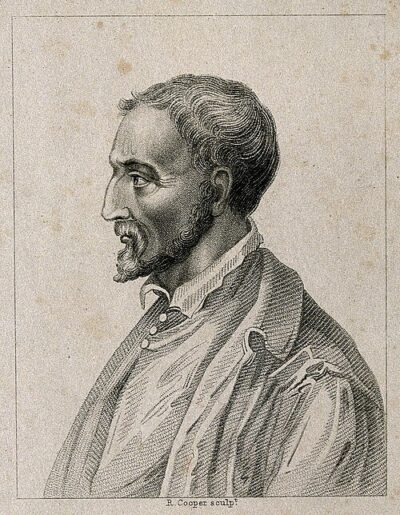
Gerolamo Cardano
Gerolamo Cardano was an Italian Renaissance mathematician, physician, astrologer. Born September 24, 1501, in Pavia. Died September 21, 1576, in Rome. Known for Ars Magna, De subtilitate rerum and Hieronymi Cardani medici Mediolanensis Contradicentium medicorum liber primus [-secundus]. Educated at University of Pavia and University of Padua.
Facts
29 facts · 2 confirmed by two sources · 15 cited · 12 from one source
Where this comes from
Papalocal keeps its own record. It started from these sources; what each one said is kept here as it was copied, so a change on their side never changes this page by itself. Tap one to read its version.
What Wikidata says · copied November 16, 2026 · revision 2569840147
- Described as
- Italian Renaissance mathematician, physician, astrologer (1501-1576)
- Other names
- Jerome Cardan
- Born
- September 24, 1501 · 6 references
- Died
- September 21, 1576 · 7 references
- Born in
- Pavia · 4 references
- Died in
- Rome · 6 references
- Buried in
- Sant'Andrea al Quirinale (1576–) · 1 reference
- Citizen of
- Duchy of Milan · 1 reference
- Occupation
- philosopher · 1 reference; mathematician · 1 reference; astrologer; inventor; engineer; physician · 2 references; astronomer · 1 reference; naturalist · 1 reference
- Worked for
- University of Bologna (1562–1570) · 1 reference; University of Pavia (2 times) (1543–1562) · 2 references; Scuole Piatti (1534–1539) · 1 reference
- Education
- University of Pavia (1520–1522) · 1 reference; University of Padua (1522–1526) · 2 references
- Known for
- Ars Magna; De subtilitate rerum; Hieronymi Cardani medici Mediolanensis Contradicentium medicorum liber primus [-secundus]; gimbal
- Field
- mathematics
- Spouse
- Lucia Banderini (1531–1546) · 1 reference
- Children
- Giovanni Battista Cardano
- Father
- Fazio Cardano
- Mother
- Chiara Micheri · 1 reference
- Religion
- Catholic Church
- Wikipedias with a page
- 81
Wikidata item Q184530 (wikidata.org/wiki/Q184530), public domain (CC0). Copied November 16, 2026.
What Wikipedia says · copied November 16, 2026 · revision 1385564393
Gerolamo Cardano (Italian: [dʒeˈrɔːlamo karˈdaːno]; also Girolamo or Geronimo; French: Jérôme Cardan; Latin: Hieronymus Cardanus; 24 September 1501– 21 September 1576) was an Italian polymath whose interests and proficiencies ranged through those of mathematician, physician, biologist, physicist, chemist, astrologer, astronomer, philosopher, music theorist, writer, and gambler. He became one of the most influential mathematicians of the Renaissance and one of the key figures in the foundation of probability; he introduced the binomial coefficients and the binomial theorem in the Western world. He wrote more than 200 works on science.
Cardano partially invented and described several mechanical devices including the combination lock, the gimbal consisting of three concentric rings allowing a supported compass or gyroscope to rotate freely, and the Cardan shaft with universal joints, which allows the transmission of rotary motion at various angles and is used in vehicles to this day. He made significant contributions to hypocycloids - published in De proportionibus, in 1570. The generating circles of these hypocycloids, later named "Cardano circles" or "cardanic circles", were used for the construction of the first high-speed printing presses.
Today, Cardano is well known for his achievements in algebra. In his 1545 book Ars Magna he made the first systematic use of negative numbers in Europe, published (with attribution) the solutions of other mathematicians for cubic and quartic equations, and acknowledged the existence of imaginary numbers.
- Born, in its opening lines
- September 24, 1501
- Died, in its opening lines
- September 21, 1576
From the Wikipedia article “Gerolamo Cardano” (en.wikipedia.org/wiki/Gerolamo_Cardano), by its contributors, under CC BY-SA 4.0 (creativecommons.org/licenses/by-sa/4.0/). Copied November 16, 2026; not changed.
Confirmed Two sources agree. Cited One source, and it names where it got it. One source One source, without a reference of its own. Sources disagree The sources disagree. We show the best-supported value and keep theirs below.
