
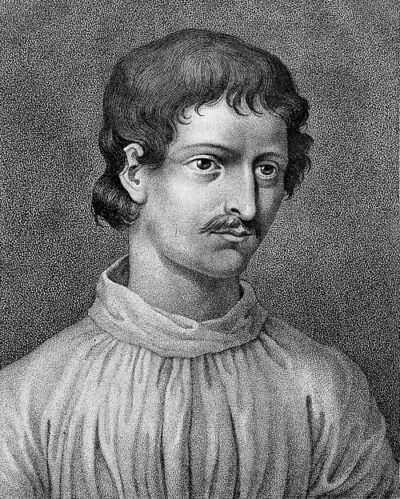
Giordano Bruno
Giordano Bruno was an Italian Dominican friar, philosopher and mathematician. Born January 1548, in Nola. Died February 17, 1600, in Rome. Educated at University of Naples Federico II.
Facts
27 facts · 1 confirmed by two sources · 12 cited · 13 from one source · 1 where the sources disagree
What’s different
- Born: we show January 1548 (Sources disagree). Wikipedia says February 1548
Where this comes from
Papalocal keeps its own record. It started from these sources; what each one said is kept here as it was copied, so a change on their side never changes this page by itself. Tap one to read its version.
What Wikidata says · copied November 16, 2026 · revision 2567934691
- Described as
- Italian Dominican friar, philosopher and mathematician (1548–1600)
- Other names
- Filippo Bruno
- Born
- January 1548
- Died
- February 17, 1600 · 14 references
- Born in
- Nola · 4 references
- Died in
- Rome · 5 references
- Cause of death
- death by burning · 1 reference
- Name at birth
- Filippo Bruno
- Citizen of
- Kingdom of Naples
- Occupation
- astronomer · 1 reference; philosopher · 3 references; poet; writer · 4 references; university teacher (1583–) · 1 reference; astrologer; mathematician; Latin Catholic priest (1572–)
- Worked for
- University of Helmstedt (1589) · 1 reference; University of Wittenberg (1586–1588) · 1 reference; University of Oxford (1583) · 1 reference; University of Paris (1581–1583) · 2 references; University of Toulouse (1896-1968) (1578–1581) · 1 reference; San Domenico Maggiore (1565–1576) · 1 reference; University of Geneva (1579); University of Marburg (1586)
- Education
- University of Naples Federico II (1562–1565) · 1 reference
- Field
- philosophy; cosmology
- Religion
- Catholic Church
- Wikipedias with a page
- 151
Wikidata item Q36330 (wikidata.org/wiki/Q36330), public domain (CC0). Copied November 16, 2026.
What Wikipedia says · copied November 16, 2026 · revision 1385241303
Giordano Bruno ( jor-DAH-noh BROO-noh; Italian: [dʒorˈdaːno ˈbruːno]; Latin: Iordanus Brunus Nolanus; born Filippo Bruno; February 1548 – 17 February 1600) was an Italian philosopher, Dominican friar and priest, poet, alchemist, astronomer, cosmological theorist, and esotericist. He is known for his cosmological theories, which included the then-novel Copernican model. He practised Hermeticism and took a mystical approach to exploring the universe. He proposed that stars are distant suns surrounded by their own planets (exoplanets), and raised the possibility that these planets might foster life of their own, a cosmological position known as cosmic pluralism. He also insisted that the universe is infinite and can have no centre.
Bruno was tried for heresy by the Roman Inquisition on charges of denial of several core Catholic doctrines, including eternal damnation, the Trinity, the deity of Christ, the virginity of Mary, and transubstantiation. Bruno's pantheism was not taken lightly by the church, nor was his teaching of metempsychosis regarding the reincarnation of the soul. The Inquisition found him guilty, and he was burned at the stake in Rome's Campo de' Fiori in 1600. After his death, he gained considerable fame, being particularly celebrated by 19th- and early 20th-century commentators who regarded him as a martyr for science. Some historians believe his heresy trial was a response not to his cosmological views but rather to his views on religion and the afterlife, while others reject this view. Bruno's case is still considered a landmark in the history of free thought and the emerging sciences.
In addition to cosmology, Bruno wrote extensively on the art of memory, a loosely organised group of mnemonic techniques and principles. Historian Frances Yates argues that Bruno was deeply influenced by the presocratic Empedocles, Neoplatonism, Renaissance Hermeticism, and Book of Genesis-like legends surrounding the Hellenistic conception of Hermes Trismegistus. Other studies of Bruno focus on his qualitative approach to mathematics and his application of the spatial concepts of geometry to language.
- Born, in its opening lines
- February 1548
- Died, in its opening lines
- February 17, 1600
From the Wikipedia article “Giordano Bruno” (en.wikipedia.org/wiki/Giordano_Bruno), by its contributors, under CC BY-SA 4.0 (creativecommons.org/licenses/by-sa/4.0/). Copied November 16, 2026; not changed.
Confirmed Two sources agree. Cited One source, and it names where it got it. One source One source, without a reference of its own. Sources disagree The sources disagree. We show the best-supported value and keep theirs below.
