
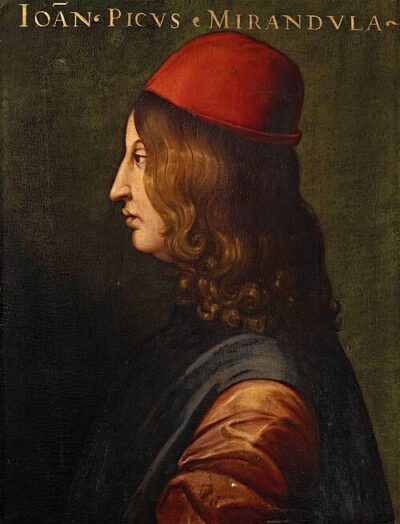
Giovanni Pico della Mirandola
Giovanni Pico della Mirandola was an Italian Renaissance philosopher. Born February 24, 1463, in Mirandola. Died November 17, 1494, in Florence. Known for Oration on the Dignity of Man, Heptaplus and Conclusiones philosophicae, cabalisticae et theologicae. Educated at University of Bologna and University of Ferrara.
Facts
32 facts · 2 confirmed by two sources · 5 cited · 25 from one source
Where this comes from
Papalocal keeps its own record. It started from these sources; what each one said is kept here as it was copied, so a change on their side never changes this page by itself. Tap one to read its version.
What Wikidata says · copied November 16, 2026 · revision 2569840640
- Described as
- Italian Renaissance philosopher (1463–1494)
- Other names
- Pico della Mirandola, Giovanni Pico, Giovanni Pico Della Mirandola, Johannes Picus de Mirandula, Ioannes Picus Mirandula, Count di Concordia, Jean Pic de la Mirandole, John Picus of Mirandola, Pico della Mirandolo
- Born
- February 24, 1463 · 2 references
- Died
- November 17, 1494 · 1 reference
- Born in
- Mirandola · 2 references
- Died in
- Florence · 2 references
- Buried in
- Museum of San Marco · 1 reference
- Cause of death
- poison
- Citizen of
- Duchy of Mirandola
- Occupation
- philosopher · 1 reference; writer · 1 reference
- Education
- University of Bologna; University of Ferrara; University of Padua; University of Paris
- Member of
- Platonic Academy
- Known for
- Oration on the Dignity of Man; Heptaplus; Conclusiones philosophicae, cabalisticae et theologicae; Disputationes adversus astrologiam divinatricem; Commentary on Girolamo Benivieni’s Canzone d’amore; Vita Hieronymi Savonarolae; Letters; Apologia conclusionum suorum; De ente et uno; De omnibus rebus et de quibusdam aliis
- Field
- philosophy
- Father
- Gianfrancesco I Pico
- Mother
- Giulia Boiardo · 1 reference
- Siblings
- Caterina Pico; Galeotto I Pico · 1 reference; Antonio Maria Pico della Mirandola; Lucrezia Pico della Mirandola
- Religion
- Catholic Church
- Wikipedias with a page
- 77
Wikidata item Q182128 (wikidata.org/wiki/Q182128), public domain (CC0). Copied November 16, 2026.
What Wikipedia says · copied November 16, 2026 · revision 1385563938
Giovanni Pico della Mirandola (24 February 1463 – 17 November 1494) was an Italian Renaissance nobleman and philosopher. He is famed for the events of 1486, when, at the age of 23, he proposed to defend 900 theses on religion, philosophy, natural philosophy, and magic against all comers, for which he wrote the Oration on the Dignity of Man, which has been called the "Manifesto of the Renaissance", and a key text of Renaissance humanism and of what has been called the "Hermetic Reformation". He was the founder of the tradition of Christian Kabbalah, a key tenet of early modern Western esotericism. The 900 Theses was the first printed book to be universally banned by the Church. Pico is sometimes seen as a proto-Protestant, because his 900 theses anticipated many Protestant views.
- Born, in its opening lines
- February 24, 1463
- Died, in its opening lines
- November 17, 1494
From the Wikipedia article “Giovanni Pico della Mirandola” (en.wikipedia.org/wiki/Giovanni_Pico_della_Mirandola), by its contributors, under CC BY-SA 4.0 (creativecommons.org/licenses/by-sa/4.0/). Copied November 16, 2026; not changed.
Confirmed Two sources agree. Cited One source, and it names where it got it. One source One source, without a reference of its own. Sources disagree The sources disagree. We show the best-supported value and keep theirs below.
