
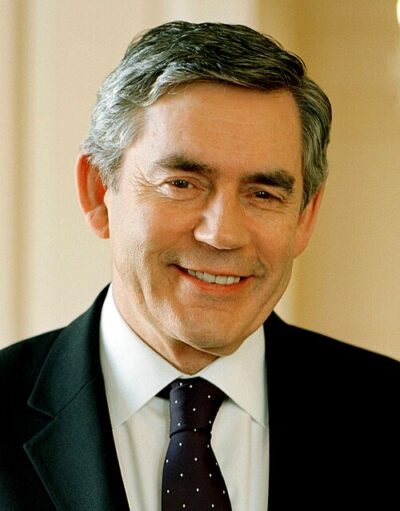
Gordon Brown
Gordon Brown is a Prime Minister of the United Kingdom from 2007 to 2010. Born February 20, 1951, in Giffnock. Positions held include Shadow Chancellor of the Exchequer (1992–1997), Shadow Chief Secretary to the Treasury (1987–1989) and Prime Minister of the United Kingdom (2007–2010). Educated at University of Edinburgh and Kirkcaldy High School. Awards include Honorary Fellow of the Royal Society of Edinburgh, Order of the Companions of Honour and honorary doctorate.
Facts
46 facts · 1 confirmed by two sources · 17 cited · 28 from one source
Where this comes from
Papalocal keeps its own record. It started from these sources; what each one said is kept here as it was copied, so a change on their side never changes this page by itself. Tap one to read its version.
What Wikidata says · copied November 16, 2026 · revision 2568207251
- Described as
- Prime Minister of the United Kingdom from 2007 to 2010
- Other names
- James Gordon Brown
- Born
- February 20, 1951 · 7 references
- Born in
- Giffnock · 1 reference
- Name at birth
- James Gordon Brown · 1 reference
- Citizen of
- United Kingdom
- Occupation
- politician · 2 references; journalist · 1 reference; biographer · 1 reference; autobiographer · 1 reference; historian; university teacher; minister · 1 reference
- Positions held
- Shadow Chancellor of the Exchequer (1992–1997); Shadow Chief Secretary to the Treasury (1987–1989); Prime Minister of the United Kingdom (2007–2010); Leader of the Labour Party (2007–2010); Chancellor of the Exchequer (1997–2007); Shadow Secretary of State for Business and Trade (1989–1992); First Lord of the Treasury (2007–2010); Minister for the Civil Service (2007–2010); Member of the Privy Council of the United Kingdom; member of the 55th Parliament of the United Kingdom (2010–2015) · 1 reference; member of the 54th Parliament of the United Kingdom (2005–2010) · 1 reference; member of the 53rd Parliament of the United Kingdom (2001–2005) · 1 reference; member of the 52nd Parliament of the United Kingdom (1997–2001) · 1 reference; member of the 51st Parliament of the United Kingdom (1992–1997) · 1 reference; member of the 50th Parliament of the United Kingdom (1987–1992) · 1 reference
- Political party
- Labour Party
- Worked for
- The Open University; United Nations; Glasgow Caledonian University
- Education
- University of Edinburgh; Kirkcaldy High School
- Awards
- Honorary Fellow of the Royal Society of Edinburgh; Order of the Companions of Honour (2024); honorary doctorate (2019) · 1 reference
- Spouse
- Sarah Brown (2000–) · 1 reference
- Children
- John Macaulay Brown; James Fraser Brown; Jennifer Jane Brown
- Father
- Rev. John Ebenezer Brown · 1 reference
- Mother
- Bunty Souter · 1 reference
- Siblings
- Andrew Brown
- Religion
- Church of Scotland · 1 reference
- Lived in
- 10 Downing Street (2007–2010); North Queensferry
- Height
- 1.81 m (5 ft 11 in) · 1 reference
- Wikipedias with a page
- 128
Wikidata item Q10648 (wikidata.org/wiki/Q10648), public domain (CC0). Copied November 16, 2026.
What Wikipedia says · copied November 16, 2026 · revision 1384894728
James Gordon Brown (born 20 February 1951) is a British politician who served as Prime Minister of the United Kingdom and Leader of the Labour Party from 2007 to 2010. Previously, he was Chancellor of the Exchequer from 1997 to 2007 under Tony Blair. Brown was Member of Parliament (MP) for Dunfermline East from 1983 to 2005 and for Kirkcaldy and Cowdenbeath from 2005 to 2015. He has served as United Nations Special Envoy for Global Education since 2012, and he was appointed as World Health Organization Ambassador for Global Health Financing in 2021. In 2026, then-Prime Minister Keir Starmer appointed Brown as a special envoy on global finance and cooperation.
Brown studied history at the University of Edinburgh, where he received a doctorate. He spent his early career as a lecturer at a further education college and as a television journalist. Brown was elected to the House of Commons at the 1983 general election as the MP for Dunfermline East. He was appointed to Neil Kinnock's shadow cabinet in 1989 and was named Shadow Chancellor of the Exchequer by John Smith in 1992. Following Labour's victory in the 1997 general election, Brown was appointed as chancellor, becoming the longest-serving in modern history. Brown's time as chancellor was marked by major reform of Britain's monetary and fiscal policy architecture, transferring interest rate setting to the Bank of England, extending the powers of the Treasury to cover much domestic policy, and transferring banking supervision to the Financial Services Authority. Brown presided over the longest period of economic growth in British history. He outlined five economic tests, which resisted the UK adopting the euro. Controversial moves included the abolition of advance corporation tax (ACT) relief in his first budget, the sale of UK gold reserves from 1999 to 2002, and the removal in his final budget of the 10% starting rate of income tax that he had introduced in the 1999 budget.
Following Blair's resignation in 2007, Brown was elected unopposed to succeed him as prime minister and party leader. The party continued as New Labour, though Brown's style of government differed from Blair's. He remained committed to close ties with the United States and to the war in Iraq, although he established an inquiry into the reasons for Britain's participation in the conflict. Brown's government introduced rescue packages to keep banks afloat during the 2008 financial crisis, and so national debt increased. The government took majority shareholdings in Northern Rock and Royal Bank of Scotland, which had experienced severe financial difficulties, and injected public money into other banks. In 2008, Brown's government passed the world's first Climate Change Act, and he also introduced the Equality Act 2010. Despite a poll boost just after Brown became prime minister, his popularity fell after he failed to call a snap election in 2007, and Labour's popularity declined with the Great Recession. Labour lost 91 seats in the 2010 general election, resulting in a hung parliament in which the Conservative Party won the most seats. After the Conservatives formed a coalition government with the Liberal Democrats, Brown was succeeded as prime minister by Conservative leader David Cameron, and as Labour leader by Ed Miliband.
After leaving office, Brown returned to the backbenches, continuing to serve as MP for Kirkcaldy and Cowdenbeath until he gave up his seat in 2015. He has since made occasional political interventions and has published politically themed books. Brown played a prominent role in the campaign to maintain the union during the 2014 Scottish independence referendum, and he wrote a report on devolution in 2022 for Labour leader Keir Starmer. Brown has served as the United Nations Special Envoy for Global Education, as well as the World Health Organization's Ambassador for Global Health Financing. He was awarded the Order of the Companions of Honour by King Charles III in the 2024 Birthday Honours for public and charitable services in the UK and abroad. As chancellor, Brown had high approval ratings; a poll of political scientists rated him the most successful post-war chancellor in terms of economic stability, working independently from the prime minister and leaving a lasting legacy on the British economy. His premiership has been viewed less favourably; although public opinion of Brown has improved since he left office, his premiership has been viewed as average in historical rankings and public opinion of British prime ministers.
- Born, in its opening lines
- February 20, 1951
From the Wikipedia article “Gordon Brown” (en.wikipedia.org/wiki/Gordon_Brown), by its contributors, under CC BY-SA 4.0 (creativecommons.org/licenses/by-sa/4.0/). Copied November 16, 2026; not changed.
Confirmed Two sources agree. Cited One source, and it names where it got it. One source One source, without a reference of its own. Sources disagree The sources disagree. We show the best-supported value and keep theirs below.
