
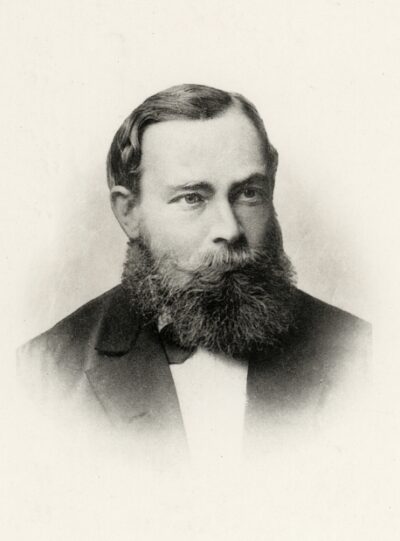
Gottlob Frege
Gottlob Frege was a German philosopher, logician, and mathematician. Born November 8, 1848, in Wismar. Died July 26, 1925, in Bad Kleinen. Known for Sense and reference, Begriffsschrift and The Foundations of Arithmetic. Educated at University of Jena and University of Göttingen.
Facts
35 facts · 2 confirmed by two sources · 18 cited · 15 from one source
Where this comes from
Papalocal keeps its own record. It started from these sources; what each one said is kept here as it was copied, so a change on their side never changes this page by itself. Tap one to read its version.
What Wikidata says · copied November 16, 2026 · revision 2569137634
- Described as
- German philosopher, logician, and mathematician (1848–1925)
- Other names
- Friedrich Ludwig Gottlob Frege
- Born
- November 8, 1848 · 10 references
- Died
- July 26, 1925 · 9 references
- Born in
- Wismar · 3 references
- Died in
- Bad Kleinen · 2 references
- Name at birth
- Friedrich Ludwig Gottlob Frege · 1 reference
- Citizen of
- Germany
- Occupation
- logician · 1 reference; analytic philosopher; philosopher of language; university teacher; mathematician · 1 reference; philosopher · 1 reference; professor · 1 reference
- Worked for
- University of Jena (1874–) · 1 reference
- Education
- University of Jena (1869–1871) · 1 reference; University of Göttingen (1871–1873) · 2 references; Grosse Stadtschule zu Wismar (1854–1869) · 4 references
- Member of
- German Academy of Sciences Leopoldina (1895–) · 1 reference
- Known for
- Sense and reference; Begriffsschrift; The Foundations of Arithmetic; Frege's theorem; Frege's propositional calculus; Frege's Puzzle; Frege system; principle of compositionality; Frege–Church ontology; Grundgesetze der Arithmetik
- Field
- philosophy; logic · 1 reference; philosophy of mathematics · 1 reference; philosophy of language · 1 reference
- Spouse
- Margarete Katharina Sophia Anna Lieseberg · 1 reference
- Father
- Karl Alexander Frege · 1 reference
- Mother
- Auguste Bialloblotzky · 1 reference
- Wikipedias with a page
- 92
Wikidata item Q60028 (wikidata.org/wiki/Q60028), public domain (CC0). Copied November 16, 2026.
What Wikipedia says · copied November 16, 2026 · revision 1385768080
Friedrich Ludwig Gottlob Frege (; German: [ˈɡɔtloːp ˈfreːɡə]; 8 November 1848 – 26 July 1925) was a German philosopher, logician, and mathematician. He was a mathematics professor at the University of Jena, and is understood by many to be the father of analytic philosophy, concentrating on the philosophy of language, logic, and mathematics. Though he was largely ignored during his lifetime, Giuseppe Peano (1858–1932), Bertrand Russell (1872–1970), and, to some extent, Ludwig Wittgenstein (1889–1951) introduced his work to later generations of philosophers. Frege is widely considered to be one of the greatest logicians since Aristotle, and one of the most profound philosophers of mathematics ever.
His contributions include the development of modern logic in the Begriffsschrift and work in the foundations of mathematics. His book The Foundations of Arithmetic is the seminal text of the logicist project, and is cited by Michael Dummett as where to pinpoint the linguistic turn. His philosophical papers "On Sense and Reference" and "The Thought" are also widely cited. The former argues for two different types of meaning and descriptivism. In Foundations and "The Thought", Frege argues for Platonism against psychologism and formalism, concerning numbers and propositions respectively.
- Born, in its opening lines
- November 8, 1848
- Died, in its opening lines
- July 26, 1925
From the Wikipedia article “Gottlob Frege” (en.wikipedia.org/wiki/Gottlob_Frege), by its contributors, under CC BY-SA 4.0 (creativecommons.org/licenses/by-sa/4.0/). Copied November 16, 2026; not changed.
Confirmed Two sources agree. Cited One source, and it names where it got it. One source One source, without a reference of its own. Sources disagree The sources disagree. We show the best-supported value and keep theirs below.
