
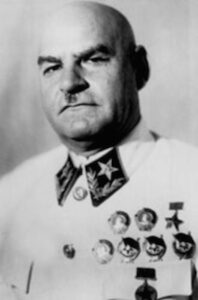
Grigory Kulik
Grigory Kulik was a Marshal of the Soviet Union. Born October 28, 1890, in Dudnykove. Died August 24, 1950, in Moscow. Positions held include deputy of the Supreme Soviet of the Soviet Union. Educated at M.V. Frunze Military Academy. Awards include Medal "For the Victory over Germany in the Great Patriotic War 1941–1945", Order of the Red Banner (4 times) and Order of Lenin (4 times).
Facts
24 facts · 1 confirmed by two sources · 0 cited · 22 from one source · 1 where the sources disagree
What’s different
- Born: we show October 28, 1890 (Sources disagree). Wikipedia says November 9, 1890
Where this comes from
Papalocal keeps its own record. It started from these sources; what each one said is kept here as it was copied, so a change on their side never changes this page by itself. Tap one to read its version.
What Wikidata says · copied November 16, 2026 · revision 2568936123
- Described as
- Marshal of the Soviet Union (1890–1950)
- Other names
- Grigory Ivanovich Kulik, Hryhorii Ivanovych Kulyk
- Born
- October 28, 1890 · 1 reference
- Died
- August 24, 1950
- Born in
- Dudnykove
- Died in
- Moscow
- Citizen of
- Russian Empire; Russian Republic; Soviet Union
- Occupation
- military personnel; politician
- Positions held
- deputy of the Supreme Soviet of the Soviet Union
- Political party
- Communist Party of the Soviet Union
- Education
- M.V. Frunze Military Academy
- Member of
- Central Committee of the Communist Party of the Soviet Union
- Awards
- Medal "For the Victory over Germany in the Great Patriotic War 1941–1945" (1945); Order of the Red Banner (4 times) (1919, 1921, 1930, 1944); Order of Lenin (4 times) (1937, 1938, 1940, 1945); Hero of the Soviet Union (1940); Jubilee Medal "XX Years of the Workers' and Peasants' Red Army" (1938); Medal "For the Defence of Leningrad" (1943); Cross of St. George 4th class (1915)
- Military branch
- artillery branch
- Military rank
- Marshal of the Soviet Union (1940); Feuerwerker · 1 reference; Sergeant · 1 reference
- Wikipedias with a page
- 34
Wikidata item Q48044 (wikidata.org/wiki/Q48044), public domain (CC0). Copied November 16, 2026.
What Wikipedia says · copied November 16, 2026 · revision 1379818408
Grigory Ivanovich Kulik (Russian: Григорий Иванович Кулик; Ukrainian: Григорій Іванович Кулик, romanized: Hryhorii Ivanovych Kulyk; 9 November 1890 – 24 August 1950) was a Soviet military commander and Marshal of the Soviet Union who served as chief of the Red Army's Main Artillery Directorate from 1937 until June 1941.
Born into a Ukrainian peasant family near Poltava, Kulik served as an artillery officer in the Imperial Russian Army during the First World War. On the outbreak of the Russian Revolution, he joined the Bolsheviks and the Red Army. He fought alongside Joseph Stalin at the Battle of Tsaritsyn during the Russian Civil War and quickly became one of Stalin's most favoured generals. In 1937, he was named chief of the Main Artillery Directorate. Kulik had a highly conservative outlook in military technology and theory. He was a strong opponent to Marshal Mikhail Tukhachevsky's reforms and his deep operations theory, and dismissed innovations such as the T-34 and KV-1 tanks and the Katyusha rocket artillery system.
Kulik was named First Deputy People's Commissar for Defence in 1939, and later took part in the Soviet invasion of Poland. In 1940, he was named a Marshal of the Soviet Union. Kulik's poor leadership during the Winter War in Finland and the German invasion of the Soviet Union led to his fall from grace. He was dismissed from his Artillery Directorate in late 1941, and in early 1942 he was court-martialed and demoted to major-general, but escaped execution thanks to his good relations with Stalin.
After the war, Stalin and Lavrentiy Beria began a new round of purges. Kulik was arrested for treason in 1947 and remained in prison until 1950, when Stalin ordered his execution.
- Born, in its opening lines
- November 9, 1890
- Died, in its opening lines
- August 24, 1950
From the Wikipedia article “Grigory Kulik” (en.wikipedia.org/wiki/Grigory_Kulik), by its contributors, under CC BY-SA 4.0 (creativecommons.org/licenses/by-sa/4.0/). Copied November 16, 2026; not changed.
Confirmed Two sources agree. Cited One source, and it names where it got it. One source One source, without a reference of its own. Sources disagree The sources disagree. We show the best-supported value and keep theirs below.
