
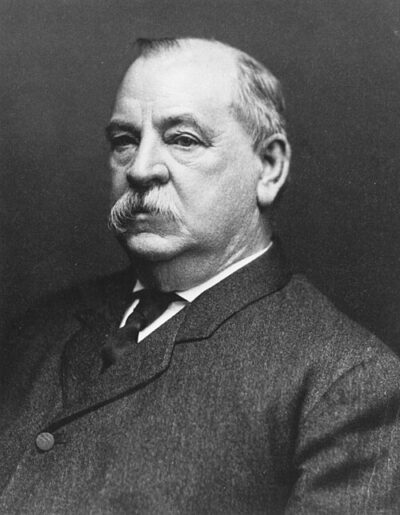
Grover Cleveland
Grover Cleveland was the 22nd & 24th President of the United States (1885–1889; 1893–1897). Born March 18, 1837, in Caldwell. Died June 24, 1908, in Princeton. Positions held include President of the United States (2 times) (1885–1897), Governor of New York (1883–1885) and President-elect of the United States (2 times) (1884–1893). Educated at Princeton University. Awards include New Jersey Hall of Fame.
Facts
37 facts · 2 confirmed by two sources · 17 cited · 17 from one source · 1 where the sources disagree
What’s different
- Born in: we show Caldwell (Sources disagree). Wikidata also lists Grover Cleveland Birthplace
Where this comes from
Papalocal keeps its own record. It started from these sources; what each one said is kept here as it was copied, so a change on their side never changes this page by itself. Tap one to read its version.
What Wikidata says · copied November 13, 2026 · revision 2568747942
- Described as
- 22nd & 24th President of the United States (1885–1889; 1893–1897)
- Other names
- Grover Cleveland Jr., Stephen Grover Cleveland Jr., Stephen Grover Cleveland, President Cleveland, Stephen G. Cleveland, S. Grover Cleveland
- Born
- March 18, 1837 · 12 references
- Died
- June 24, 1908 · 12 references
- Born in
- Caldwell · 1 reference; Grover Cleveland Birthplace
- Died in
- Princeton · 2 references
- Buried in
- Princeton Cemetery · 2 references
- Cause of death
- myocardial infarction
- Name at birth
- Stephen Grover Cleveland
- Citizen of
- United States
- Occupation
- politician · 1 reference; lawyer; statesperson; executioner · 1 reference; writer · 1 reference; governor · 1 reference; mayor · 1 reference; sheriff · 1 reference
- Positions held
- President of the United States (2 times) (1885–1897) · 1 reference; Governor of New York (1883–1885); President-elect of the United States (2 times) (1884–1893); Mayor of Buffalo, New York (1882)
- Political party
- Democratic Party
- Education
- Princeton University
- Member of
- American Philosophical Society (1897–)
- Awards
- New Jersey Hall of Fame (2013) · 1 reference
- Spouse
- Frances Cleveland (1886–1908) · 2 references
- Children
- Ruth Cleveland; Esther Cleveland; Richard F. Cleveland · 1 reference; Francis Cleveland · 1 reference; Marion Cleveland · 1 reference
- Father
- Richard Falley Cleveland
- Mother
- Anne Neal · 1 reference
- Siblings
- Rose Cleveland · 1 reference
- Religion
- Presbyterianism
- Lived in
- Westland Mansion (1897–1908) · 1 reference; Grover Cleveland Birthplace · 1 reference
- Height
- 1.80 m (5 ft 11 in) · 1 reference
- Wikipedias with a page
- 146
Wikidata item Q35171 (wikidata.org/wiki/Q35171), public domain (CC0). Copied November 13, 2026.
What Wikipedia says · copied November 13, 2026 · revision 1385280399
Stephen Grover Cleveland (March 18, 1837 – June 24, 1908) was the 22nd and 24th president of the United States, serving from 1885 to 1889 and from 1893 to 1897. He was the first Democrat elected president after the American Civil War and the first U.S. president to serve nonconsecutive terms.
Born in Caldwell, New Jersey, Cleveland was elected mayor of Buffalo in 1881 and governor of New York in 1882. While governor, he closely cooperated with state assembly minority leader Theodore Roosevelt to pass reform measures, winning national attention. He led the Bourbon Democrats, a pro-business movement opposed to high tariffs, free silver, inflation, imperialism, and subsidies to businesses, farmers, or veterans. His crusade for political reform and fiscal conservatism made him an icon for American conservatives of the time. Cleveland also won praise for honesty, self-reliance, integrity, and commitment to classical liberalism. His fight against political corruption, patronage, and bossism convinced many like-minded Republicans, called "Mugwumps", to cross party lines and support him despite a sexual assault scandal involving a child he allegedly fathered.
During his first presidency, Cleveland signed the Interstate Commerce Act of 1887, which made the railroad industry the first industry subject to federal regulation by a regulatory body, and the Dawes Act, which subdivided Native American tribal communal landholdings into individual allotments. This policy led to Native Americans ceding control of about two-thirds of their land between 1887 and 1934. In the 1888 election, Cleveland won the popular vote but lost the electoral college and therefore the election to Benjamin Harrison. He returned to New York City and joined a law firm.
In a rematch against Harrison for the 1892 election, Cleveland won both the popular vote and electoral college, returning him to the White House. One month before his second presidency began, the Panic of 1893 sparked a severe national depression. An anti-imperialist, Cleveland opposed the push to annex Hawaii, launched an investigation into the 1893 coup against Queen Liliʻuokalani, and called for her restoration. Cleveland intervened in the 1894 Pullman Strike to keep the railroads moving, angering Illinois Democrats and labor unions nationwide; his support of the gold standard and opposition to free silver alienated the agrarian wing of the Democrats. Critics complained that Cleveland had little imagination and seemed overwhelmed by the nation's economic disasters—depressions and strikes—in his second term. Many voters blamed the Democrats, opening the way for a Republican landslide in 1894 and for the agrarian and free silver (silverite) seizure of the Democratic Party at the 1896 Democratic convention. By the end of his second term, he was highly unpopular, even among Democrats.
After leaving the White House, Cleveland served as a trustee of Princeton University. He joined the American Anti-Imperialist League in protest of the 1898 Spanish–American War. He died in 1908.
- Born, in its opening lines
- March 18, 1837
- Died, in its opening lines
- June 24, 1908
From the Wikipedia article “Grover Cleveland” (en.wikipedia.org/wiki/Grover_Cleveland), by its contributors, under CC BY-SA 4.0 (creativecommons.org/licenses/by-sa/4.0/). Copied November 13, 2026; not changed.
Confirmed Two sources agree. Cited One source, and it names where it got it. One source One source, without a reference of its own. Sources disagree The sources disagree. We show the best-supported value and keep theirs below.
