
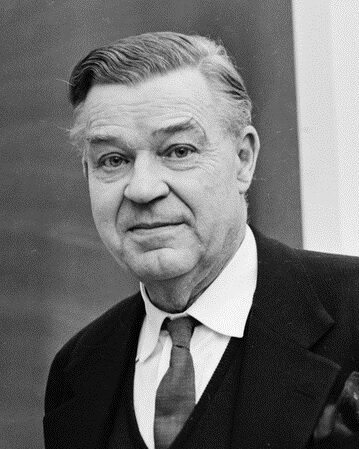
Gunnar Myrdal
Gunnar Myrdal was a Swedish economist. Born December 6, 1898, in Skattunge Parish. Died May 17, 1987, in Danderyd. Positions held include member of the First Chamber (2 times) (1936–1947), Minister of Trade (1945–1947) and professor (2 times) (1933–1967). Educated at Stockholm University and Norra Real. Awards include Prize in Economic Sciences in Memory of Alfred Nobel, Peace Prize of the German Publishers' and Booksellers' Association and Bronislaw Malinowski Award.
Facts
38 facts · 2 confirmed by two sources · 21 cited · 15 from one source
Where this comes from
Papalocal keeps its own record. It started from these sources; what each one said is kept here as it was copied, so a change on their side never changes this page by itself. Tap one to read its version.
What Wikidata says · copied November 16, 2026 · revision 2569911390
- Described as
- Swedish economist (1898–1987)
- Other names
- Karl Gunnar Myrdal
- Born
- December 6, 1898 · 7 references
- Died
- May 17, 1987 · 6 references
- Born in
- Skattunge Parish · 2 references
- Died in
- Danderyd · 2 references
- Buried in
- Garden of Remembrance, Norra Begravningsplatsen (1987–) · 2 references
- Citizen of
- Sweden
- Occupation
- economist; university teacher · 1 reference; politician · 1 reference; sociologist · 1 reference
- Positions held
- member of the First Chamber (2 times) (1936–1947) · 1 reference; Minister of Trade (1945–1947) · 1 reference; professor (2 times) (1933–1967) · 1 reference; general secretary (1947–1957) · 1 reference
- Political party
- Swedish Social Democratic Party · 1 reference
- Worked for
- Stockholm School of Economics; Stockholm University
- Education
- Stockholm University · 1 reference; Norra Real
- Member of
- Royal Swedish Academy of Sciences (1945–); Hungarian Academy of Sciences; American Academy of Arts and Sciences; Econometric Society (1939–) · 1 reference; American Philosophical Society (1982–)
- Awards
- Prize in Economic Sciences in Memory of Alfred Nobel (1974) · 2 references; Peace Prize of the German Publishers' and Booksellers' Association (1970) · 1 reference; Bronislaw Malinowski Award; Anisfield-Wolf Book Awards (1945); Fellow of the Econometric Society (1939) · 1 reference; Jawaharlal Nehru Award for International Understanding (1981); Kurt Lewin Award (1952) · 1 reference; doctor honoris causa from the University of Nancy (1950) · 1 reference
- Field
- economics; sociology
- Spouse
- Alva Myrdal (1924–) · 2 references
- Children
- Jan Myrdal · 1 reference; Sissela Bok · 1 reference; Kaj Fölster · 1 reference
- Wikipedias with a page
- 79
Wikidata item Q152452 (wikidata.org/wiki/Q152452), public domain (CC0). Copied November 16, 2026.
What Wikipedia says · copied November 16, 2026 · revision 1383201568
Karl Gunnar Myrdal ( MUR-dahl, MEER-; Swedish: [ˈɡɵ̌nːar ˈmy̌ːɖɑːl]; 6 December 1898 – 17 May 1987) was a Swedish economist and sociologist. In 1974, he received the Nobel Memorial Prize in Economic Sciences along with Friedrich Hayek for "their pioneering work in the theory of money and economic fluctuations and for their penetrating analysis of the interdependence of economic, social and institutional phenomena." When his wife, Alva Myrdal, received the Nobel Peace Prize in 1982, they became the fourth married couple to have won Nobel Prizes, and the first and only to win independent of each other (versus a shared Nobel Prize by scientist spouses).
Myrdal is best known in the United States for his study of race relations, which culminated in his 1944 book An American Dilemma: The Negro Problem and Modern Democracy. The study was influential in the 1954 landmark U.S. Supreme Court decision Brown v. Board of Education. In Sweden, his work and political influence were important to the establishment of the Folkhemmet and the welfare state.
- Born, in its opening lines
- December 6, 1898
- Died, in its opening lines
- May 17, 1987
From the Wikipedia article “Gunnar Myrdal” (en.wikipedia.org/wiki/Gunnar_Myrdal), by its contributors, under CC BY-SA 4.0 (creativecommons.org/licenses/by-sa/4.0/). Copied November 16, 2026; not changed.
Confirmed Two sources agree. Cited One source, and it names where it got it. One source One source, without a reference of its own. Sources disagree The sources disagree. We show the best-supported value and keep theirs below.
