
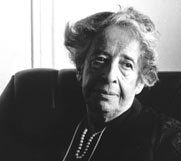
Hannah Arendt
Hannah Arendt was a German-American political theorist and philosopher. Born October 14, 1906, in Linden. Died December 4, 1975, in Upper West Side. Known for The Origins of Totalitarianism, The Human Condition and Eichmann in Jerusalem. Educated at Humboldt-Universität zu Berlin and University of Marburg. Awards include Guggenheim Fellowship, Fellow of the American Academy of Arts and Sciences and Sigmund Freud Prize.
Facts
61 facts · 2 confirmed by two sources · 24 cited · 34 from one source · 1 where the sources disagree
What’s different
- Born in: we show Linden (Sources disagree). Wikidata also lists Lindener Marktplatz 2, Hannover and Hanover
Where this comes from
Papalocal keeps its own record. It started from these sources; what each one said is kept here as it was copied, so a change on their side never changes this page by itself. Tap one to read its version.
What Wikidata says · copied November 13, 2026 · revision 2568296852
- Described as
- German-American political theorist and philosopher (1906–1975)
- Other names
- Hanna Arendt, Johanna "Hannah" Arendt, Johanna "Hannah" Cohn Arendt, Hannah Arendt Blücher, Hannah Arendt Bluecher, Johanna Arendt, Arendt Hannah
- Born
- October 14, 1906 · 14 references
- Died
- December 4, 1975 · 13 references
- Born in
- Lindener Marktplatz 2, Hannover · 1 reference; Linden · 2 references; Hanover · 2 references
- Died in
- Upper West Side · 5 references
- Buried in
- Bard College
- Cause of death
- myocardial infarction
- Name at birth
- Johanna Arendt
- Citizen of
- Prussia (1906–1937) · 2 references; statelessness (1937–1951); United States (1951–) · 2 references
- Occupation
- philosopher · 5 references; historian · 2 references; writer · 6 references; political scientist · 2 references; essayist; university teacher; sociologist · 1 reference; political theorist
- Worked for
- Princeton University; Northwestern University; Wesleyan University; University of California, Berkeley; University of Chicago (1963–1967) · 1 reference; Yale University; Columbia University; The New Yorker · 1 reference
- Education
- Humboldt-Universität zu Berlin (1922–1923); University of Marburg (1924–1926); University of Freiburg; Heidelberg University (–1928) · 1 reference
- Member of
- American Academy of Arts and Letters; German Academy for Language and Literature; American Academy of Arts and Sciences
- Known for
- The Origins of Totalitarianism · 2 references; The Human Condition · 2 references; Eichmann in Jerusalem · 1 reference; On Revolution · 1 reference; Rahel Varnhagen; natality
- Awards
- Guggenheim Fellowship (1952) · 2 references; Fellow of the American Academy of Arts and Sciences (1962); Sigmund Freud Prize (1967) · 1 reference; Emerson-Thoreau Medal (1969); Sonning Prize (1975); honorary doctorate from Princeton University; Benjamin E. Lippincott Award (1975) · 1 reference
- Field
- political philosophy; contemporary philosophy; philosophy · 1 reference; Protestant theology · 1 reference; Greek studies · 1 reference; totalitarianism
- Spouse
- Günther Anders (1929–1937) · 1 reference; Heinrich Blücher (1940–1970) · 1 reference
- Father
- Paul Arendt · 1 reference
- Religion
- Judaism · 2 references
- Lived in
- Hanover; New York City (–1975) · 1 reference; Marburg; Heidelberg; Königsberg · 1 reference
- Wikipedias with a page
- 127
Wikidata item Q60025 (wikidata.org/wiki/Q60025), public domain (CC0). Copied November 13, 2026.
What Wikipedia says · copied November 13, 2026 · revision 1385233348
Hannah Arendt (born Johanna Arendt; 14 October 1906 – 4 December 1975) was a German and American philosopher, political theorist, and public historian. She was one of the most influential political theorists of the twentieth century.
Her works cover a broad range of topics, but she is best known for those dealing with the nature of wealth, power, fame, and evil, as well as politics, direct democracy, authority, tradition, and totalitarianism. She is also remembered for the controversy surrounding the trial of Adolf Eichmann, for her attempt to explain how ordinary people become actors in totalitarian systems, and for the phrase "the banality of evil". Her name appears in the names of journals, schools, scholarly prizes, humanitarian prizes, think-tanks, and streets; appears on stamps and monuments; and is attached to other cultural and institutional markers that commemorate her thought.
Hannah Arendt was born to a Jewish family in Linden in 1906. Her father died when she was seven. Arendt was raised in a politically progressive, secular family, her mother being an ardent Social Democrat. After completing secondary education in Berlin, Arendt studied at the University of Marburg under Martin Heidegger, with whom she engaged in a romantic affair that began while she was his student. She obtained her doctorate in philosophy at the University of Heidelberg in 1929. Her dissertation was entitled Love and Saint Augustine, and her supervisor was the existentialist philosopher Karl Jaspers.In 1933, Arendt was briefly imprisoned by the Gestapo for performing illegal research into antisemitism. On release, she fled Germany, settling in Paris. There she worked for Youth Aliyah, assisting young Jews to emigrate to the British Mandate of Palestine. When Germany invaded France she was detained as an alien by the French government. She escaped and made her way to the United States in 1941. She became a writer and editor and worked for the Jewish Cultural Reconstruction, becoming an American citizen in 1950. With the publication of The Origins of Totalitarianism in 1951, her reputation as a thinker and writer was established, and a series of works followed. These included the books The Human Condition in 1958, as well as Eichmann in Jerusalem and On Revolution in 1963. She taught at many American universities while declining tenure-track appointments. She died suddenly of a heart attack in 1975, leaving her last work, The Life of the Mind, unfinished.
- Born, in its opening lines
- October 14, 1906
- Died, in its opening lines
- December 4, 1975
From the Wikipedia article “Hannah Arendt” (en.wikipedia.org/wiki/Hannah_Arendt), by its contributors, under CC BY-SA 4.0 (creativecommons.org/licenses/by-sa/4.0/). Copied November 13, 2026; not changed.
Confirmed Two sources agree. Cited One source, and it names where it got it. One source One source, without a reference of its own. Sources disagree The sources disagree. We show the best-supported value and keep theirs below.
