
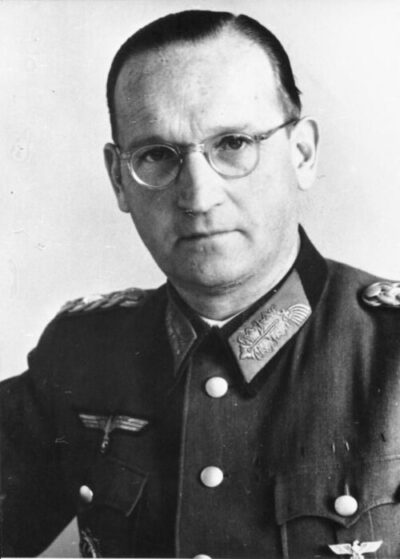
Hans Speidel
Hans Speidel was a German general; chief of staff under Erwin Rommel. Born October 28, 1897, in Metzingen. Died November 28, 1984, in Bad Honnef. Educated at Humboldt-Universität zu Berlin. Awards include German Cross in Gold, Knight's Cross of the Iron Cross and Great Cross with Star and Sash of the Order of Merit of the Federal Republic of Germany.
Facts
28 facts · 2 confirmed by two sources · 12 cited · 14 from one source
What’s different
- Born: we show October 28, 1897 (Confirmed). Wikidata also lists October 22, 1897
- Died: we show November 28, 1984 (Confirmed). Wikidata also lists November 22, 1984
Where this comes from
Papalocal keeps its own record. It started from these sources; what each one said is kept here as it was copied, so a change on their side never changes this page by itself. Tap one to read its version.
What Wikidata says · copied November 17, 2026 · revision 2565535868
- Described as
- German general; chief of staff under Erwin Rommel (1897–1984)
- Other names
- Dr. Hans Speidel, Major General Hans Speidel
- Born
- October 28, 1897 · 6 references; October 22, 1897 · 1 reference
- Died
- November 28, 1984 · 6 references; November 22, 1984 · 1 reference
- Born in
- Metzingen · 1 reference
- Died in
- Bad Honnef · 1 reference
- Buried in
- Pragfriedhof Stuttgart
- Citizen of
- Germany
- Occupation
- career soldier; military personnel (1914–1944) · 1 reference; resistance fighter; studies (1923–) · 1 reference; university teacher (1949–) · 2 references; historian · 1 reference; soldier · 1 reference
- Worked for
- University of Tübingen
- Education
- Humboldt-Universität zu Berlin
- Awards
- German Cross in Gold; Knight's Cross of the Iron Cross; Great Cross with Star and Sash of the Order of Merit of the Federal Republic of Germany (1963) · 1 reference; Grand Cross of the Cross of Military Merit with White Decoration (1979) · 1 reference
- Field
- history of war · 1 reference
- Children
- Hans Helmut Speidel · 1 reference
- Father
- Emil Speidel
- Siblings
- Wilhelm Speidel · 1 reference
- Military branch
- Imperial German Army · 1 reference
- Military rank
- general · 3 references; major general · 1 reference; captain (1932–1935) · 1 reference
- Lived in
- Freudenstadt District (1947) · 1 reference
- Wikipedias with a page
- 26
Wikidata item Q61638 (wikidata.org/wiki/Q61638), public domain (CC0). Copied November 17, 2026.
What Wikipedia says · copied November 17, 2026 · revision 1386064926
Hans Speidel (28 October 1897 – 28 November 1984) was a German general who successively served in the armies of the German Empire, Nazi Germany and West Germany. The first general officer of the Bundeswehr, he was a key player in West German rearmament during the Cold War as well as West Germany's integration into NATO and international negotiations on European and Western defence cooperation in the 1950s. He served as Commander of the Allied Land Forces Central Europe (COMLANDCENT) from 1957 to 1963 and then as President of the German Institute for International and Security Affairs from 1964.
Speidel joined the Imperial German Army in 1914, seeing action during World War I, and served in the Reichswehr during the interwar period. He served as chief of staff to Field Marshal Erwin Rommel during World War II and was promoted to lieutenant general in 1944. Speidel participated in the 20 July Plot to assassinate Hitler due to objecting to the racial policy of Nazi Germany, and he was tasked with recruiting Rommel for the resistance. After the plot failed he was arrested by the Gestapo. With the help of religious Pallottines, he was able to escape together with other prisoners and they were able to go into hiding in Urnau in today's Lake Constance district and were taken there by French troops in the last days of the war. Speidel was one of the few participants in the 20 July Plot to survive the war.
During the early Cold War, Speidel emerged as one of the major military leaders of West Germany, and played a key role in West Germany's rearmament, Western international negotiations on defence cooperation and West German integration into NATO. He is thus regarded as one of the founders of the Bundeswehr. He was appointed as the military advisor of Chancellor Konrad Adenauer in 1950 and joined the predecessor of the Federal Ministry of Defence in 1951, was the West German chief delegate to the conference on the Treaty establishing the European Defence Community from 1951 to 1954 and was a lead negotiator when West Germany joined NATO. In 1955 he became a director-general in the Federal Ministry of Defence with the military rank of lieutenant-general in the Bundeswehr, and in 1957 he became the first officer to be promoted to full General in West Germany. He served as COMLANDCENT from 1957 to 1963, with headquarters at the Palace of Fontainebleau in Paris.
Speidel was also a historian by training, taught at the University of Tübingen and wrote several books. He received the Grand Cross with Star and Sash of the Order of Merit of the Federal Republic of Germany in 1963. In 1964 he became President of the German Institute for International and Security Affairs, the German government's main think tank in international relations. He was the father of Brigadier General Hans Helmut Speidel and the father-in-law of European Commissioner and liberal politician Guido Brunner. A German Army military base, the General Dr Speidel Barracks in Bruchsal, was named in his honour in 1997.
- Born, in its opening lines
- October 28, 1897
- Died, in its opening lines
- November 28, 1984
From the Wikipedia article “Hans Speidel” (en.wikipedia.org/wiki/Hans_Speidel), by its contributors, under CC BY-SA 4.0 (creativecommons.org/licenses/by-sa/4.0/). Copied November 17, 2026; not changed.
Confirmed Two sources agree. Cited One source, and it names where it got it. One source One source, without a reference of its own. Sources disagree The sources disagree. We show the best-supported value and keep theirs below.
