
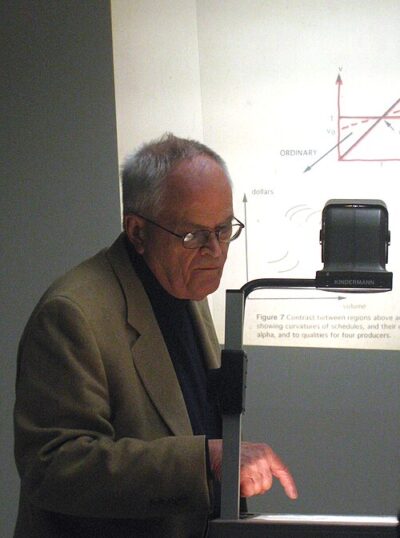
Harrison White
Harrison White was an American sociologist. Born March 21, 1930, in Washington, D.C.. Died May 18, 2024, in Tucson. Educated at Princeton University and Massachusetts Institute of Technology. Awards include Guggenheim Fellowship, W.E.B. Du Bois Career of Distinguished Scholarship award and honorary doctor of the University of Toulouse-II.
Facts
22 facts · 2 confirmed by two sources · 7 cited · 13 from one source
What’s different
- Died: we show May 18, 2024 (Confirmed). Wikidata also lists May 19, 2024
Where this comes from
Papalocal keeps its own record. It started from these sources; what each one said is kept here as it was copied, so a change on their side never changes this page by itself. Tap one to read its version.
What Wikidata says · copied November 18, 2026 · revision 2569227641
- Described as
- American sociologist (1930–2024)
- Other names
- Harrison Colyar White
- Born
- March 21, 1930 · 1 reference
- Died
- May 19, 2024 · 1 reference; May 18, 2024 · 2 references
- Born in
- Washington, D.C. · 1 reference
- Died in
- Tucson · 2 references
- Citizen of
- United States
- Occupation
- sociologist · 1 reference; university teacher
- Worked for
- Harvard University; University of Arizona; University of Chicago; Columbia University; Carnegie Mellon University · 1 reference
- Education
- Princeton University (–1960); Massachusetts Institute of Technology (–1955)
- Member of
- National Academy of Sciences; American Academy of Arts and Sciences
- Awards
- Guggenheim Fellowship · 1 reference; W.E.B. Du Bois Career of Distinguished Scholarship award (2011) · 1 reference; honorary doctor of the University of Toulouse-II (2004) · 1 reference
- Field
- sociological theory · 1 reference; social media analytics; mathematical sociology
- Wikipedias with a page
- 15
Wikidata item Q1586301 (wikidata.org/wiki/Q1586301), public domain (CC0). Copied November 18, 2026.
What Wikipedia says · copied November 18, 2026 · revision 1384824992
Harrison Colyar White (March 21, 1930 – May 18, 2024) was an American sociologist who was the Giddings Professor of Sociology at Columbia University. White played an influential role in the “Harvard Revolution” in social networks and the New York School of relational sociology. He is credited with the development of a number of mathematical models of social structure including vacancy chains and blockmodels. He has been a leader of a revolution in sociology that is still in process, using models of social structure that are based on patterns of relations instead of the attributes and attitudes of individuals.
Among social network researchers, White is widely respected. For instance, at the 1997 International Network of Social Network Analysis conference, the organizer held a special “White Tie” event, dedicated to White. Social network researcher Emmanuel Lazega refers to him as both “Copernicus and Galileo” because he invented both the vision and the tools.
The most comprehensive documentation of his theories can be found in the book Identity and Control, first published in 1992. A major rewrite of the book appeared in June 2008. In 2011, White received the W.E.B. DuBois Career of Distinguished Scholarship Award from the American Sociological Association, which honors "scholars who have shown outstanding commitment to the profession of sociology and whose cumulative work has contributed in important ways to the advancement of the discipline." Before his retirement to live in Tucson, Arizona, White was interested in sociolinguistics and business strategy as well as sociology.
- Born, in its opening lines
- March 21, 1930
- Died, in its opening lines
- May 18, 2024
From the Wikipedia article “Harrison White” (en.wikipedia.org/wiki/Harrison_White), by its contributors, under CC BY-SA 4.0 (creativecommons.org/licenses/by-sa/4.0/). Copied November 18, 2026; not changed.
Confirmed Two sources agree. Cited One source, and it names where it got it. One source One source, without a reference of its own. Sources disagree The sources disagree. We show the best-supported value and keep theirs below.
