
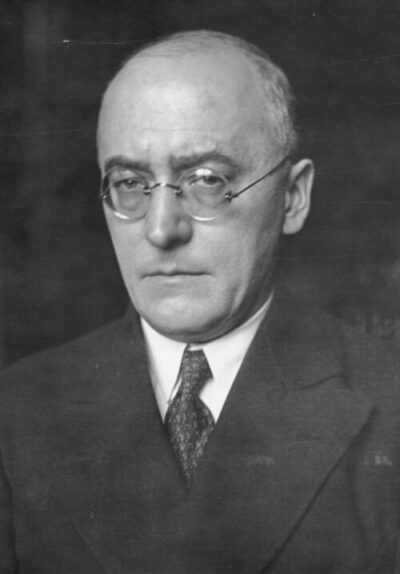
Heinrich Brüning
Heinrich Brüning was a German chancellor. Born November 26, 1885, in Münster. Died March 30, 1970, in Norwich. Positions held include member of the Reichstag of the Weimar Republic, member of Landtag of Prussia and Reich Chancellor in the Weimar Republic (1930–1932). Educated at London School of Economics and Political Science and University of Bonn. Awards include Iron Cross, honorary citizenship and Fellow of the American Academy of Arts and Sciences.
Facts
32 facts · 2 confirmed by two sources · 6 cited · 24 from one source
Where this comes from
Papalocal keeps its own record. It started from these sources; what each one said is kept here as it was copied, so a change on their side never changes this page by itself. Tap one to read its version.
What Wikidata says · copied November 16, 2026 · revision 2562683903
- Described as
- German chancellor (1885-1970)
- Other names
- Heinrich Aloysius Maria Elisabeth Brüning
- Born
- November 26, 1885 · 9 references
- Died
- March 30, 1970 · 8 references
- Born in
- Münster · 2 references
- Died in
- Norwich · 1 reference
- Buried in
- Münster Central Cemetery
- Citizen of
- Germany
- Occupation
- politician · 1 reference; economist; trade unionist; university teacher · 2 references; political scientist · 1 reference; chancellor · 1 reference
- Positions held
- member of the Reichstag of the Weimar Republic; member of Landtag of Prussia; Reich Chancellor in the Weimar Republic (1930–1932); Reich Minister of Finance (1930); Federal Minister for Foreign Affairs (1931–1932) · 1 reference
- Political party
- Centre Party
- Worked for
- Harvard University (1939–1952) · 1 reference; University of Cologne
- Education
- London School of Economics and Political Science; University of Bonn; LMU Munich · 1 reference; Gymnasium Paulinum
- Member of
- American Academy of Arts and Sciences (1938–); Katholischer Studentenverein Askania-Burgundia Berlin · 1 reference
- Awards
- Iron Cross; honorary citizenship; Fellow of the American Academy of Arts and Sciences (1938); Goethe Medal for Art and Science
- Religion
- Catholicism
- Military rank
- lieutenant · 1 reference
- Wikipedias with a page
- 51
Wikidata item Q155398 (wikidata.org/wiki/Q155398), public domain (CC0). Copied November 16, 2026.
What Wikipedia says · copied November 16, 2026 · revision 1381223314
Heinrich Aloysius Maria Elisabeth Brüning (pronounced [ˈhaɪnʁɪç ˈbʁyːnɪŋ] ; 26 November 1885 – 30 March 1970) was a German Centre Party politician and academic, who served as the chancellor of Germany during the Weimar Republic from 1930 to 1932. His use of deflation in an attempt to combat the effects of the Great Depression in Germany increased unemployment and poverty and earned him the nickname of the “Hunger Chancellor".
A political scientist and Christian social activist, he entered politics in the 1920s and was elected to the Reichstag in 1924. In 1930, he was appointed interim chancellor, just as the Great Depression took hold. His austerity policies in response were unpopular, with most of the Reichstag opposed, so he governed by emergency decrees issued by President Paul von Hindenburg, overriding the Reichstag. This lasted until May 1932, when his land distribution policy offended Hindenburg, who refused to issue any more decrees. Brüning resigned in response to the refusal.
After Hitler took power, Brüning fled Germany in 1934. He eventually settled in the United States. From 1937 to 1952, he was a professor at Harvard University. He returned to Germany in 1951 to teach at the University of Cologne but again moved to the United States in 1955 and lived out his days in retirement in Vermont.
Brüning remains a controversial figure in Germany's history, as historians debate whether he was the "last bulwark of the Weimar Republic", the "Republic's undertaker", or both. Scholars are divided over how much room for manoeuvre he had during the Depression, in a period of great political instability. While he intended to protect the Republic's government, his policies, notably his use of emergency powers, also contributed to the gradual decline of the Weimar Republic during his chancellorship.
- Born, in its opening lines
- November 26, 1885
- Died, in its opening lines
- March 30, 1970
From the Wikipedia article “Heinrich Brüning” (en.wikipedia.org/wiki/Heinrich_Brüning), by its contributors, under CC BY-SA 4.0 (creativecommons.org/licenses/by-sa/4.0/). Copied November 16, 2026; not changed.
Confirmed Two sources agree. Cited One source, and it names where it got it. One source One source, without a reference of its own. Sources disagree The sources disagree. We show the best-supported value and keep theirs below.
