
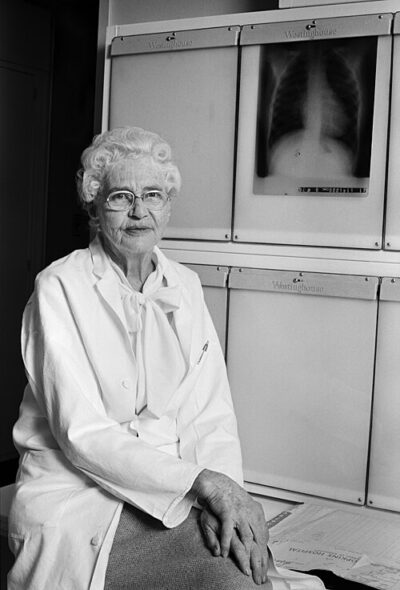
Helen B. Taussig
Helen B. Taussig was a Jewish-American cardiologist. Born May 24, 1898, in Cambridge. Died May 20, 1986, in Kennett Square. Educated at Boston University and Harvard Medical School. Awards include National Women's Hall of Fame, Elizabeth Blackwell Medal and Lasker-DeBakey Clinical Medical Research Award.
Facts
36 facts · 2 confirmed by two sources · 13 cited · 21 from one source
Where this comes from
Papalocal keeps its own record. It started from these sources; what each one said is kept here as it was copied, so a change on their side never changes this page by itself. Tap one to read its version.
What Wikidata says · copied November 15, 2026 · revision 2565762962
- Described as
- Jewish-American cardiologist (1898-1986)
- Other names
- Helen Brooke Taussig, Helen Taussig
- Born
- May 24, 1898 · 5 references
- Died
- May 20, 1986 · 5 references
- Born in
- Cambridge
- Died in
- Kennett Square · 1 reference
- Buried in
- Mount Auburn Cemetery · 1 reference
- Cause of death
- car collision
- Citizen of
- United States
- Occupation
- cardiologist; physician · 1 reference
- Education
- Boston University; Harvard Medical School; University of California, Berkeley; Johns Hopkins School of Medicine; Johns Hopkins University; Buckingham Browne & Nichols School · 1 reference
- Member of
- National Academy of Sciences (1973–) · 1 reference; American Academy of Arts and Sciences; American Philosophical Society (1973–)
- Awards
- National Women's Hall of Fame (1973) · 1 reference; Elizabeth Blackwell Medal (1982) · 1 reference; Lasker-DeBakey Clinical Medical Research Award (1954) · 1 reference; Canada Gairdner International Award (1959) · 1 reference; Feltrinelli Prize (1954); AMA Scientific Achievement Award (1977); Presidential Medal of Freedom (1964) · 1 reference; Carl-Ludwig Honorary Medal (1967); Elizabeth Blackwell Award (1970) · 1 reference; honorary doctor of the University of Vienna · 1 reference; Fellow of the American College of Cardiology; Fellow of the American Academy of Arts and Sciences; E. Mead Johnson Award (1947) · 1 reference; Maryland Women's Hall of Fame (1987) · 1 reference; George M. Kober Medal (1987) · 1 reference
- Field
- pediatrics; cardiology
- Father
- Frank William Taussig
- Wikipedias with a page
- 32
Wikidata item Q271531 (wikidata.org/wiki/Q271531), public domain (CC0). Copied November 15, 2026.
What Wikipedia says · copied November 15, 2026 · revision 1372004824
Helen Brooke Taussig (May 24, 1898 – May 20, 1986) was an American cardiologist, working in Baltimore and Boston, who founded the field of pediatric cardiology. She is credited with developing the concept for a procedure that would extend the lives of children born with Tetralogy of Fallot (the most common cause of blue baby syndrome). This concept was applied in practice as a procedure known as the Blalock-Thomas-Taussig shunt. The procedure was developed by Alfred Blalock and Vivien Thomas, who were Taussig's colleagues at the Johns Hopkins Hospital.
Taussig was partially deaf following an ear infection in childhood; in early adulthood this progressed to full deafness. To compensate for her loss of hearing, she learned to use lip-reading techniques and hearing aids to speak with her patients. Taussig also developed a method of using her fingers, rather than a stethoscope, to feel the rhythm of their heartbeats. Some of her innovations have been attributed to her ability to diagnose heart problems by touch rather than by sound.
Taussig is also known for her work in banning thalidomide and was widely recognized as a highly skilled physician. She was the first woman to be elected head of the American Heart Association. In 1964, she was awarded a Presidential Medal of Freedom.
- Born, in its opening lines
- May 24, 1898
- Died, in its opening lines
- May 20, 1986
From the Wikipedia article “Helen B. Taussig” (en.wikipedia.org/wiki/Helen_B._Taussig), by its contributors, under CC BY-SA 4.0 (creativecommons.org/licenses/by-sa/4.0/). Copied November 15, 2026; not changed.
Confirmed Two sources agree. Cited One source, and it names where it got it. One source One source, without a reference of its own. Sources disagree The sources disagree. We show the best-supported value and keep theirs below.
