
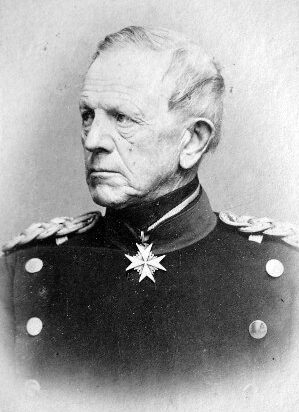
Helmuth von Moltke the Elder
Helmuth von Moltke the Elder was a German Field Marshal. Born October 26, 1800, in Parchim. Died April 24, 1891, in Berlin. Positions held include member of the Reichstag of the German Empire (1871–1891), member of the Prussian House of Lords (1872–) and Member of the Customs Parliament. Educated at Prussian Military Academy. Awards include Knight of the Order of St. Alexander Nevsky, Order of the Black Eagle and honorary citizen of Berlin.
Facts
45 facts · 2 confirmed by two sources · 10 cited · 33 from one source
Where this comes from
Papalocal keeps its own record. It started from these sources; what each one said is kept here as it was copied, so a change on their side never changes this page by itself. Tap one to read its version.
What Wikidata says · copied November 16, 2026 · revision 2568852912
- Described as
- German Field Marshal (1800–1891)
- Other names
- Helmuth Karl Bernhard von Moltke, H. K. B. von Moltke, Count von Moltke, Count Helmuth von Moltke, Helmuth Karl Bernhard Graf von Moltke
- Born
- October 26, 1800 · 6 references
- Died
- April 24, 1891 · 6 references
- Born in
- Parchim · 1 reference
- Died in
- Berlin · 2 references
- Citizen of
- Kingdom of Prussia
- Occupation
- writer · 1 reference; military officer; historian; politician; teacher · 1 reference; Generalfeldmarschall · 1 reference; military personnel · 1 reference
- Positions held
- member of the Reichstag of the German Empire (1871–1891); member of the Prussian House of Lords (1872–); Member of the Customs Parliament
- Political party
- German Conservative Party; Conservative Party
- Education
- Prussian Military Academy
- Member of
- Royal Prussian Academy of Sciences; Saint Petersburg Academy of Sciences; Russian Academy of Sciences
- Awards
- Knight of the Order of St. Alexander Nevsky; Order of the Black Eagle; honorary citizen of Berlin (1871) · 1 reference; honorary citizen of Munich (1890) · 1 reference; Grand Cross of the Imperial Order of Leopold; Pour le Mérite for Sciences and Arts order; Order of Saint Anna, 1st class; Order of the White Eagle; Order of St. Andrew; Order of St. George, 2nd class; Knight Grand Cross of the Military Order of Savoy; Order of Saint Stephen of Hungary · 1 reference; Lifesaving Medal; Grand Cross of the Military Karl-Friedrich Merit Order (1868) · 1 reference; honorary citizen of Görlitz (1871) · 2 references
- Spouse
- Marie von Moltke · 1 reference
- Father
- Friedrich von Moltke
- Mother
- Henriette von Moltke · 1 reference
- Siblings
- Auguste Brist; Louis von Moltke · 1 reference; Adolf von Moltke · 1 reference
- Military branch
- Prussian Army · 1 reference
- Military rank
- general; Generalfeldmarschall (1871–)
- Wikipedias with a page
- 72
Wikidata item Q44205 (wikidata.org/wiki/Q44205), public domain (CC0). Copied November 16, 2026.
What Wikipedia says · copied November 16, 2026 · revision 1382987136
Graf Helmuth Karl Bernhard von Moltke (German: [ˈhɛlmuːt fɔn ˈmɔltkə]; 26 October 1800 – 24 April 1891) was a Prussian Generalfeldmarschall. The chief of staff of the Prussian Army for thirty years, he is regarded as the creator of a new, more modern method of directing armies in the field and one of the finest military minds of his generation. He commanded troops in the Middle-East and then in Europe during the Second Schleswig War, Austro-Prussian War, and Franco-Prussian War. He is described as embodying "Prussian military organization and tactical genius". He was fascinated with railways and pioneered their military use.
He is often referred to as Moltke the Elder to distinguish him from his nephew Helmuth von Moltke the Younger (Helmuth Johann Ludwig von Moltke), who commanded the German army at the outbreak of the First World War. He is notably the earliest-born human whose recorded voice is preserved, being born in the year 1800. He made four recordings; two that were recorded in October 1889 are preserved to this day.
- Born, in its opening lines
- October 26, 1800
- Died, in its opening lines
- April 24, 1891
From the Wikipedia article “Helmuth von Moltke the Elder” (en.wikipedia.org/wiki/Helmuth_von_Moltke_the_Elder), by its contributors, under CC BY-SA 4.0 (creativecommons.org/licenses/by-sa/4.0/). Copied November 16, 2026; not changed.
Confirmed Two sources agree. Cited One source, and it names where it got it. One source One source, without a reference of its own. Sources disagree The sources disagree. We show the best-supported value and keep theirs below.
