
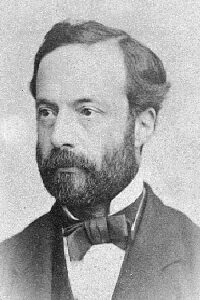
Henri Étienne Sainte-Claire Deville
Henri Étienne Sainte-Claire Deville was a French chemist. Born March 11, 1818, in Saint Thomas. Died July 1, 1881, in Boulogne-Billancourt. Educated at Collège Stanislas de Paris and Collège-lycée Jacques-Decour. Awards include Commander of the Legion of Honour and Jean Reynaud Prize.
Facts
30 facts · 2 confirmed by two sources · 1 cited · 27 from one source
Where this comes from
Papalocal keeps its own record. It started from these sources; what each one said is kept here as it was copied, so a change on their side never changes this page by itself. Tap one to read its version.
What Wikidata says · copied November 17, 2026 · revision 2568098986
- Described as
- French chemist (1818–1881)
- Other names
- Henri Etienne Sainte-Claire Deville
- Born
- March 11, 1818 · 4 references
- Died
- July 1, 1881 · 10 references
- Born in
- Saint Thomas
- Died in
- Boulogne-Billancourt
- Buried in
- Père Lachaise Cemetery
- Citizen of
- France
- Occupation
- chemist · 1 reference; professor
- Worked for
- Marie and Louis Pasteur University; École Normale Supérieure; Science Faculty of Paris
- Education
- Collège Stanislas de Paris; Collège-lycée Jacques-Decour; Paris Medical Faculty; Science Faculty of Paris
- Member of
- Société Philomathique de Paris; French Academy of Sciences; Hungarian Academy of Sciences; Société Ramond; Saint Petersburg Academy of Sciences; Russian Academy of Sciences; Royal Prussian Academy of Sciences; Académie des sciences, belles-lettres et arts de Besançon et de Franche-Comté; Göttingen Academy of Sciences and Humanities in Lower Saxony
- Awards
- Commander of the Legion of Honour; Jean Reynaud Prize (1882)
- Spouse
- Cécile Girod de l'Ain
- Children
- Charles Étienne Sainte-Claire Deville
- Father
- Louis-Joseph Sainte-Claire Deville
- Siblings
- Charles Joseph Sainte-Claire Deville
- Wikipedias with a page
- 26
Wikidata item Q905534 (wikidata.org/wiki/Q905534), public domain (CC0). Copied November 17, 2026.
What Wikipedia says · copied November 17, 2026 · revision 1376828949
Henri Étienne Sainte-Claire Deville (11 March 1818 – 1 July 1881) was a French chemist.
He was born in the island of St Thomas in the Danish West Indies, where his father was French consul. Together with his elder brother Charles, he was educated in Paris at the collège Rollin. In 1844, having graduated as a doctor of medicine and doctor of science, he was appointed to organize the new faculty of science at Besançon, where he acted as dean and professor of chemistry from 1845 to 1851. Returning to Paris in the latter year he succeeded Antoine Jérôme Balard at the École Normale, and in 1859 became professor at the Sorbonne in place of J. B. A. Dumas, for whom he had begun to lecture in 1853. He died at Boulogne-sur-Seine.
In 1841, he began his experiments with investigations of oil of turpentine and tolu balsam, in the course of which he discovered toluene. But his most important work was perhaps in inorganic and thermal chemistry. In 1849 he discovered anhydrous nitric acid (nitrogen pentoxide), a substance interesting as the first obtained of the so-called "anhydrides" of the monobasic acids. In 1854, he succeeded in obtaining metallic aluminium, and ultimately he devised a method by which the metal could be prepared on a large scale by the aid of sodium, the manufacture of which he also developed. Together with Friedrich Wöhler, he discovered silicon nitride in 1857. With Jules Henri Debray (1827–1888) he worked at the platinum metals, his object being on the one hand to prepare them pure, and on the other to find a suitable metal for the standard metre for the International Metric Commission then sitting at Paris. With Louis Joseph Troost (born 1825) he devised a method for determining vapour densities at temperatures up to 1400˚C, and, partly with F. Wöhler, he investigated the allotropic forms of silicon and boron.
The artificial preparation of minerals, especially of apatite and isorhor-phous minerals and of crystalline oxides, was another subject in which he made many experiments. But his best known contribution to general chemistry is his work on the phenomena of reversible reactions, which he comprehended under a general theory of "dissociation". He first took up the subject about 1857, and it was in the course of his investigations on it that he devised the apparatus known as the "Deville hot and cold tube."
Deville was elected to the American Philosophical Society in 1860. In 1885, the rue Sainte-Claire-Deville in the 12th arrondissement de Paris was named in his honour.
- Born, in its opening lines
- March 11, 1818
- Died, in its opening lines
- July 1, 1881
From the Wikipedia article “Henri Étienne Sainte-Claire Deville” (en.wikipedia.org/wiki/Henri_Étienne_Sainte-Claire_Deville), by its contributors, under CC BY-SA 4.0 (creativecommons.org/licenses/by-sa/4.0/). Copied November 17, 2026; not changed.
Confirmed Two sources agree. Cited One source, and it names where it got it. One source One source, without a reference of its own. Sources disagree The sources disagree. We show the best-supported value and keep theirs below.
