
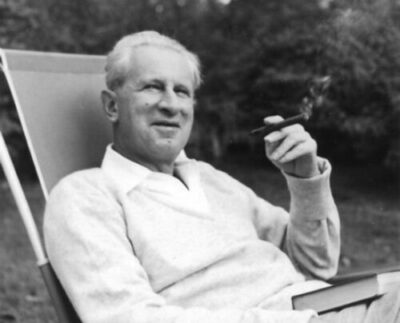
Herbert Marcuse
Herbert Marcuse was a German philosopher, sociologist, and political theorist. Born July 19, 1898, in Berlin. Died July 29, 1979, in Starnberg. Known for Eros and Civilization, One-Dimensional Man and Existentialistische Marx-Interpretation. Educated at Harvard University and Columbia University.
Facts
38 facts · 2 confirmed by two sources · 7 cited · 29 from one source
Where this comes from
Papalocal keeps its own record. It started from these sources; what each one said is kept here as it was copied, so a change on their side never changes this page by itself. Tap one to read its version.
What Wikipedia says · copied November 13, 2026 · revision 1380587043
Herbert Marcuse ( mar-KOO-zə; German: [maʁˈkuːzə]; July 19, 1898 – July 29, 1979) was a German and American philosopher, social critic, and political theorist, associated with the Frankfurt School of critical theory. Born in Berlin, Marcuse studied at the Friedrich Wilhelm University of Berlin and then at the University of Freiburg, where he received his PhD under the supervision of Martin Heidegger. He was a prominent figure in the Frankfurt-based Institute for Social Research, which later became known as the Frankfurt School. In his written works, he criticized capitalism, modern technology, Soviet Communism, and popular culture, arguing that they represent new forms of social control.
In the 1960s and the 1970s, he became known as the pre-eminent theorist of the New Left and the student movements of West Germany, France, and the United States; some consider him "the Father of the New Left".
The best-known works of Herbert Marcuse are Eros and Civilization (1955) and One-Dimensional Man (1964). His Marxist scholarship inspired many radical intellectuals and political activists in the 1960s and 1970s, and has from then on considerably influenced left-wing political thinking in the Western world. The name "Marcuse" itself, however, remains obscure outside of specialized contexts where critical theory is taught or referenced.
- Born, in its opening lines
- July 19, 1898
- Died, in its opening lines
- July 29, 1979
From the Wikipedia article “Herbert Marcuse” (en.wikipedia.org/wiki/Herbert_Marcuse), by its contributors, under CC BY-SA 4.0 (creativecommons.org/licenses/by-sa/4.0/). Copied November 13, 2026; not changed.
What Wikidata says · copied November 14, 2026 · revision 2569137644
- Described as
- German philosopher, sociologist, and political theorist (1898–1979)
- Born
- July 19, 1898 · 13 references
- Died
- July 29, 1979 · 13 references
- Born in
- Berlin · 4 references
- Died in
- Starnberg · 1 reference
- Buried in
- Dorotheenstadt Cemetery
- Cause of death
- cerebral hemorrhage
- Citizen of
- Weimar Republic; United States; West Germany; Germany · 2 references
- Occupation
- philosopher · 3 references; sociologist · 3 references; political theorist; university teacher; political scientist · 2 references
- Political party
- Social Democratic Party of Germany; Independent Social Democratic Party of Germany
- Worked for
- Freie Universität Berlin (1965–); Brandeis University (1954–); University of California, San Diego (1964–); Office of Strategic Services; Goethe University Frankfurt · 1 reference
- Education
- Harvard University; Columbia University; Humboldt-Universität zu Berlin; University of Freiburg · 1 reference
- Known for
- Eros and Civilization; One-Dimensional Man; Existentialistische Marx-Interpretation; Counterrevolution and Revolt; A Critique of Pure Tolerance
- Field
- philosophy; social theory · 1 reference; Freudo-Marxism · 1 reference
- Spouse
- Sophie Wertheim; Inge Neumann; Erica Sherover-Marcuse
- Children
- Peter Marcuse · 1 reference
- Wikipedias with a page
- 87
Wikidata item Q60030 (wikidata.org/wiki/Q60030), public domain (CC0). Copied November 14, 2026.
Confirmed Two sources agree. Cited One source, and it names where it got it. One source One source, without a reference of its own. Sources disagree The sources disagree. We show the best-supported value and keep theirs below.
