
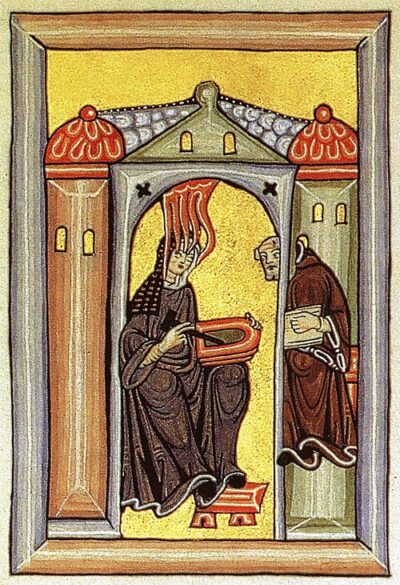
Hildegard of Bingen
Hildegard of Bingen was a German Benedictine abbess, polymath, mystic and Doctor of Church. Born 1098, in Bermersheim vor der Höhe. Died September 17, 1179, in Kloster Rupertsberg. Positions held include abbess (1136–1179). Known for Scivias, Ordo Virtutum and Liber divinorum operum. Educated at Disibodenberg.
Facts
33 facts · 2 confirmed by two sources · 14 cited · 17 from one source
Where this comes from
Papalocal keeps its own record. It started from these sources; what each one said is kept here as it was copied, so a change on their side never changes this page by itself. Tap one to read its version.
What Wikidata says · copied November 16, 2026 · revision 2568967627
- Described as
- German Benedictine abbess, polymath, mystic and Doctor of Church (1098–1179)
- Other names
- Saint Hildegard, Saint Ildegarda di Bingen, Saint Hildegard of Bingen, St. Hildegard, Saint Hildegarde de Bingen, Saint Hildegard von Bingen, Hildegard von Bingen, Abbess Hildegard of Bingen, Hildegardis
- Born
- 1098 · 45 references
- Died
- September 17, 1179 · 3 references
- Born in
- Bermersheim vor der Höhe · 3 references
- Died in
- Kloster Rupertsberg · 2 references
- Buried in
- Saint Hildegard parish church in Eibingen · 1 reference
- Citizen of
- Holy Roman Empire · 1 reference
- Occupation
- naturalist; writer · 1 reference; composer · 2 references; philosopher; illuminator; physician; nun (1114–) · 2 references; poet · 1 reference
- Positions held
- abbess (1136–1179) · 1 reference
- Education
- Disibodenberg
- Known for
- Scivias; Ordo Virtutum; Liber divinorum operum; Liber vitae meritorum; Vita sancti Ruperti; Vita sancti Dysibodi; Explanatio regulae sancti Benedicti; Physica; Causae et curae; Letters
- Field
- Christian mysticism · 1 reference; medicine · 1 reference; creative and professional writing · 1 reference; poetry · 1 reference; music · 1 reference
- Religion
- Catholic Church · 1 reference
- Nickname
- Sibyl of the Rhine · 1 reference
- Wikipedias with a page
- 114
Wikidata item Q70991 (wikidata.org/wiki/Q70991), public domain (CC0). Copied November 16, 2026.
What Wikipedia says · copied November 16, 2026 · revision 1385560652
Hildegard of Bingen (German: Hildegard von Bingen, pronounced [ˈhɪldəɡaʁt fɔn ˈbɪŋən]; Latin: Hildegardis Bingensis; c. 1098 – 17 September 1179), also known as the "Sibyl of the Rhine", was a German Benedictine abbess and polymath, active during the High Middle Ages as a (medical) writer, composer, philosopher, mystic and visionary. She is one of the best-known composers of sacred monophony, as well as the most recorded in modern history. A number of scholars have considered her to be the founder of scientific natural history in Germany.
Hildegard's convent at Disibodenberg elected her as magistra (mother superior) in 1136. She founded the monasteries of Rupertsberg in 1150 and Eibingen in 1165. Hildegard wrote theological, botanical, and medicinal works, as well as letters, hymns, and antiphons for the liturgy. She wrote poems, and supervised miniature illuminations in the Rupertsberg manuscript of her first work, Scivias. There are more surviving chants by Hildegard than by any other composer from the entire Middle Ages, and she is one of the few known composers to have written both the music and the words. One of her works, the Ordo Virtutum, is an early example of liturgical drama and arguably the oldest surviving morality play. She is noted for the invention of a constructed language known as Lingua Ignota.
Although the history of her formal canonization is complicated, regional calendars of the Catholic Church have listed her as a saint for centuries. On 10 May 2012, Pope Benedict XVI extended the liturgical cult of Hildegard to the entire Catholic Church in a process known as "equivalent canonization". On 7 October 2012, he named her a Doctor of the Church, in recognition of "her holiness of life and the originality of her teaching."
- Born, in its opening lines
- c. 1098
- Died, in its opening lines
- September 17, 1179
From the Wikipedia article “Hildegard of Bingen” (en.wikipedia.org/wiki/Hildegard_of_Bingen), by its contributors, under CC BY-SA 4.0 (creativecommons.org/licenses/by-sa/4.0/). Copied November 16, 2026; not changed.
Confirmed Two sources agree. Cited One source, and it names where it got it. One source One source, without a reference of its own. Sources disagree The sources disagree. We show the best-supported value and keep theirs below.
