
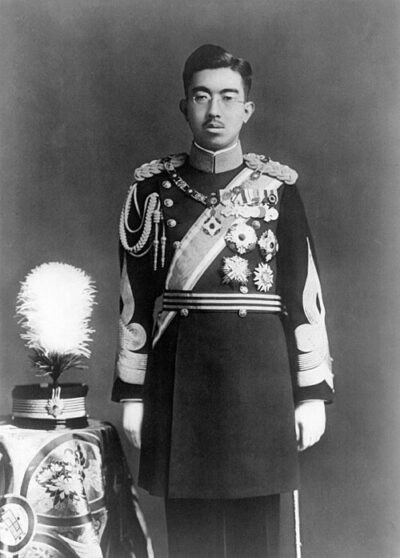
Hirohito
Hirohito was an emperor of Japan from 1926 to 1989. Born April 29, 1901, in Akasaka Estate. Died January 7, 1989, in Fukiage Gyoen. Positions held include Emperor of Japan (1926–1989) and Governor-General of the Philippines. Known for Hirohito surrender broadcast. Educated at Gakushūin. Awards include Knight of the Order of the Golden Fleece, Knight Grand Cross with Collar of the Order of Merit of the Italian Republic and Order of the White Eagle.
Facts
52 facts · 2 confirmed by two sources · 4 cited · 46 from one source
Where this comes from
Papalocal keeps its own record. It started from these sources; what each one said is kept here as it was copied, so a change on their side never changes this page by itself. Tap one to read its version.
What Wikidata says · copied November 16, 2026 · revision 2560452167
- Described as
- emperor of Japan from 1926 to 1989
- Other names
- Emperor Showa, Emperor Hirohito, Prince Michi, Emperor Shōwa, Showa, Shōwa
- Born
- April 29, 1901 · 1 reference
- Died
- January 7, 1989 · 1 reference
- Born in
- Akasaka Estate
- Died in
- Fukiage Gyoen
- Buried in
- Musashi Imperial Graveyard
- Cause of death
- duodenum adenocarcinoma
- Citizen of
- Japan; Empire of Japan (–1947)
- Occupation
- military personnel; diplomat; marine biologist; zoologist · 1 reference; monarch; aristocrat; scientific collector · 1 reference
- Positions held
- Emperor of Japan (1926–1989); Governor-General of the Philippines
- Education
- Gakushūin
- Member of
- Royal Society of London (1971–); Emperor Hirohito and Empress Nagako · 1 reference
- Known for
- Hirohito surrender broadcast
- Awards
- Knight of the Order of the Golden Fleece (1928) · 1 reference; Knight Grand Cross with Collar of the Order of Merit of the Italian Republic (1982) · 1 reference; Order of the White Eagle; Order of the Rising Sun with Paulownia Flowers, 1st class; Grand Cordon of the Supreme Order of the Chrysanthemum; Order of St. Andrew; Grand Cross Special Class of the Order of Merit of the Federal Republic of Germany; Order of the Golden Kite · 1 reference; Order of the Most Holy Annunciation · 1 reference; Order of the Rajamitrabhorn · 1 reference; Order of the Garter (1929) · 1 reference; Order of Seri Paduka Mahkota Brunei · 1 reference; Royal Order of the Seraphim (1919) · 1 reference; Order of the Elephant · 1 reference; Order of Ojaswi Rajanya · 1 reference
- Spouse
- Kōjun
- Children
- Shigeko Higashikuni; Sachiko, Princess Hisa; Kazuko Takatsukasa; Atsuko Ikeda; Akihito; Masahito, Prince Hitachi; Takako Shimazu
- Father
- Emperor Taishō
- Mother
- Empress Teimei
- Siblings
- Yasuhito, Prince Chichibu; Nobuhito, Prince Takamatsu; Takahito, Prince Mikasa
- Religion
- Shinto
- Military rank
- dai-gensui
- Height
- 1.65 m (5 ft 5 in)
- Wikipedias with a page
- 157
Wikidata item Q34479 (wikidata.org/wiki/Q34479), public domain (CC0). Copied November 16, 2026.
What Wikipedia says · copied November 16, 2026 · revision 1384928864
Hirohito (29 April 1901 – 7 January 1989), also known by his posthumous name Emperor Shōwa, was Emperor of Japan from 25 December 1926 until his death in 1989. He is the longest-reigning non-legendary emperor in Japanese history and one of the longest-reigning monarchs in the world. The Shōwa era that corresponded to his reign was initially characterized by heightened Japanese nationalism and militarism, developments which culminated in Japan's entry into World War II as an Axis power. After Japan's defeat in the war and under pressure from the victorious Allied powers, he renounced his divinity as Emperor via the Humanity Declaration and sanctioned a new Constitution for Japan based on parliamentary government and pacifism.
Hirohito was born during the reign of his paternal grandfather, Emperor Meiji, as the first child of Crown Prince Yoshihito and Crown Princess Sadako (later Emperor Taishō and Empress Teimei). When Emperor Meiji died in 1912, Hirohito's father ascended the Chrysanthemum Throne, and Hirohito was proclaimed Crown Prince of Japan in 1916, making him the heir apparent. In 1921, he made an official visit to six European countries, marking the first time a Japanese crown prince had traveled abroad. Due to his father's ill health, Hirohito became Sesshō of Japan (regent) that same year. In 1924, he married Princess Nagako Kuni, with whom he later had seven children: Shigeko, Sachiko, Kazuko, Atsuko, Akihito, Masahito and Takako. He became emperor upon his father's death in 1926.
As Japan's head of state, Emperor Hirohito oversaw the rise of militarism in Japanese politics. In 1931, he raised no objection when Japan's Kwantung Army staged the Mukden incident as a pretext for the invasion of Manchuria. Following the onset of the Second Sino-Japanese War in 1937, tensions steadily grew between Japan and the United States. After Hirohito formally sanctioned his government's decision to go to war against the U.S. and its allies on 1 December 1941, Japan entered World War II upon its military's attack on Pearl Harbor as well as its invasion of American and European colonies in Asia and the Pacific. After the atomic bombings of Hiroshima and Nagasaki and the Soviet invasion of Japanese-occupied Manchuria and Korea, Hirohito called upon the Imperial Japanese Armed Forces (IJAF) to surrender in a radio broadcast on 15 August 1945. While historians agree Hirohito was involved to at least some extent in Japan's military strategy and war crimes during the conflict, the degree of that involvement remains disputed.
Following Japan's surrender, Emperor Hirohito was never prosecuted for war crimes at the International Military Tribunal for the Far East (IMTFE), even though the war had been waged in his name. After the surrender, Japan came under Allied occupation, administered primarily by the United States. The Supreme Commander for the Allied Powers, U.S. General Douglas MacArthur, believed that a cooperative emperor would facilitate a peaceful occupation and support U.S. postwar objectives. MacArthur therefore excluded any evidence from the tribunal that could have incriminated Hirohito or other members of the Imperial House of Japan. In 1946, Hirohito was pressured by the Allies to renounce his divinity. Under Japan's post-war constitution, drafted by U.S. officials and enacted in 1947, his role as emperor was redefined as "the symbol of the State and of the unity of the People". He died at Fukiage Ōmiya Palace, aged 87, of a duodenal cancer (adenocarcinoma). He was succeeded by his elder son, Akihito, beginning the Heisei era.
- Born, in its opening lines
- April 29, 1901
- Died, in its opening lines
- January 7, 1989
From the Wikipedia article “Hirohito” (en.wikipedia.org/wiki/Hirohito), by its contributors, under CC BY-SA 4.0 (creativecommons.org/licenses/by-sa/4.0/). Copied November 16, 2026; not changed.
Confirmed Two sources agree. Cited One source, and it names where it got it. One source One source, without a reference of its own. Sources disagree The sources disagree. We show the best-supported value and keep theirs below.
