
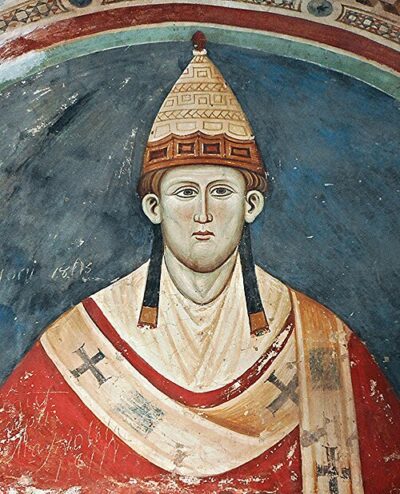
Innocent III
Innocent III was a Head of the Catholic Church from 1198 to 1216. Born 1160s, in Gavignano. Died July 16, 1216, in Perugia. Positions held include cardinal (1190–), Titular Patriarch of Alexandria (1215–1216) and Pope (1198–1216). Known for De miseria condicionis humane and De sacro altaris mysterio. Educated at University of Paris and University of Bologna.
Facts
18 facts · 0 confirmed by two sources · 8 cited · 8 from one source · 2 where the sources disagree
What’s different
- Born: we show 1160s (Sources disagree). Wikipedia says July 16, 1216
- Buried in: we show Archbasilica of St. John Lateran (1891–) (Sources disagree). Wikidata also lists Tomb of Innocentius III
Where this comes from
Papalocal keeps its own record. It started from these sources; what each one said is kept here as it was copied, so a change on their side never changes this page by itself. Tap one to read its version.
What Wikidata says · copied November 16, 2026 · revision 2569031578
- Described as
- Head of the Catholic Church from 1198 to 1216
- Other names
- Pope Innozenz III, papa Innocenzo III, Lothar of Segni, Innocentius PP. III, Lotario dei Conti di Segni, Innozenz III. Papst, Pope Innocentius III, Lotario di Segni, Pope Innocenzo III, pape Innocent III, Lothair of Segni, Pope Innocenz III
- Born
- 1160s · 1 reference
- Died
- July 16, 1216 · 3 references
- Born in
- Gavignano · 1 reference
- Died in
- Perugia · 2 references
- Buried in
- Archbasilica of St. John Lateran (1891–) · 1 reference; Tomb of Innocentius III · 1 reference
- Name at birth
- Lotario de' Conti di Segni
- Occupation
- Catholic priest; writer · 1 reference
- Positions held
- cardinal (1190–) · 1 reference; Titular Patriarch of Alexandria (1215–1216); Pope (1198–1216) · 1 reference
- Education
- University of Paris; University of Bologna · 1 reference
- Known for
- De miseria condicionis humane; De sacro altaris mysterio
- Father
- Trasimondo Conti, Conte di Segni · 1 reference
- Siblings
- Riccardo Conti
- Religion
- Catholic Church · 1 reference
- Wikipedias with a page
- 96
Wikidata item Q128076 (wikidata.org/wiki/Q128076), public domain (CC0). Copied November 16, 2026.
What Wikipedia says · copied November 16, 2026 · revision 1385560706
Pope Innocent III (Latin: Innocentius III; born Lotario de' Conti di Segni; 1160/1161 – 16 July 1216) was the head of the Catholic Church and sovereign of the Papal States from 8 January 1198 until his death in 1216.
Pope Innocent was one of the most powerful and influential of the medieval popes. He exerted a wide influence over the Christian states of Europe, claiming supremacy over all of Europe's kings. He was central in supporting the Catholic Church's reforms of ecclesiastical affairs through his decretals and the Fourth Lateran Council. This resulted in a considerable refinement of Western canon law. He is furthermore notable for using interdict and other censures to compel princes to obey his decisions, although these measures were not uniformly successful.
Innocent greatly extended the scope of the Crusades, directing crusades against Muslim Iberia and the Holy Land as well as the Livonian Crusade against the Baltic and Finnic pagans of Livonia and the Albigensian Crusade against the Cathars in southern France. He organized the Fourth Crusade of 1202–1204, which ended in the sack of Constantinople. Although the attack on Constantinople went against his explicit orders, and the Crusaders were subsequently excommunicated, Innocent reluctantly accepted this result, seeing it as the will of God to reunite the Latin and Eastern Orthodox Churches. In the event, the sack of Constantinople and the subsequent period of Frankokratia heightened the hostility between the Latin and Greek churches; the Byzantine Empire was restored in 1261, albeit in a much weaker state.
- Born, in its opening lines
- July 16, 1216
From the Wikipedia article “Pope Innocent III” (en.wikipedia.org/wiki/Pope_Innocent_III), by its contributors, under CC BY-SA 4.0 (creativecommons.org/licenses/by-sa/4.0/). Copied November 16, 2026; not changed.
Confirmed Two sources agree. Cited One source, and it names where it got it. One source One source, without a reference of its own. Sources disagree The sources disagree. We show the best-supported value and keep theirs below.
