
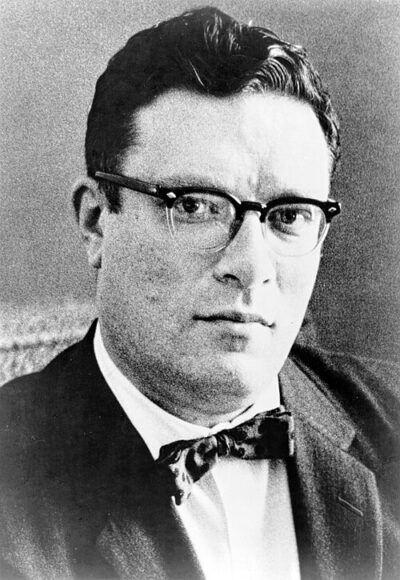
Isaac Asimov
Isaac Asimov was an American writer and biochemist. Born January 2, 1920, in Petrovichi. Died April 6, 1992, in Manhattan. Known for Foundation series, Robot series and Nightfall. Educated at Columbia University and Fu Foundation School of Engineering and Applied Science. Awards include Hugo Award, James T. Grady-James H. Stack Award for Interpreting Chemistry and Hugo Award for Best All-Time Series.
Facts
60 facts · 2 confirmed by two sources · 19 cited · 39 from one source
Where this comes from
Papalocal keeps its own record. It started from these sources; what each one said is kept here as it was copied, so a change on their side never changes this page by itself. Tap one to read its version.
What Wikidata says · copied November 13, 2026 · revision 2568763172
- Described as
- American writer and biochemist (1920–1992)
- Other names
- Paul French, Isaak Ozimov, Itzhak Ozimov, Asimov, Isaak Osimov
- Born
- January 2, 1920 · 4 references
- Died
- April 6, 1992 · 16 references
- Born in
- Petrovichi · 5 references
- Died in
- Manhattan
- Cause of death
- AIDS related disease
- Name at birth
- Исаáк Ази́мов · 1 reference
- Citizen of
- Russian Socialist Federative Soviet Republic; United States · 1 reference
- Occupation
- biochemist · 1 reference; novelist; prose writer; autobiographer; science fiction writer; science writer; non-fiction writer; university teacher · 1 reference
- Political party
- Democratic Party
- Worked for
- Boston University
- Education
- Columbia University (–1939) · 1 reference; Fu Foundation School of Engineering and Applied Science; Columbia University School of General Studies; Boys and Girls High School · 1 reference; Boys High School
- Member of
- American Academy of Arts and Sciences
- Genre
- science fiction
- Known for
- Foundation series; Robot series; Nightfall · 1 reference; The Intelligent Man's Guide to Science; I, Robot; The Bicentennial Man; The Gods Themselves; Youth
- Awards
- Hugo Award (1963); James T. Grady-James H. Stack Award for Interpreting Chemistry (1965); Hugo Award for Best All-Time Series (1966); Humanist of the Year (1984); Edward E. Smith Memorial Award (1967); Nebula Award for Best Novel (1973) · 1 reference; Locus Award for Best Novel (1973) · 1 reference; Hugo Award for Best Novel (2 times) (1973, 1983) · 1 reference; Klumpke-Roberts Award (1975); Nebula Award for Best Novelette (1977) · 1 reference; Locus Award for Best Novelette (1977) · 1 reference; Hugo Award for Best Novelette (2 times) (1977, 1992) · 1 reference; Locus Award for Best Science Fiction Novel (1983) · 1 reference; Damon Knight Memorial Grand Master Award (1987) · 1 reference; Locus Award for Best Short Story (1987) · 1 reference
- Field
- biochemistry · 1 reference
- Spouse
- Janet Asimov (1973–1992); Gertrude Asimov (1942–1973) · 1 reference
- Children
- Robyn Asimov · 1 reference
- Siblings
- Stanley Asimov
- Military branch
- United States Army
- Lived in
- Brooklyn (1923–1942) · 1 reference; Petrovichi (1920–1923) · 1 reference; Boston (1949–1970) · 1 reference; West Philadelphia (1942–1945) · 1 reference; Manhattan (1970–1992) · 2 references
- Website
- http://www.asimovonline.com/
- Wikipedias with a page
- 163
Wikidata item Q34981 (wikidata.org/wiki/Q34981), public domain (CC0). Copied November 13, 2026.
What Wikipedia says · copied November 13, 2026 · revision 1385476915
Isaac Asimov ( AZ-im-ov; c. January 2, 1920 – April 6, 1992) was an American writer and professor of biochemistry at Boston University. During his lifetime, Asimov was considered one of the "Big Three" science fiction writers, along with Robert A. Heinlein and Arthur C. Clarke. He wrote or edited more than 500 books and an estimated 90,000 letters and postcards. Best known for his hard science fiction, Asimov also wrote mysteries and fantasy, as well as popular science and other non-fiction. His work spans nine out of the ten categories of the Dewey decimal system.
Asimov's most famous work is the Foundation series about a fallen space empire. The first three books won the one-time Hugo Award for "Best All-Time Series" in 1966. His other major series are the Galactic Empire series and the Robot series, which include major works such as The Caves of Steel and The Naked Sun, both written in the mid-1950s. The Galactic Empire novels are set in the much earlier history of the same fictional universe as the Foundation series. Later, with Foundation and Earth (1986), he linked this distant future to the Robot series, creating a unified "future history" for his works. He also wrote more than 380 short stories, including "Nightfall", which in 1964 was voted the best short science fiction story of all time by the Science Fiction Writers of America. Asimov wrote the Lucky Starr series of juvenile science-fiction novels using the pen name Paul French.
Most of his popular science books explain concepts in a historical way, going as far back as possible to a time when the science in question was at its simplest stage. Examples include Guide to Science, the three-volume Understanding Physics, and Asimov's Chronology of Science and Discovery. He wrote on many other scientific and non-scientific topics, such as chemistry, astronomy, mathematics, history and literary criticism, including guides to the Bible and Shakespeare.
Asimov was the president of the American Humanist Association. Several entities have been named in his honor, including the asteroid (5020) Asimov, a crater on Mars, a Brooklyn elementary school, Honda's humanoid robot ASIMO, and four literary awards.
- Born, in its opening lines
- January 2, 1920
- Died, in its opening lines
- April 6, 1992
From the Wikipedia article “Isaac Asimov” (en.wikipedia.org/wiki/Isaac_Asimov), by its contributors, under CC BY-SA 4.0 (creativecommons.org/licenses/by-sa/4.0/). Copied November 13, 2026; not changed.
Confirmed Two sources agree. Cited One source, and it names where it got it. One source One source, without a reference of its own. Sources disagree The sources disagree. We show the best-supported value and keep theirs below.
