
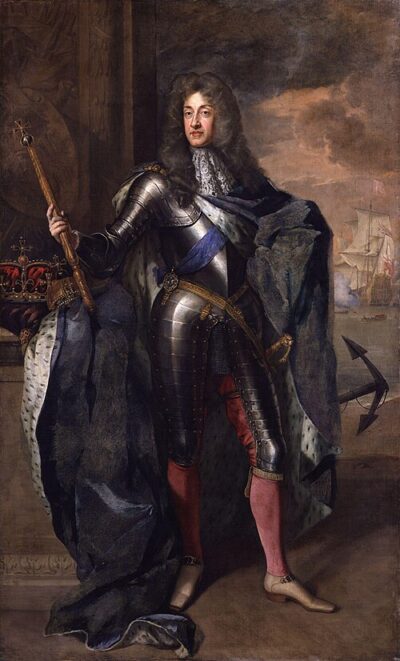
James II of England
James II of England was a King of England, Scotland, and Ireland from 1685 to 1688. Born October 14, 1633, in London. Died September 5, 1701, in Saint-Germain-en-Laye. Positions held include Monarch of Scotland (1685–1688), Monarch of England (1685–1688) and Duke of York (1633–1685). Awards include Fellow of the Royal Society, Knight of the Garter and Knight Companion of the Order of the Thistle.
Facts
50 facts · 1 confirmed by two sources · 19 cited · 29 from one source · 1 where the sources disagree
What’s different
- Died: we show September 5, 1701 (Sources disagree). Wikipedia says September 16, 1701
Where this comes from
Papalocal keeps its own record. It started from these sources; what each one said is kept here as it was copied, so a change on their side never changes this page by itself. Tap one to read its version.
What Wikidata says · copied November 16, 2026 · revision 2568753228
- Described as
- King of England, Scotland, and Ireland from 1685 to 1688 (1633–1701)
- Other names
- James, Duke of York and Albany, James II of England and VII of Scotland, James VII of Scotland, James VII, James VII and II, James, Duke of York Stuart, James II Stuart, King James II and VII, James II and VII, James II
- Born
- October 14, 1633 · 3 references
- Died
- September 5, 1701 · 1 reference
- Born in
- London · 1 reference
- Died in
- Saint-Germain-en-Laye · 1 reference
- Buried in
- Windsor Castle
- Cause of death
- cerebral hemorrhage
- Citizen of
- Kingdom of Scotland; Kingdom of England
- Occupation
- politician; slave trader · 1 reference; sovereign; monarch
- Positions held
- Monarch of Scotland (1685–1688); Monarch of England (1685–1688); Duke of York (1633–1685) · 1 reference; Duke of Normandy; King of Ireland (1685–1688); Jacobite pretender (1688–1701); Lord Warden of the Cinque Ports (1660–1673); Lord High Admiral (2 times) (1660–1688)
- Member of
- Royal Society of London (1665–)
- Awards
- Fellow of the Royal Society; Knight of the Garter (1642) · 1 reference; Knight Companion of the Order of the Thistle (1687)
- Spouse
- Anne, Duchess of York (1659–1671) · 3 references; Mary of Modena (1673–) · 2 references
- Children
- Mary II of England · 3 references; Anne of Great Britain · 2 references; James Francis Edward Stuart, Prince of Wales · 1 reference; Louisa Maria Stuart; Prince James, Duke of Cambridge; Henrietta FitzJames · 1 reference; James FitzJames, 1st Duke of Berwick · 1 reference; Henry FitzJames · 1 reference; Princess Isabel of York · 1 reference; Charles Stuart, Duke of Cambridge; Charles Stuart, Duke of Cambridge; Edgar Stuart, Duke of Cambridge
- Father
- Charles I of England · 2 references
- Mother
- Henrietta Maria of France · 2 references
- Siblings
- Henrietta of England · 2 references; Mary Henrietta, Princess Royal · 2 references; Princess Elizabeth of England; Princess Anne of England; Charles II of England · 2 references; Henry Stuart, Duke of Gloucester · 1 reference; Charles James Stuart, Duke of Cornwall; Catherine Stuart
- Religion
- Catholic Church
- Military rank
- admiral
- Wikipedias with a page
- 89
Wikidata item Q126188 (wikidata.org/wiki/Q126188), public domain (CC0). Copied November 16, 2026.
What Wikipedia says · copied November 16, 2026 · revision 1384800372
James II and VII (14 October 1633 O.S. – 16 September 1701) was King of England and Ireland as James II and King of Scotland as James VII from February 1685 until he was deposed in the 1688 Glorious Revolution. The last Catholic monarch of England, Scotland, and Ireland, his reign was marked by conflicts over religion, absolutism and the divine right of kings; his deposition ended a century of political and civil strife by confirming the primacy of the English Parliament over the Crown.
James was the second surviving son of Charles I of England and Henrietta Maria of France, and was created Duke of York at birth. His conversion to Catholicism in the 1660s caused growing concern, particularly during the Exclusion Crisis of 1679–81, when attempts were made by Whigs to exclude him from the succession on religious grounds. However, the trauma of the brief republican Commonwealth of England 20 years earlier made the public reluctant to undermine the principle of hereditary succession. At the age of 51, James therefore succeeded to the throne with widespread support following the death of his elder brother, Charles II, with many believing that a Catholic monarchy would be temporary. However, tolerance of James's personal views did not extend to Catholicism in general, and both the English and Scottish parliaments refused to pass measures viewed as undermining the primacy of the Protestant religion. His attempts to impose them by absolutist decrees, as a matter of his perceived divine right, were met with opposition.
In June 1688, two events turned dissent into a renewed crisis. Firstly, the birth of James's son and heir James Francis Edward Stuart on 10 June raised the prospect of a Catholic dynasty, displacing his Protestant daughter Mary, who had been heir presumptive. Secondly, the state prosecution of the Seven Bishops was seen as an assault on the Church of England, and their acquittal on 30 June heavily damaged his political authority. Ensuing anti-Catholic riots in England and Scotland led to a general feeling that only James's removal could prevent another civil war. Leading members of the English political class invited William of Orange, James's nephew and son-in-law, to assume the English throne. When William landed in Brixham on 5 November 1688, James's army deserted and he went into exile in France on 23 December. In February 1689, a special Convention Parliament held James had "vacated" the English throne and installed William and Mary as joint monarchs, thereby establishing the principle that sovereignty derived from Parliament, not birth. James landed in Ireland on 14 March 1689 in an attempt to recover his kingdoms, but, despite a simultaneous rising in Scotland, in April a Scottish Convention followed England in ruling that James had "forfeited" the throne, which was offered to William and Mary.
After his defeat at the Battle of the Boyne in July 1690, James returned to France, where he spent the rest of his life in exile at Saint-Germain, protected by Louis XIV. While contemporary opponents often portrayed him as an absolutist tyrant, some 20th-century historians have praised James for advocating religious tolerance, although more recent scholarship has tended to take a middle ground between these views.
- Born, in its opening lines
- October 14, 1633
- Died, in its opening lines
- September 16, 1701
From the Wikipedia article “James II of England” (en.wikipedia.org/wiki/James_II_of_England), by its contributors, under CC BY-SA 4.0 (creativecommons.org/licenses/by-sa/4.0/). Copied November 16, 2026; not changed.
Confirmed Two sources agree. Cited One source, and it names where it got it. One source One source, without a reference of its own. Sources disagree The sources disagree. We show the best-supported value and keep theirs below.
