
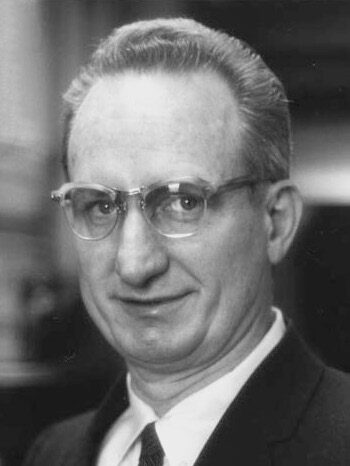
James Rainwater
James Rainwater was an American physicist. Born December 9, 1917, in Council. Died May 31, 1986, in New York City. Educated at California Institute of Technology and Columbia University. Awards include Nobel Prize in Physics, Fellow of the American Physical Society and IEEE Fellow.
Facts
19 facts · 2 confirmed by two sources · 6 cited · 11 from one source
What’s different
- Died: we show May 31, 1986 (Confirmed). Wikidata also lists May 30, 1986
Where this comes from
Papalocal keeps its own record. It started from these sources; what each one said is kept here as it was copied, so a change on their side never changes this page by itself. Tap one to read its version.
What Wikidata says · copied November 13, 2026 · revision 2567592787
- Described as
- American physicist
- Other names
- Leo James Rainwater, Leo Rainwater
- Born
- December 9, 1917 · 6 references
- Died
- May 31, 1986 · 4 references; May 30, 1986 · 2 references
- Born in
- Council · 1 reference
- Died in
- New York City · 1 reference
- Citizen of
- United States
- Occupation
- physicist · 1 reference; nuclear physicist; university teacher
- Worked for
- Columbia University
- Education
- California Institute of Technology; Columbia University
- Member of
- American Physical Society; National Academy of Sciences; American Association for the Advancement of Science · 1 reference
- Awards
- Nobel Prize in Physics (1975) · 2 references; Fellow of the American Physical Society; IEEE Fellow; Ernest Orlando Lawrence Award (1963) · 1 reference
- Field
- atomic physics
- Wikipedias with a page
- 65
Wikidata item Q190745 (wikidata.org/wiki/Q190745), public domain (CC0). Copied November 13, 2026.
What Wikipedia says · copied November 13, 2026 · revision 1366943943
Leo James Rainwater (December 9, 1917 – May 31, 1986) was an American physicist who shared the Nobel Prize in Physics in 1975 for his part in determining the asymmetrical shapes of certain atomic nuclei.
During World War II, he worked on the Manhattan Project that developed the first atomic bombs. In 1949, he began developing his theory that, contrary to what was then believed, not all atomic nuclei are spherical. His ideas were later tested and confirmed by Aage Bohr's and Ben Mottelson's experiments. He also contributed to the scientific understanding of X-rays and participated in the United States Atomic Energy Commission and naval research projects.
Rainwater joined the physics faculty at Columbia in 1946, where he reached the rank of full professor in 1952 and was named Pupin Professor of Physics in 1982. He received the Ernest Orlando Lawrence Award for Physics in 1963 and in 1975 was awarded the Nobel Prize in Physics, "for the discovery of the connection between collective motion and particle motion in atomic nuclei and the development of the theory of the structure of the atomic nucleus based on this connection".
- Born, in its opening lines
- December 9, 1917
- Died, in its opening lines
- May 31, 1986
From the Wikipedia article “James Rainwater” (en.wikipedia.org/wiki/James_Rainwater), by its contributors, under CC BY-SA 4.0 (creativecommons.org/licenses/by-sa/4.0/). Copied November 13, 2026; not changed.
Confirmed Two sources agree. Cited One source, and it names where it got it. One source One source, without a reference of its own. Sources disagree The sources disagree. We show the best-supported value and keep theirs below.
