
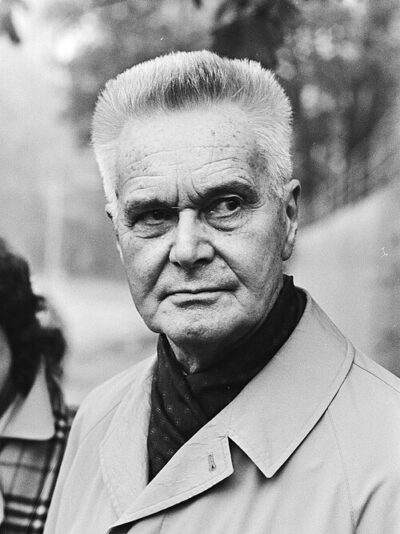
Jan Tinbergen
Jan Tinbergen was a Dutch economist. Born April 12, 1903, in The Hague. Died June 9, 1994, in The Hague. Positions held include Cleveringa chair (1973–1975). Known for Tinbergen theory. Educated at Leiden University. Awards include honorary doctor of the Katholieke Universiteit Leuven, Fellow of the American Statistical Association and Legatum Stolpianum.
Facts
41 facts · 2 confirmed by two sources · 22 cited · 17 from one source
Where this comes from
Papalocal keeps its own record. It started from these sources; what each one said is kept here as it was copied, so a change on their side never changes this page by itself. Tap one to read its version.
What Wikidata says · copied November 16, 2026 · revision 2567363161
- Described as
- Dutch economist (1903–1994)
- Other names
- J. Tinbergen
- Born
- April 12, 1903 · 11 references
- Died
- June 9, 1994 · 9 references
- Born in
- The Hague · 2 references
- Died in
- The Hague · 1 reference
- Buried in
- Oud Eik en Duinen · 1 reference
- Citizen of
- Kingdom of the Netherlands · 1 reference
- Occupation
- economist · 1 reference; university teacher · 1 reference
- Positions held
- Cleveringa chair (1973–1975) · 1 reference
- Political party
- Labour Party · 1 reference
- Worked for
- Netherlands School of Economics (1933–1973) · 1 reference; Bureau for Economic Policy Analysis (1945–1955) · 1 reference; Leiden University (1973–1975) · 1 reference; Statistics Netherlands (1927–1945) · 1 reference; Erasmus University Rotterdam
- Education
- Leiden University (1921–1926) · 1 reference
- Member of
- Royal Netherlands Academy of Arts and Sciences; Hungarian Academy of Sciences; American Academy of Arts and Sciences; National Academy of Sciences (1974–); Econometric Society (1933–) · 1 reference; Koninklijke Vlaamse Academie van België voor Wetenschappen en Kunsten · 1 reference; American Philosophical Society (1963–); Accademia Nazionale dei Lincei (1982–) · 1 reference
- Known for
- Tinbergen theory
- Awards
- honorary doctor of the Katholieke Universiteit Leuven; Fellow of the American Statistical Association; Legatum Stolpianum (1930); Fellow of the Econometric Society (1933) · 1 reference; honorary doctorate from the University of Strasbourg (1959) · 1 reference; doctor honoris causa from the University of Grenoble (1959) · 1 reference; honorary doctor of the University of Bordeaux (1964) · 1 reference; Erasmus Prize (1967) · 1 reference; Prize in Economic Sciences in Memory of Alfred Nobel (1969) · 1 reference; doctor honoris causa from the University of Paris (1970) · 1 reference; De Gouden Ganzenveer (1985); Four Freedoms Award – Freedom from Want (1992) · 1 reference
- Field
- economics · 1 reference
- Father
- D. C. Tinbergen
- Siblings
- Nikolaas Tinbergen; Luuk Tinbergen
- Wikipedias with a page
- 71
Wikidata item Q183181 (wikidata.org/wiki/Q183181), public domain (CC0). Copied November 16, 2026.
What Wikipedia says · copied November 16, 2026 · revision 1381842423
Jan Tinbergen ( TIN-bur-gən, Dutch: [jɑn ˈtɪmbɛrɣə(n)]; 12 April 1903 – 9 June 1994) was a Dutch economist who was awarded the first Nobel Memorial Prize in Economic Sciences in 1969, which he shared with Ragnar Frisch for having developed and applied dynamic models for the analysis of economic processes. He is widely considered to be one of the most influential economists of the 20th century and one of the founding fathers of econometrics.
His important contributions to econometrics include the development of the first macroeconometric models, the solution of the identification problem, and the understanding of dynamic models. Tinbergen was a founding trustee of Economists for Peace and Security. In 1945, he founded the Bureau for Economic Policy Analysis (CPB) and was the agency's first director.
- Born, in its opening lines
- April 12, 1903
- Died, in its opening lines
- June 9, 1994
From the Wikipedia article “Jan Tinbergen” (en.wikipedia.org/wiki/Jan_Tinbergen), by its contributors, under CC BY-SA 4.0 (creativecommons.org/licenses/by-sa/4.0/). Copied November 16, 2026; not changed.
Confirmed Two sources agree. Cited One source, and it names where it got it. One source One source, without a reference of its own. Sources disagree The sources disagree. We show the best-supported value and keep theirs below.
