
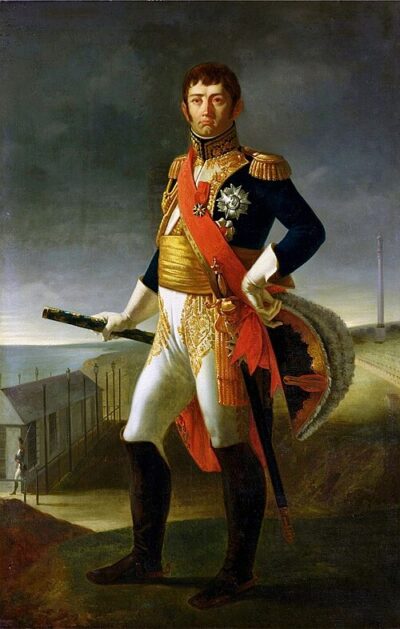
Jean-de-Dieu Soult
Jean-de-Dieu Soult was a Prime Minister of France (1832–1834, 1834–1839, 1840–1847) and French Marshal. Born March 29, 1769, in Saint-Amans-Soult. Died November 26, 1851, in Saint-Amans-Soult. Positions held include Minister of War, head of government of France (2 times) (1832–1847) and Pair of France. Awards include Grand Cross of the Legion of Honour, Marshal of the Empire and Knight Commander of the Order of Saint Louis.
Facts
39 facts · 2 confirmed by two sources · 3 cited · 34 from one source
Where this comes from
Papalocal keeps its own record. It started from these sources; what each one said is kept here as it was copied, so a change on their side never changes this page by itself. Tap one to read its version.
What Wikidata says · copied November 16, 2026 · revision 2568783247
- Described as
- Prime Minister of France (1832–1834, 1834–1839, 1840–1847) and French Marshal (born 1769–1851)
- Other names
- Nicolas Jean de Dieu Soult, duc de Dalmatie, Jean de Dieu Soult, 1st Duke of Dalmatia, Marshal Soult, Nicolas-Jean de Dieu Soult
- Born
- March 29, 1769 · 8 references
- Died
- November 26, 1851 · 9 references
- Born in
- Saint-Amans-Soult
- Died in
- Saint-Amans-Soult
- Buried in
- Saint-Amans-Soult
- Citizen of
- France
- Occupation
- politician; military personnel; art collector · 1 reference; duke · 1 reference
- Positions held
- Minister of War; head of government of France (2 times) (1832–1847); Pair of France; Peer of France; defence minister · 1 reference
- Political party
- independent politician
- Awards
- Grand Cross of the Legion of Honour; Marshal of the Empire (1804–); Knight Commander of the Order of Saint Louis; Knight of the Order of the Holy Spirit; Knight of the Order of Saint Michael; Knight of the Order of the Golden Fleece; list of names inscribed on the Arc de Triomphe; Grand Cross of the Order of the Redeemer; Grand Officer of the Legion of Honour · 1 reference; Knight of the Legion of Honour · 1 reference; Royal Order of the Seraphim · 1 reference
- Spouse
- Louise Berg
- Children
- Napoléon-Hector Soult de Dalmatie; Joséphine Louise Hortense Soult
- Father
- Jean Soult
- Mother
- Brigitte de Grenier
- Siblings
- Jean-François Soult; Pierre Benoît Soult
- Religion
- Catholic Church
- Military branch
- infantry
- Military rank
- Marshal of the Empire; general · 1 reference
- Lived in
- hôtel du Périgord
- Wikipedias with a page
- 46
Wikidata item Q296023 (wikidata.org/wiki/Q296023), public domain (CC0). Copied November 16, 2026.
What Wikipedia says · copied November 16, 2026 · revision 1382983746
Marshal General Jean-de-Dieu Soult, 1st Duke of Dalmatia (English: SOOLT, French: [ʒɑ̃dədjø sult]; 29 March 1769 – 26 November 1851) was a French military commander and statesman. He was a Marshal of the Empire during the Napoleonic Wars, and served three times as President of the Council of Ministers (prime minister) of France. Soult is referred to as one of the outstanding military commanders of the modern era.
Son of a country notary from southern France, Soult enlisted in the French Royal Army in 1785 and quickly rose through the ranks during the French Revolution. He was promoted to brigade general after distinguishing himself at the Battle of Fleurus in 1794, and by 1799 he was a division general. He fought a drawn battle against equally numbered troops of Alexander Suvorov at Glarus in 1799 and in the same year notably defeated the Austrians under the lead of Friedrich von Hotze at the Linth River as Hotze died at the very beginning of battle leaving his Austrians without organization.
In 1804, Napoleon made Soult one of his first eighteen Marshals of the Empire. Soult played a key role in many of Napoleon's campaigns, most notably in the Ulm campaign (e.g., Battle of Memmingen) and at the Battle of Austerlitz, where his corps delivered the decisive attack that secured French victory. He was subsequently created Duke of Dalmatia. From 1808, he commanded French forces during the Peninsular War. At the Battle of Corunna, Soult clashed with the British under generals John Moore and John Hope; during Soult's attack, his troops were outflanked by numerically superior infantry and retreated to their original positions as did the British troops, but eventually the battlefield remained his due to the British retreat to their ships, thus Spain was left without British support for a while. At the Battle of Albuera, against superior Anglo-allied forces of general William Beresford, he again fought to a draw.
Despite several initial victories, for instance at the Battle of Ocaña, Soult was eventually outmaneuvered and driven out of Spain by the coalition forces under the command of Arthur Wellesley (later Duke of Wellington), which were superior to the army given to Soult in terms of the quality of troops and supplies. Soult then stubbornly fought Wellington at Toulouse in 1814, days after Napoleon's first abdication. Soult declared himself a royalist following the First Bourbon Restoration, but rejoined Napoleon during the Hundred Days. He was Napoleon's chief of staff during the Waterloo campaign in 1815, where the emperor suffered a final defeat; in this role Soult proved himself less capable than as a field commander.
Following the second restoration, Soult went into exile in Germany. In 1819 he was recalled to France and returned to royal favour, and in 1830 he was made Minister of War after the July Revolution. Soult oversaw reforms of the French military and was responsible for the creation of the French Foreign Legion. Under King Louis Philippe I, he was three times French prime minister from 1832 to 1834, almost a year between 1839 and 1840 and from 1840 to 1847. In 1847, he was awarded the title Marshal General of France. Soult again declared himself a Republican after Louis Philippe's overthrow in the French Revolution of 1848. He died in 1851.
During his military career, Soult amassed a large collection of paintings, many during his time in Spain. The collection was dispersed in a sale following Soult's death.
- Born, in its opening lines
- March 29, 1769
- Died, in its opening lines
- November 26, 1851
From the Wikipedia article “Jean-de-Dieu Soult” (en.wikipedia.org/wiki/Jean-de-Dieu_Soult), by its contributors, under CC BY-SA 4.0 (creativecommons.org/licenses/by-sa/4.0/). Copied November 16, 2026; not changed.
Confirmed Two sources agree. Cited One source, and it names where it got it. One source One source, without a reference of its own. Sources disagree The sources disagree. We show the best-supported value and keep theirs below.
