
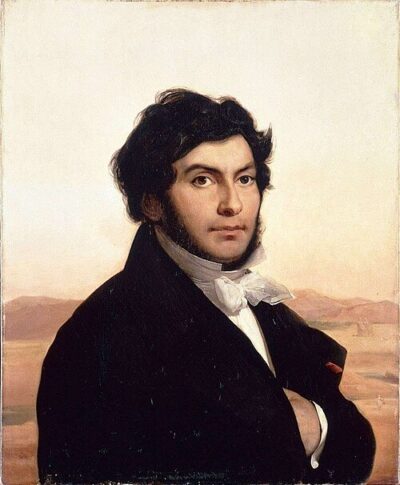
Jean-François Champollion
Jean-François Champollion was a French classical scholar. Born December 23, 1790, in Figeac. Died March 4, 1832, in Paris. Known for Précis du système hiéroglyphique des anciens Égyptiens and Bulletin universel des sciences et de l'industrie. Educated at Collège de France and Institut national des langues et civilisations orientales. Awards include Knight of the Legion of Honour and Order of Saint Joseph.
Facts
45 facts · 2 confirmed by two sources · 23 cited · 18 from one source · 2 where the sources disagree
What’s different
- Buried in: we show Père Lachaise Cemetery (Sources disagree). Wikidata also lists Grave of Champollion
- Cause of death: we show cardiac arrest (Sources disagree). Wikidata also lists stroke
Where this comes from
Papalocal keeps its own record. It started from these sources; what each one said is kept here as it was copied, so a change on their side never changes this page by itself. Tap one to read its version.
What Wikidata says · copied November 16, 2026 · revision 2565598810
- Described as
- French classical scholar (1790-1832)
- Other names
- Jean Francois Champollion, Jean François Champollion, Jean-Francois Champollion, Champollion
- Born
- December 23, 1790 · 10 references
- Died
- March 4, 1832 · 14 references
- Born in
- Figeac · 4 references
- Died in
- Paris · 5 references
- Buried in
- Père Lachaise Cemetery · 1 reference; Grave of Champollion
- Cause of death
- cardiac arrest; stroke
- Citizen of
- France
- Occupation
- Egyptologist · 1 reference; linguist · 2 references; philosopher; epigrapher; professor · 1 reference; author · 1 reference; entomologist; university teacher · 1 reference
- Worked for
- Collège de France (1831–1832) · 1 reference; University of Grenoble (1810–1815) · 1 reference; Department of Egyptian Antiquities of the Louvre (1826–1832) · 1 reference
- Education
- Collège de France (1808–1810) · 1 reference; Institut national des langues et civilisations orientales (1808–1810) · 1 reference; Lycée Stendhal (1804–1807) · 1 reference
- Member of
- Société Asiatique; Académie des Inscriptions et Belles-Lettres (1830–1832) · 2 references; German Archaeological Institute; Royal Netherlands Academy of Arts and Sciences (1824–) · 1 reference; Russian Academy of Sciences (1826–) · 1 reference; Royal Swedish Academy of Letters, History and Antiquities; Academy of Sciences of Turin (1825–) · 1 reference; Académie delphinale (1808–) · 1 reference; Accademia delle Arti del Disegno; Göttingen Academy of Sciences and Humanities in Lower Saxony (1826–) · 1 reference
- Known for
- Précis du système hiéroglyphique des anciens Égyptiens; Bulletin universel des sciences et de l'industrie
- Awards
- Knight of the Legion of Honour (1825) · 1 reference; Order of Saint Joseph
- Field
- Egyptian hieroglyphs; history · 1 reference; linguistics; Egyptology
- Spouse
- Rosine Blanc (1818–) · 1 reference
- Children
- Zoraide Eulalie Champollion
- Father
- Jacques Champollion
- Siblings
- Jacques-Joseph Champollion · 1 reference; Thérèse Champollion; Marie Champollion
- Wikipedias with a page
- 86
Wikidata item Q260 (wikidata.org/wiki/Q260), public domain (CC0). Copied November 16, 2026.
What Wikipedia says · copied November 16, 2026 · revision 1372772687
Jean-François Champollion (French: [ʒɑ̃ fʁɑ̃swa ʃɑ̃pɔljɔ̃]), also known as Champollion le jeune ('the Younger'; 23 December 1790 – 4 March 1832), was a French philologist and orientalist, known primarily as the decipherer of Egyptian hieroglyphs and a founding figure in the field of Egyptology. Partially raised by his brother, the scholar Jacques Joseph Champollion-Figeac, Champollion was a child prodigy in philology, giving his first public paper on the decipherment of Demotic in his late teens. As a young man he was renowned in scientific circles, and read Coptic, Ancient Greek, Latin, Hebrew and Arabic.
During the early 19th century, French culture experienced a period of 'Egyptomania', brought on by Napoleon's discoveries in Egypt during his campaign there (1798–1801), which also brought to light the trilingual Rosetta Stone. Scholars debated the age of Egyptian civilization and the function and nature of the hieroglyphic script, which language if any it recorded, and the degree to which the signs were phonetic (representing speech sounds) or ideographic (recording semantic concepts directly). Many thought that the script was used only for sacred and ritual functions, and that as such it was unlikely to be decipherable since it was tied to esoteric and philosophical ideas, and did not record historical information. The significance of Champollion's decipherment was that he showed these assumptions to be wrong, and made it possible to begin to retrieve many kinds of information recorded by the ancient Egyptians.
Champollion lived in a period of political turmoil in France, which continuously threatened to disrupt his research in various ways. During the Napoleonic Wars, he was able to avoid conscription, but his Napoleonic allegiances meant that he was considered suspect by the subsequent Royalist regime. His own actions, sometimes brash and reckless, did not help his case. His relations with important political and scientific figures of the time, such as Joseph Fourier and Silvestre de Sacy, helped him, although in some periods he lived exiled from the scientific community.
In 1820, Champollion embarked in earnest on the project of the decipherment of hieroglyphic script, soon overshadowing the achievements of British polymath Thomas Young, who had made the first advances in decipherment before 1819. In 1822, Champollion published his first breakthrough in the decipherment of the Rosetta hieroglyphs, showing that the Egyptian writing system was a combination of phonetic and ideographic signs – the first such script discovered. In 1824, he published a Précis in which he detailed a decipherment of the hieroglyphic script demonstrating the values of its phonetic and ideographic signs. In 1829, he travelled to Egypt where he was able to read many hieroglyphic texts that had never before been studied and brought home a large body of new drawings of hieroglyphic inscriptions. Home again, he was given a professorship in Egyptology but lectured only a few times before his health, ruined by the hardships of the Egyptian journey, forced him to give up teaching. He died in Paris in 1832, 41 years old. His grammar of Ancient Egyptian was published posthumously under the supervision of his brother.
During his life as well as long after his death, intense discussions over the merits of his decipherment were carried out among Egyptologists. Some faulted him for not having given sufficient credit to the early discoveries of Young, accusing him of plagiarism, and others long disputed the accuracy of his decipherments. However, subsequent findings and confirmations of his readings by scholars building on his results gradually led to the general acceptance of his work. Although some still argue that he should have acknowledged the contributions of Young, his decipherment is now universally accepted and has been the basis for all further developments in the field. Consequently, he is regarded as the "Founder and Father of Egyptology".
- Born, in its opening lines
- December 23, 1790
- Died, in its opening lines
- March 4, 1832
From the Wikipedia article “Jean-François Champollion” (en.wikipedia.org/wiki/Jean-François_Champollion), by its contributors, under CC BY-SA 4.0 (creativecommons.org/licenses/by-sa/4.0/). Copied November 16, 2026; not changed.
Confirmed Two sources agree. Cited One source, and it names where it got it. One source One source, without a reference of its own. Sources disagree The sources disagree. We show the best-supported value and keep theirs below.
