
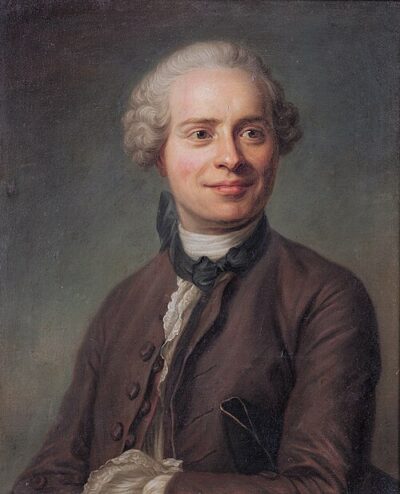
Jean Le Rond d'Alembert
Jean Le Rond d'Alembert was a French mathematician, mechanician, physicist, philosopher and music theorist. Born November 16, 1717, in Paris. Died October 29, 1783, in Paris. Positions held include perpetual secretary of the French Academy (1772–1783) and Member of the Académie française (1754–1783). Known for d'Alembert's paradox, d'Alembert operator and Encyclopédie. Educated at University of Paris and Collège des Quatre-Nations. Awards include Fellow of the Royal Society and Fellow of the American Academy of Arts and Sciences.
Facts
47 facts · 2 confirmed by two sources · 22 cited · 23 from one source
Where this comes from
Papalocal keeps its own record. It started from these sources; what each one said is kept here as it was copied, so a change on their side never changes this page by itself. Tap one to read its version.
What Wikidata says · copied November 16, 2026 · revision 2564793770
- Described as
- French mathematician, mechanician, physicist, philosopher and music theorist (1717-1783)
- Other names
- Jean Le Rond, Jean Le Rond D'Alembert, Jean Le Rond d' Alembert, D'Alembert, Jean-Baptiste Le Rond d'Alembert, Jean le Rond d'Alembert
- Born
- November 16, 1717 · 11 references
- Died
- October 29, 1783 · 13 references
- Born in
- Paris · 9 references
- Died in
- Paris · 8 references
- Buried in
- Catacombs of Paris (1825–); cimetière Saint-Eustache (–1825) · 2 references
- Name at birth
- Jean Baptiste Louis d’Aremberg · 2 references
- Citizen of
- Kingdom of France · 1 reference
- Occupation
- philosopher · 3 references; mathematician · 4 references; physicist · 3 references; musicologist; translator · 1 reference; writer · 4 references; music theorist; encyclopédistes · 1 reference
- Positions held
- perpetual secretary of the French Academy (1772–1783); Member of the Académie française (1754–1783) · 1 reference
- Education
- University of Paris (–1738) · 1 reference; Collège des Quatre-Nations (–1735) · 1 reference
- Member of
- Royal Society of London (1748–); Académie Française (1754–1783) · 1 reference; Royal Prussian Academy of Sciences (1746–) · 1 reference; French Academy of Sciences (1754–); Saint Petersburg Academy of Sciences (1773–) · 1 reference; American Academy of Arts and Sciences (1781–); Royal Norwegian Society of Sciences and Letters; Royal Swedish Academy of Letters, History and Antiquities; Academy of Sciences of Turin · 1 reference; Diderot and d'Alembert
- Known for
- d'Alembert's paradox (1752); d'Alembert operator; Encyclopédie; ratio test; D'Alembert's principle; D'Alembert's equation; d'Alembert's formula; Traité de dynamique · 1 reference; Éloge historique de M. Jean Bernoulli · 1 reference; Éloges lus dans les séances publiques de l’Académie françoise
- Awards
- Fellow of the Royal Society; Fellow of the American Academy of Arts and Sciences (1781–) · 1 reference
- Field
- mathematics; mechanics
- Father
- Léopold Philippe d'Arenberg · 1 reference
- Mother
- Claudine Guérin de Tencin · 3 references
- Religion
- atheism
- Wikipedias with a page
- 115
Wikidata item Q153232 (wikidata.org/wiki/Q153232), public domain (CC0). Copied November 16, 2026.
What Wikipedia says · copied November 16, 2026 · revision 1377846210
Jean Le Rond d'Alembert ( DAL-əm-BAIR; French: [ʒɑ̃ lə ʁɔ̃ dalɑ̃bɛʁ]; 16 November 1717 – 29 October 1783) was a French mathematician, physicist, philosopher, and music theorist. Until 1759 he was, together with Denis Diderot, a co-editor of the Encyclopédie.
His most famous achievements include the wave equation, also known as d'Alembert's equation, and D'Alembert's formula for solving said equation. In French, the fundamental theorem of algebra is named in his honour.
- Born, in its opening lines
- November 16, 1717
- Died, in its opening lines
- October 29, 1783
From the Wikipedia article “Jean Le Rond d'Alembert” (en.wikipedia.org/wiki/Jean_Le_Rond_d'Alembert), by its contributors, under CC BY-SA 4.0 (creativecommons.org/licenses/by-sa/4.0/). Copied November 16, 2026; not changed.
Confirmed Two sources agree. Cited One source, and it names where it got it. One source One source, without a reference of its own. Sources disagree The sources disagree. We show the best-supported value and keep theirs below.
