
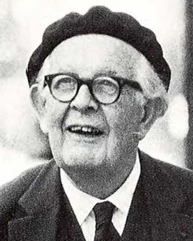
Jean Piaget
Jean Piaget was a Swiss psychologist, biologist, logician, philosopher and academic. Born August 9, 1896, in Neuchâtel. Died September 16, 1980, in Geneva. Educated at University of Neuchâtel. Awards include doctor honoris causa from the University of Paris, doctor honoris causa from the University of Aix-Marseille and APA Award for Distinguished Scientific Contributions to Psychology.
Facts
46 facts · 2 confirmed by two sources · 18 cited · 26 from one source
Where this comes from
Papalocal keeps its own record. It started from these sources; what each one said is kept here as it was copied, so a change on their side never changes this page by itself. Tap one to read its version.
What Wikidata says · copied November 16, 2026 · revision 2564003926
- Described as
- Swiss psychologist, biologist, logician, philosopher and academic (1896–1980)
- Other names
- Jean William Fritz Piaget
- Born
- August 9, 1896 · 14 references
- Died
- September 16, 1980 · 14 references
- Born in
- Neuchâtel · 3 references
- Died in
- Geneva · 2 references
- Buried in
- Cemetery of Kings · 1 reference
- Name at birth
- Jean William Fritz Piaget
- Citizen of
- Switzerland
- Occupation
- psychologist · 3 references; zoologist; logician; philosopher · 1 reference; university teacher; malacologist · 1 reference; pedagogue; biologist · 1 reference
- Worked for
- University of Paris; University of Zurich; University of Geneva (1929–1971) · 1 reference; University of Lausanne (1938–1951) · 1 reference; International Bureau of Education (1929–1967); University of Neuchâtel (1925–1929)
- Education
- University of Neuchâtel
- Member of
- American Academy of Arts and Sciences; National Academy of Sciences (1966–); Accademia Nazionale dei Lincei (1951–) · 1 reference
- Awards
- doctor honoris causa from the University of Paris (1947) · 2 references; doctor honoris causa from the University of Aix-Marseille (1963) · 1 reference; APA Award for Distinguished Scientific Contributions to Psychology (1969) · 1 reference; Award for Distinguished Contributions to Developmental Psychology (1971) · 1 reference; Erasmus Prize (1972) · 1 reference; Career Achievement Award for Distinguished Psychological Contributions to Education (1976) · 1 reference; Balzan Prize (1979); Honorary Fellow of the British Psychological Society
- Field
- psychology; developmental psychology · 1 reference; cognitive psychology · 1 reference; biology · 1 reference; logic · 1 reference; philosophy · 1 reference
- Spouse
- Valentine Piaget (1923–)
- Father
- Arthur Piaget
- Mother
- Rebecca Suzanne Jackson
- Siblings
- Madeleine Piaget · 1 reference; Marthe Piaget · 1 reference
- Religion
- Roman Catholic; reformed · 1 reference
- Wikipedias with a page
- 106
Wikidata item Q123190 (wikidata.org/wiki/Q123190), public domain (CC0). Copied November 16, 2026.
What Wikipedia says · copied November 16, 2026 · revision 1371941987
Jean William Fritz Piaget (9 August 1896 – 16 September 1980) was a Swiss psychologist known for his work on child development. Piaget's theory of cognitive development and epistemological view are together called genetic epistemology.
Piaget placed great importance on the education of children. As the Director of the International Bureau of Education, he declared in 1934 that "only education is capable of saving our societies from possible collapse, whether violent, or gradual". His theory of child development has been studied in pre-service education programs. Nowadays, educators and theorists working in the area of early childhood education persist in incorporating constructivist-based strategies.
Piaget created the International Center for Genetic Epistemology in Geneva in 1955 while on the faculty of the University of Geneva, and directed the center until his death in 1980. The number of collaborations that its founding made possible, and their impact, ultimately led to the Center being referred to in the scholarly literature as "Piaget's factory".
According to Ernst von Glasersfeld, Piaget was "the great pioneer of the constructivist theory of knowing". His ideas were widely popularized in the 1960s. This then led to the emergence of the study of development as a major sub-discipline in psychology. By the end of the 20th century, he was second only to B. F. Skinner as the most-cited psychologist.
- Born, in its opening lines
- August 9, 1896
- Died, in its opening lines
- September 16, 1980
From the Wikipedia article “Jean Piaget” (en.wikipedia.org/wiki/Jean_Piaget), by its contributors, under CC BY-SA 4.0 (creativecommons.org/licenses/by-sa/4.0/). Copied November 16, 2026; not changed.
Confirmed Two sources agree. Cited One source, and it names where it got it. One source One source, without a reference of its own. Sources disagree The sources disagree. We show the best-supported value and keep theirs below.
