
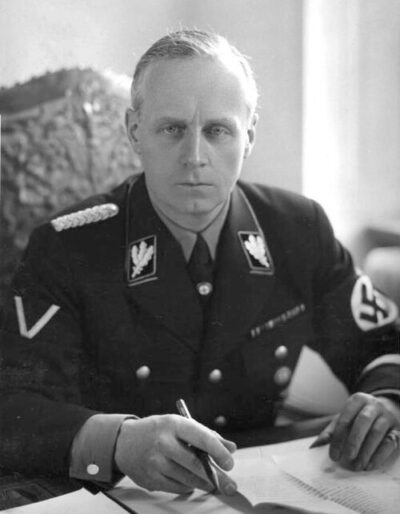
Joachim von Ribbentrop
Joachim von Ribbentrop was a German Foreign Minister of Nazi Germany. Born April 30, 1893, in Wesel. Died October 16, 1946, in Nuremberg Court Prison. Positions held include member of the Reichstag of Nazi Germany, German Foreign Minister (1938–1945) and ambassador of the German Reich (1936–1938). Educated at Lycée Fabert. Awards include Collar of the Order of Isabella the Catholic, Golden Party Badge and Iron Cross (1914), 2nd class.
Facts
48 facts · 2 confirmed by two sources · 24 cited · 22 from one source
Where this comes from
Papalocal keeps its own record. It started from these sources; what each one said is kept here as it was copied, so a change on their side never changes this page by itself. Tap one to read its version.
What Wikidata says · copied November 16, 2026 · revision 2568740291
- Described as
- German Foreign Minister of Nazi Germany (1893–1946)
- Other names
- Ullrich Friedrich Willy Joachim von Ribbentrop, Ullrich Friedrich Willy Joachim Ribbentrop, Ulrich Friedrich-Wilhelm Joachim von Ribbentrop
- Born
- April 30, 1893 · 14 references
- Died
- October 16, 1946 · 14 references
- Born in
- Wesel · 3 references
- Died in
- Nuremberg Court Prison · 1 reference
- Buried in
- Wenzbach · 1 reference
- Cause of death
- hanging to death · 1 reference
- Name at birth
- Ulrich Friedrich Wilhelm Joachim Ribbentrop
- Citizen of
- Germany
- Occupation
- politician · 1 reference; diplomat · 2 references
- Positions held
- member of the Reichstag of Nazi Germany · 1 reference; German Foreign Minister (1938–1945) · 1 reference; ambassador of the German Reich (1936–1938) · 1 reference; Federal Minister for Foreign Affairs (1938–1945) · 1 reference
- Political party
- Nazi Party (1930–) · 2 references
- Education
- Lycée Fabert
- Member of
- Schutzstaffel · 1 reference; Travellers Club
- Awards
- Collar of the Order of Isabella the Catholic (1939) · 2 references; Golden Party Badge; Iron Cross (1914), 2nd class · 1 reference; Order of the German Eagle (1938); Order of the Most Holy Annunciation (1939); Knight Grand Cross of the Order of Saints Maurice and Lazarus; Knight grand cross of the order of the crown of Italy; Grand Cross with Collar of the Order of the White Rose of Finland (1942) · 1 reference; Order of Saint Stephen of Hungary; Order of Isabella the Catholic · 1 reference; Imperial Order of the Yoke and Arrows · 1 reference; National Order of Merit Carlos Manuel de Céspedes · 1 reference; Honour Chevron for the Old Guard · 2 references; Danzig Cross 1st Class · 2 references; Order of Saints Cyril and Methodius Equal-to-apostles (1940) · 1 reference
- Spouse
- Annelies von Ribbentrop (1920–) · 1 reference
- Children
- Rudolf von Ribbentrop · 1 reference; Bettina von Ribbentrop · 1 reference; Ursula von Ribbentrop · 1 reference; Adolf Richard von Ribbentrop · 1 reference; Barthold von Ribbentrop · 2 references
- Father
- Richard Ribbentrop · 1 reference
- Mother
- Johanne Sophie Hertwig · 1 reference
- Military rank
- Oberleutnant · 1 reference; Obergruppenführer (1938–1945) · 1 reference
- Lived in
- Switzerland · 1 reference; England · 1 reference; Canada · 1 reference; Germany · 1 reference; Dahlem · 1 reference
- Wikipedias with a page
- 89
Wikidata item Q101886 (wikidata.org/wiki/Q101886), public domain (CC0). Copied November 16, 2026.
What Wikipedia says · copied November 16, 2026 · revision 1384282296
Ulrich Friedrich-Wilhelm Joachim von Ribbentrop (German: [joˈʔaxɪm fɔn ˈʁɪbəntʁɔp]; 30 April 1893 – 16 October 1946) was a German politician, diplomat, and war criminal who served as Minister of Foreign Affairs of Nazi Germany from 1938 to 1945.
Ribbentrop first came to Adolf Hitler's notice as a well-travelled businessman with more knowledge of the outside world than most senior Nazis and as a perceived authority on foreign affairs. He offered his house Schloss Fuschl for the secret meetings in January 1933 that resulted in Hitler's appointment as Chancellor of Germany. He became a close confidant of Hitler, to the dismay of some party members, who thought him unintelligent, superficial and lacking in talent. He was appointed ambassador to the Court of St James's, the royal court of the United Kingdom, in 1936 and then Foreign Minister of Germany in February 1938.
Before World War II, he played a key role in brokering the Pact of Steel (an alliance with Fascist Italy) and the Molotov–Ribbentrop Pact (the German–Soviet non-aggression pact). He favoured retaining good relations with the Soviet Union, opposing the invasion of the Soviet Union. In late 1941, due to American aid to Britain and the increasingly frequent "incidents" in the North Atlantic between U-boats and American warships guarding convoys to Britain, Ribbentrop worked for the failure of the Japanese-American talks in Washington and for Japan to attack the United States. He did his utmost to support a declaration of war on the United States after the attack on Pearl Harbor. From 1941 onwards, Ribbentrop's influence declined.
Arrested in June 1945, Ribbentrop was convicted and sentenced to death at the Nuremberg trials for his role in starting World War II in Europe and enabling the Holocaust. On 16 October 1946, he became the first of the Nuremberg defendants to be executed by hanging.
- Born, in its opening lines
- April 30, 1893
- Died, in its opening lines
- October 16, 1946
From the Wikipedia article “Joachim von Ribbentrop” (en.wikipedia.org/wiki/Joachim_von_Ribbentrop), by its contributors, under CC BY-SA 4.0 (creativecommons.org/licenses/by-sa/4.0/). Copied November 16, 2026; not changed.
Confirmed Two sources agree. Cited One source, and it names where it got it. One source One source, without a reference of its own. Sources disagree The sources disagree. We show the best-supported value and keep theirs below.
