
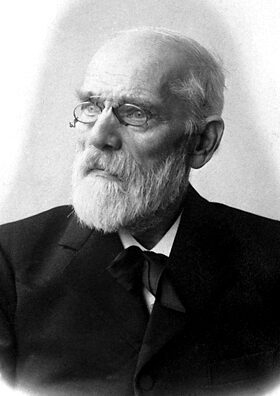
Johannes Diderik van der Waals
Johannes Diderik van der Waals was a Dutch physicist. Born November 23, 1837, in Leiden. Died March 8, 1923, in Amsterdam. Known for van der Waals radius and van der Waals equation. Educated at Leiden University. Awards include Nobel Prize in Physics.
Facts
26 facts · 2 confirmed by two sources · 7 cited · 17 from one source
Where this comes from
Papalocal keeps its own record. It started from these sources; what each one said is kept here as it was copied, so a change on their side never changes this page by itself. Tap one to read its version.
What Wikidata says · copied November 16, 2026 · revision 2568003215
- Described as
- Dutch physicist (1837–1923)
- Other names
- Johannes van der Waals, J.D. van der Waals
- Born
- November 23, 1837 · 11 references
- Died
- March 8, 1923 · 9 references
- Born in
- Leiden · 1 reference
- Died in
- Amsterdam · 1 reference
- Buried in
- Amsterdam New Eastern Cemetery
- Citizen of
- Kingdom of the Netherlands · 2 references
- Occupation
- physicist · 1 reference; chemist; mathematician; theoretical physicist; university teacher · 2 references; teacher · 1 reference
- Worked for
- University of Amsterdam (1877–1908) · 1 reference
- Education
- Leiden University
- Member of
- Royal Netherlands Academy of Arts and Sciences; Royal Prussian Academy of Sciences; American Philosophical Society (1916–) · 1 reference; National Academy of Sciences (1913–); Accademia Nazionale dei Lincei (1903–) · 1 reference
- Known for
- van der Waals radius; van der Waals equation
- Awards
- Nobel Prize in Physics (1910) · 2 references
- Field
- physics
- Spouse
- Anna Magdalena Smit (1865–1881)
- Children
- Jacqueline E. van der Waals; Johannes Diderik van der Waals Jr.
- Wikipedias with a page
- 101
Wikidata item Q131721 (wikidata.org/wiki/Q131721), public domain (CC0). Copied November 16, 2026.
What Wikipedia says · copied November 16, 2026 · revision 1381615531
Johannes Diderik van der Waals (Dutch: [joːˈɦɑnəz ˈdidərɪk fɑn dər ˈʋaːls] ; 23 November 1837 – 8 March 1923) was a Dutch theoretical physicist who received the Nobel Prize in Physics in 1910 "for his work on the equation of state for gases and liquids." Van der Waals started his career as a schoolteacher, before becoming the first physics professor of the University of Amsterdam when its status was upgraded to Municipal University in 1877.
His name is primarily associated with the van der Waals equation, an equation of state that describes the behavior of gases and their condensation to the liquid phase. His name is also associated with van der Waals forces (forces between stable molecules), with van der Waals molecules (small molecular clusters bound by van der Waals forces), and with the van der Waals radius (size of molecules). James Clerk Maxwell once said that, "there can be no doubt that the name of Van der Waals will soon be among the foremost in molecular science."
In his 1873 thesis, Van der Waals noted the non-ideality of real gases and attributed it to the existence of intermolecular interactions. He introduced the first equation of state derived by the assumption of a finite volume occupied by the constituent molecules. Spearheaded by Ernst Mach and Wilhelm Ostwald, a strong philosophical current that denied the existence of molecules arose towards the end of the 19th century. The molecular existence was considered unproven and the molecular hypothesis unnecessary. At the time Van der Waals's thesis was written (1873), the molecular structure of fluids had not been accepted by most physicists, and liquid and vapor were often considered as chemically distinct. But Van der Waals's work affirmed the reality of molecules and allowed an assessment of their size and attractive strength. His new formula revolutionized the study of equations of state. By comparing his equation of state with experimental data, Van der Waals was able to obtain estimates for the actual size of molecules and the strength of their mutual attraction.
The effect of Van der Waals's work on molecular physics in the 20th century was direct and fundamental. By introducing parameters characterizing molecular size and attraction in constructing his equation of state, Van der Waals set the tone for modern molecular science. That molecular aspects such as size, shape, attraction, and multipolar interactions should form the basis for mathematical formulations of the thermodynamic and transport properties of fluids is presently considered an axiom. With the help of the Van der Waals's equation of state, the critical-point parameters of gases could be accurately predicted from thermodynamic measurements made at much higher temperatures. Nitrogen, oxygen, hydrogen, and helium subsequently succumbed to liquefaction. Heike Kamerlingh Onnes was significantly influenced by the pioneering work of Van der Waals. In 1908, Onnes became the first to make liquid helium; this led directly to his 1911 discovery of superconductivity.
- Born, in its opening lines
- November 23, 1837
- Died, in its opening lines
- March 8, 1923
From the Wikipedia article “Johannes Diderik van der Waals” (en.wikipedia.org/wiki/Johannes_Diderik_van_der_Waals), by its contributors, under CC BY-SA 4.0 (creativecommons.org/licenses/by-sa/4.0/). Copied November 16, 2026; not changed.
Confirmed Two sources agree. Cited One source, and it names where it got it. One source One source, without a reference of its own. Sources disagree The sources disagree. We show the best-supported value and keep theirs below.
