
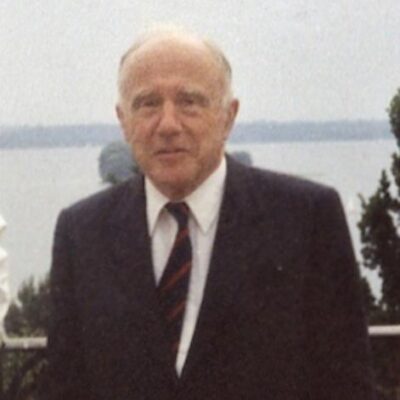
John Archibald Wheeler
John Archibald Wheeler was an American physicist. Born July 9, 1911, in Jacksonville. Died April 13, 2008, in Hightstown. Positions held include professor (1947–). Known for Gravitation Theory and Gravitation Collapse, wormhole and Breit–Wheeler process. Educated at Johns Hopkins University and New York University. Awards include Einstein Prize, Science Writing Award and Wolf Prize in Physics.
Facts
48 facts · 2 confirmed by two sources · 22 cited · 24 from one source
Where this comes from
Papalocal keeps its own record. It started from these sources; what each one said is kept here as it was copied, so a change on their side never changes this page by itself. Tap one to read its version.
What Wikidata says · copied November 13, 2026 · revision 2567880490
- Described as
- American physicist (1911-2008)
- Other names
- J Wheeler, John A. Wheeler, J.A. Wheeler, John Wheeler
- Born
- July 9, 1911 · 8 references
- Died
- April 13, 2008 · 13 references
- Born in
- Jacksonville
- Died in
- Hightstown
- Cause of death
- pneumonia
- Citizen of
- United States · 1 reference
- Occupation
- physicist · 2 references; nuclear physicist; theoretical physicist; university teacher · 1 reference; non-fiction writer; astrophysicist · 1 reference
- Positions held
- professor (1947–)
- Worked for
- Princeton University (1938–1976); University of North Carolina at Chapel Hill (1935–1938); Leiden University (1965–) · 1 reference; University of Texas at Austin (1976–) · 1 reference
- Education
- Johns Hopkins University (–1933); New York University; Rayen High School
- Member of
- Royal Society of London (1995–) · 1 reference; American Academy of Arts and Sciences (1954–) · 1 reference; National Academy of Sciences (1952–) · 1 reference; American Physical Society (1936–) · 1 reference; Accademia Nazionale dei Lincei (1994–) · 1 reference; International Astronomical Union
- Known for
- Gravitation Theory and Gravitation Collapse; wormhole · 1 reference; Breit–Wheeler process · 1 reference; quantum foam · 1 reference; neutron moderator · 1 reference
- Awards
- Einstein Prize (2003) · 1 reference; Science Writing Award (1999) · 1 reference; Wolf Prize in Physics (1996) · 1 reference; Matteucci Medal (1993) · 1 reference; Oskar Klein Medal (1992) · 1 reference; Marcel Grossmann Award (1988) · 1 reference; Albert Einstein Medal (1988) · 1 reference; J. Robert Oppenheimer Memorial Prize (1984) · 1 reference; Oersted Medal (1983) · 1 reference; Niels Bohr International Gold Medal (1982) · 1 reference; National Medal of Science (1970) · 1 reference; Franklin Medal (1969) · 1 reference; Enrico Fermi Award (1968); Albert Einstein Award (1965); Richtmyer Memorial Lecture Award (1954) · 1 reference
- Field
- physics
- Father
- Joseph L. Wheeler · 1 reference
- Wikipedias with a page
- 60
Wikidata item Q202631 (wikidata.org/wiki/Q202631), public domain (CC0). Copied November 13, 2026.
What Wikipedia says · copied November 13, 2026 · revision 1373518403
John Archibald Wheeler (July 9, 1911 – April 13, 2008) was an American theoretical physicist. He was largely responsible for reviving interest in general relativity in the United States after World War II. Wheeler also worked with Niels Bohr to explain the basic principles of nuclear fission. Together with Gregory Breit, Wheeler explored positron-electron pair production from the collision of two photons, now known as the Breit–Wheeler process. He is known for popularizing the term "black hole" to describe the gravitationally completely collapsed objects predicted by general relativity. He also coined "quantum foam", "neutron moderator", "wormhole" and "it from bit", and hypothesized the "one-electron universe". Stephen Hawking called Wheeler the "hero of the black hole story".
At 21, Wheeler earned his doctorate at Johns Hopkins University under the supervision of Karl Herzfeld. He studied under Breit and Bohr on a National Research Council fellowship. In 1939 he collaborated with Bohr on a series of papers using the liquid drop model to explain the mechanism of fission. During World War II, he worked with the Manhattan Project's Metallurgical Laboratory in Chicago, where he helped design nuclear reactors, and then at the Hanford Site in Richland, Washington, where he helped DuPont build them. He returned to Princeton after the war but returned to government service to help design and build the hydrogen bomb in the early 1950s. He and Edward Teller were the main civilian proponents of thermonuclear weapons.
For most of his career, Wheeler was a professor of physics at Princeton University, which he joined in 1938, remaining until 1976. At Princeton he supervised 46 PhD students, more than any other physics professor.
Wheeler left Princeton at the age of 65. He was appointed director of the Center for Theoretical Physics at the University of Texas at Austin in 1976 and remained in the position until 1986, when he retired and became a professor emeritus. With Kip Thorne and Charles Misner, he coauthored the general relativity textbook Gravitation.
- Born, in its opening lines
- July 9, 1911
- Died, in its opening lines
- April 13, 2008
From the Wikipedia article “John Archibald Wheeler” (en.wikipedia.org/wiki/John_Archibald_Wheeler), by its contributors, under CC BY-SA 4.0 (creativecommons.org/licenses/by-sa/4.0/). Copied November 13, 2026; not changed.
Confirmed Two sources agree. Cited One source, and it names where it got it. One source One source, without a reference of its own. Sources disagree The sources disagree. We show the best-supported value and keep theirs below.
