
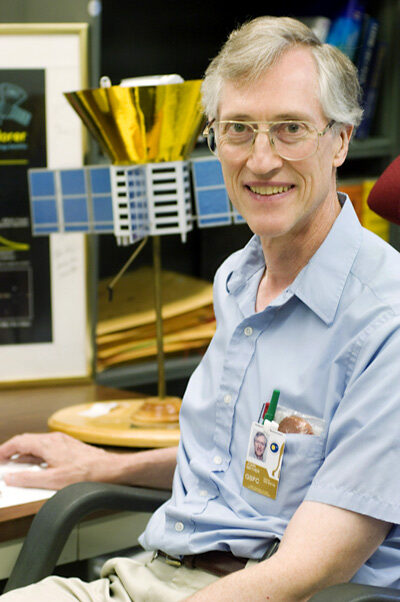
John C. Mather
John C. Mather is an American astrophysicist and cosmologist. Born August 7, 1946, in Roanoke. Educated at University of California, Berkeley and Swarthmore College. Awards include Nobel Prize in Physics, NASA Exceptional Scientific Achievement Medal and Dannie Heineman Prize for Astrophysics.
Facts
29 facts · 1 confirmed by two sources · 11 cited · 17 from one source
Where this comes from
Papalocal keeps its own record. It started from these sources; what each one said is kept here as it was copied, so a change on their side never changes this page by itself. Tap one to read its version.
What Wikidata says · copied November 13, 2026 · revision 2563199735
- Described as
- American astrophysicist and cosmologist
- Other names
- John Mather, John Cromwell Mather
- Born
- August 7, 1946 · 5 references
- Born in
- Roanoke · 2 references
- Name at birth
- John Cromwell Mather
- Citizen of
- United States · 2 references
- Occupation
- astronomer · 2 references; physicist · 1 reference; astrophysicist · 1 reference; researcher
- Worked for
- University of Maryland
- Education
- University of California, Berkeley; Swarthmore College; Newton High School · 1 reference
- Member of
- National Academy of Sciences (1997–); American Physical Society; American Academy of Arts and Sciences; International Astronomical Union; American Astronomical Society
- Awards
- Nobel Prize in Physics (2006) · 2 references; NASA Exceptional Scientific Achievement Medal (1991); Dannie Heineman Prize for Astrophysics (1993) · 1 reference; Rumford Prize (1996) · 1 reference; Benjamin Franklin Medal (1999); George David Birkhoff Prize (2003); Gruber Prize in Cosmology (2006) · 1 reference; Fellow of the American Physical Society; Fellow of the Optical Society; NASA Distinguished Service Medal (2007) · 1 reference; John Scott Award (1995) · 1 reference
- Field
- astrophysics
- Wikipedias with a page
- 70
Wikidata item Q104651 (wikidata.org/wiki/Q104651), public domain (CC0). Copied November 13, 2026.
What Wikipedia says · copied November 13, 2026 · revision 1372424013
John Cromwell Mather (born August 7, 1946) is an American astrophysicist and cosmologist. He shared the 2006 Nobel Prize in Physics with George Smoot for the "for their discovery of the black body form and anisotropy of the cosmic microwave background radiation".
This work helped cement the Big Bang theory of the universe. According to the Nobel Prize committee, "the COBE-project can also be regarded as the starting point for cosmology as a precision science."
Mather is a senior astrophysicist at the NASA Goddard Space Flight Center (GSFC) in Maryland and adjunct professor of physics at the University of Maryland College of Computer, Mathematical, and Natural Sciences. In 2007, Time magazine listed Mather among the 100 Most Influential People in The World. In October 2012, he was listed again by Time magazine in a special issue on New Space Discoveries as one of the 25 most influential people in space.
Mather is one of the 20 American recipients of the Nobel Prize in Physics to sign a letter addressed to President George W. Bush in May 2008, urging him to "reverse the damage done to basic science research in the Fiscal Year 2008 Omnibus Appropriations Bill" by requesting additional emergency funding for the Department of Energy's Office of Science, the National Science Foundation, and the National Institute of Standards and Technology.
Mather served as the senior project scientist for the James Webb Space Telescope (JWST) from 1995 until 2023, when he was succeeded by Jane Rigby.
In 2014, Mather delivered an address on the James Webb Space Telescope at the second Starmus Festival in the Canary Islands.
- Born, in its opening lines
- August 7, 1946
From the Wikipedia article “John C. Mather” (en.wikipedia.org/wiki/John_C._Mather), by its contributors, under CC BY-SA 4.0 (creativecommons.org/licenses/by-sa/4.0/). Copied November 13, 2026; not changed.
Confirmed Two sources agree. Cited One source, and it names where it got it. One source One source, without a reference of its own. Sources disagree The sources disagree. We show the best-supported value and keep theirs below.
