
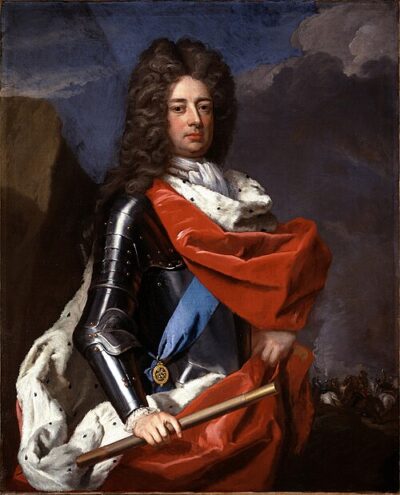
John Churchill, 1st Duke of Marlborough
John Churchill, 1st Duke of Marlborough was an English soldier and statesman. Born May 26, 1650, in Musbury. Died June 16, 1722, in Cumberland Lodge. Positions held include ambassador, Member of Parliament in the Parliament of England and Member of the 1679 Parliament. Educated at St Paul's School and St John's College. Awards include Knight of the Garter.
Facts
37 facts · 2 confirmed by two sources · 16 cited · 19 from one source
Where this comes from
Papalocal keeps its own record. It started from these sources; what each one said is kept here as it was copied, so a change on their side never changes this page by itself. Tap one to read its version.
What Wikidata says · copied November 16, 2026 · revision 2563820062
- Described as
- English soldier and statesman (1650-1722)
- Other names
- John, Duke of Marlborough Churchill, John, 1st Duke of Marlborough, Duke of Marlborough John Churchill, [1st] Duke of Marlborough, John, 1st Duke of Marlborough Churchill, John Churchill 1st Duke of Marlborough, John Churchill, 1st Duke of Marlborough, Prince of Mindelheim, Prince of Mellenburg, John Churchill, 1st Duke of Marlborough John Churchill, 1st Duke of Marlborough, Prince of Mindelheim, Prince of Mellenburg John Churchill, John Churchill, Duke of Marlborough
- Born
- May 26, 1650 · 2 references
- Died
- June 16, 1722 · 3 references
- Born in
- Musbury
- Died in
- Cumberland Lodge
- Buried in
- Blenheim Palace
- Cause of death
- cerebrovascular disease
- Citizen of
- Kingdom of Great Britain
- Occupation
- politician · 1 reference; diplomat; military officer; military leader · 1 reference; military personnel · 1 reference
- Positions held
- ambassador; Member of Parliament in the Parliament of England; Member of the 1679 Parliament; Master-General of the Ordnance (1702–1712)
- Education
- St Paul's School · 1 reference; St John's College
- Awards
- Knight of the Garter (1702)
- Spouse
- Sarah Churchill, Duchess of Marlborough (1678–) · 3 references
- Children
- Anne Churchill, Countess of Sunderland · 1 reference; John Churchill, Marquess of Blandford · 1 reference; Henrietta Churchill, 2nd Duchess of Marlborough · 1 reference; Barbara FitzRoy; Elizabeth Churchill, Countess of Bridgewater · 1 reference; Mary Churchill, Duchess of Montagu · 1 reference; Harriet Churchill · 1 reference; Lord Charles Churchill · 1 reference
- Father
- Winston Churchill · 1 reference
- Mother
- Elizabeth Drake · 2 references
- Siblings
- George Churchill · 1 reference; Arabella Churchill · 1 reference; Charles Churchill · 2 references
- Military branch
- British Army; English Army
- Military rank
- general; generalissimo
- Wikipedias with a page
- 57
Wikidata item Q153803 (wikidata.org/wiki/Q153803), public domain (CC0). Copied November 16, 2026.
What Wikipedia says · copied November 16, 2026 · revision 1385201761
General John Churchill, 1st Duke of Marlborough, 1st Prince of Mindelheim, 1st Count of Nellenburg, Prince of the Holy Roman Empire (26 May 1650 – 16 June 1722 O.S.) was a British army officer and statesman. From a gentry family, he served as a page at the court of the House of Stuart under James, Duke of York, through the 1670s and early 1680s, earning military and political advancement through his courage and diplomatic skill. He is known for never having lost a battle.
Churchill's role in defeating the Monmouth Rebellion in 1685 helped secure James on the throne, but he was a key player in the military conspiracy that led to James being deposed during the Glorious Revolution. Rewarded by William III with the title Earl of Marlborough, persistent charges of Jacobitism led to his fall from office and temporary imprisonment in the Tower of London. William recognised his abilities by appointing him as his deputy in Southern Netherlands (modern-day Belgium) before the outbreak of the War of the Spanish Succession in 1701, but not until the accession of Queen Anne in 1702 did he secure his fame and fortune.
Marriage to Sarah Jennings and her relationship with Anne ensured Marlborough's rise, first to the captain-generalcy of British forces, then to a dukedom. As de facto leader of Allied forces in the Low Countries, his victories at the battles of Blenheim (1704), Ramillies (1706), Oudenarde (1708), and Malplaquet (1709) ensured his place in history as one of Europe's great generals. His wife's stormy relationship with the Queen, and her subsequent dismissal from court, was central to his own fall. Incurring Anne's disfavour, and caught between Tory and Whig factions, Marlborough was forced from office and went into self-imposed exile. He returned to favour with the accession of George I to the throne in 1714, but a stroke in 1716 ended his career.
Marlborough's leadership of the main Allied army against Louis XIV from 1701 to 1711 helped to consolidate Britain's emergence as a front-rank power, while his ability to maintain unity in the fractious coalition demonstrated his diplomatic skills. He is often remembered by military historians as much for his organisational and logistic skills as his tactical abilities. Marlborough's military exploits have resulted in successive historians describing him as one of the finest military commanders in history.
- Born, in its opening lines
- May 26, 1650
- Died, in its opening lines
- June 16, 1722
From the Wikipedia article “John Churchill, 1st Duke of Marlborough” (en.wikipedia.org/wiki/John_Churchill,_1st_Duke_of_Marlborough), by its contributors, under CC BY-SA 4.0 (creativecommons.org/licenses/by-sa/4.0/). Copied November 16, 2026; not changed.
Confirmed Two sources agree. Cited One source, and it names where it got it. One source One source, without a reference of its own. Sources disagree The sources disagree. We show the best-supported value and keep theirs below.
