
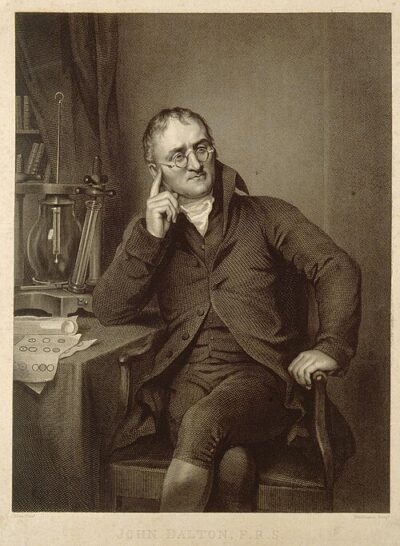
John Dalton
John Dalton was a British chemist and mathematician. Born September 6, 1766, in Cumberland. Died July 27, 1844, in Manchester. Positions held include president (1816–1844) and secretary (1800–1809). Known for History of atomic theory, dalton and color blindness. Educated at Harris Manchester College. Awards include Fellow of the Royal Society, Royal Medal and Fellow of the American Academy of Arts and Sciences.
Facts
36 facts · 2 confirmed by two sources · 9 cited · 25 from one source
Where this comes from
Papalocal keeps its own record. It started from these sources; what each one said is kept here as it was copied, so a change on their side never changes this page by itself. Tap one to read its version.
What Wikidata says · copied November 16, 2026 · revision 2568748847
- Described as
- British chemist and mathematician (1766–1844)
- Other names
- Jn.Dalton
- Born
- September 6, 1766 · 7 references
- Died
- July 27, 1844 · 10 references
- Born in
- Cumberland · 1 reference
- Died in
- Manchester · 3 references
- Buried in
- Ardwick Cemetery · 1 reference
- Citizen of
- United Kingdom of Great Britain and Ireland · 1 reference
- Occupation
- physicist; mathematician; meteorologist; chemist · 1 reference; botanist; naturalist · 1 reference
- Positions held
- president (1816–1844); secretary (1800–1809)
- Worked for
- University of Oxford
- Education
- Harris Manchester College · 1 reference
- Member of
- Royal Society of London (1822–); American Academy of Arts and Sciences; Royal Prussian Academy of Sciences; French Academy of Sciences · 1 reference; Bavarian Academy of Sciences and Humanities; Manchester Literary and Philosophical Society
- Known for
- History of atomic theory; dalton; color blindness; law of multiple proportions; Dalton's law; A New System of Chemical Philosophy · 1 reference
- Awards
- Fellow of the Royal Society; Royal Medal; Fellow of the American Academy of Arts and Sciences
- Field
- chemistry; physics; meteorology
- Father
- Joseph Dalton · 1 reference
- Mother
- Deborah Greenup
- Wikipedias with a page
- 113
Wikidata item Q41284 (wikidata.org/wiki/Q41284), public domain (CC0). Copied November 16, 2026.
What Wikipedia says · copied November 16, 2026 · revision 1383861554
John Dalton (; 5 or 6 September 1766 – 27 July 1844) was an English chemist, physicist, and meteorologist whose work laid the foundations of modern atomic theory and stoichiometric chemistry. Building on earlier ideas about the indivisibility of matter and his own precise measurements of combining ratios, Dalton proposed that each chemical element consists of identical atoms of characteristic weight, and that compounds are formed when atoms of different elements combine in fixed whole-number proportions. His A New System of Chemical Philosophy (1808) presented a coherent atomic model, supplied relative atomic weights and symbolic notation, and established the quantitative framework that shaped nineteenth-century chemistry and remains the basis of modern chemical thought.
Dalton was also a pioneering meteorologist and physicist; he kept daily weather observations for over fifty years, formulated the first empirical law of partial pressures (later known as Dalton's law), and studied the behaviour of gases through his work on vapor pressure and gas solubility. His investigations into his own color blindness led to the first scientific description of the condition—which in several languages is still known as Daltonism—and helped establish experimental methods for linking perception with physiology. Elected a Fellow of the Royal Society in 1822 and awarded its Royal Medal in 1826, Dalton became the first British scientist to develop a quantitative atomic theory and one of the key figures in the transition of chemistry from a qualitative to a mathematical science.
- Born, in its opening lines
- September 6, 1766
- Died, in its opening lines
- July 27, 1844
From the Wikipedia article “John Dalton” (en.wikipedia.org/wiki/John_Dalton), by its contributors, under CC BY-SA 4.0 (creativecommons.org/licenses/by-sa/4.0/). Copied November 16, 2026; not changed.
Confirmed Two sources agree. Cited One source, and it names where it got it. One source One source, without a reference of its own. Sources disagree The sources disagree. We show the best-supported value and keep theirs below.
