
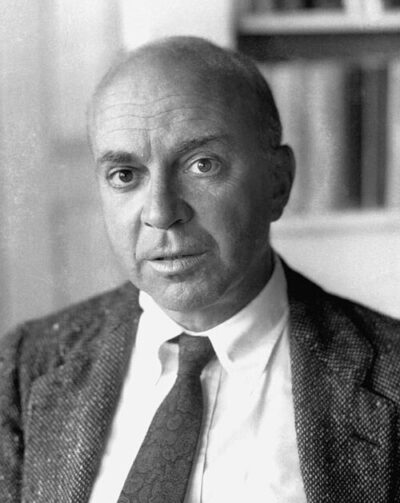
John Dos Passos
John Dos Passos was an American novelist. Born January 14, 1896, in Chicago. Died September 28, 1970, in Baltimore. Known for U.S.A. and Manhattan Transfer. Educated at Harvard University and Choate Rosemary Hall. Awards include Guggenheim Fellowship (3 times) and Feltrinelli Prize.
Facts
30 facts · 2 confirmed by two sources · 9 cited · 19 from one source
Where this comes from
Papalocal keeps its own record. It started from these sources; what each one said is kept here as it was copied, so a change on their side never changes this page by itself. Tap one to read its version.
What Wikidata says · copied November 13, 2026 · revision 2568216685
- Described as
- American novelist (1896–1970)
- Other names
- John Roderigo Dos Passos, J. R. Dos Passos
- Born
- January 14, 1896 · 16 references
- Died
- September 28, 1970 · 15 references
- Born in
- Chicago · 3 references
- Died in
- Baltimore · 2 references
- Buried in
- Yeocomico Episcopal Churchyard · 1 reference
- Name at birth
- John Roderigo Dos Passos
- Citizen of
- United States
- Occupation
- war correspondent; screenwriter; novelist; journalist; writer · 2 references; painter · 1 reference; poet · 1 reference; translator · 1 reference
- Political party
- Republican Party
- Education
- Harvard University · 1 reference; Choate Rosemary Hall; Harvard College; Sidwell Friends School · 1 reference
- Member of
- American Academy of Arts and Letters; American Academy of Arts and Sciences
- Genre
- Lost Generation
- Known for
- U.S.A.; Manhattan Transfer
- Awards
- Guggenheim Fellowship (3 times) (1939, 1940, 1942) · 1 reference; Feltrinelli Prize
- Father
- John R. Dos Passos · 1 reference
- Mother
- Lucy Addison Sprigg Dos Passos · 1 reference
- Website
- http://www.johndospassos.com
- Wikipedias with a page
- 64
Wikidata item Q312407 (wikidata.org/wiki/Q312407), public domain (CC0). Copied November 13, 2026.
What Wikipedia says · copied November 13, 2026 · revision 1373328798
John Roderigo Dos Passos (; January 14, 1896 – September 28, 1970) was an American novelist, most notable for his U.S.A. trilogy.
Born in Chicago, Dos Passos graduated from Harvard College in 1916. He traveled widely as a young man, visiting Europe and southwest Asia, where he learned about literature, art, and architecture. During World War I, he was an ambulance driver for the American Volunteer Motor Ambulance Corps in Paris and Italy, before joining the United States Army Medical Corps as a private.
In 1920, his first novel, One Man's Initiation: 1917, was published, and in 1925, his novel Manhattan Transfer became a commercial success. His U.S.A. trilogy, which consists of the novels The 42nd Parallel (1930), 1919 (1932), and The Big Money (1936), was ranked by the Modern Library in 1998 as 23rd of the 100 best English-language novels of the 20th century. Written in experimental, non-linear form, the trilogy blends elements of biography and news reports to paint a landscape of early 20th-century American culture.
Beyond his writing, Dos Passos is known for his shift in political views. Following his experiences in World War I, he became interested in socialism and pacifism, which also influenced his early work. In 1928, he traveled to the Soviet Union, curious about its social and political experiment, though he left with mixed impressions. His experiences during the Spanish Civil War disillusioned him with left-wing politics while also severing his relationship with fellow writer Ernest Hemingway. By the 1950s, his political views had changed dramatically, and he had become more conservative. In the 1960s, he campaigned for presidential candidates Barry Goldwater and Richard Nixon.
As an artist, Dos Passos created his own cover art for his books, influenced by the modernism of 1920s Paris. He died in Baltimore, Maryland. Spence's Point, his Virginia estate, was designated as a National Historic Landmark in 1971.
- Born, in its opening lines
- January 14, 1896
- Died, in its opening lines
- September 28, 1970
From the Wikipedia article “John Dos Passos” (en.wikipedia.org/wiki/John_Dos_Passos), by its contributors, under CC BY-SA 4.0 (creativecommons.org/licenses/by-sa/4.0/). Copied November 13, 2026; not changed.
Confirmed Two sources agree. Cited One source, and it names where it got it. One source One source, without a reference of its own. Sources disagree The sources disagree. We show the best-supported value and keep theirs below.
