
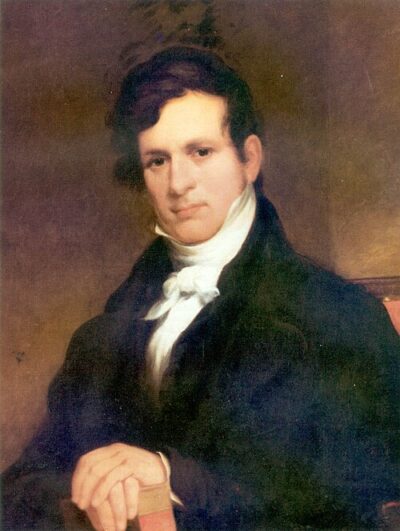
John Eaton
John Eaton was an American politician and diplomat. Born June 18, 1790, in Scotland Neck. Died November 17, 1856, in Washington, D.C.. Positions held include member of the Tennessee House of Representatives, United States Secretary of War (1829–1831) and Governor of the Territory of Florida (1834–1836). Educated at University of North Carolina at Chapel Hill.
Facts
23 facts · 2 confirmed by two sources · 8 cited · 13 from one source
Where this comes from
Papalocal keeps its own record. It started from these sources; what each one said is kept here as it was copied, so a change on their side never changes this page by itself. Tap one to read its version.
What Wikidata says · copied November 18, 2026 · revision 2571652195
- Described as
- American politician and diplomat (1790-1856)
- Other names
- John Henry Eaton
- Born
- June 18, 1790 · 3 references
- Died
- November 17, 1856 · 3 references
- Born in
- Scotland Neck
- Died in
- Washington, D.C.
- Buried in
- Oak Hill Cemetery
- Citizen of
- United States
- Occupation
- politician · 2 references; lawyer · 1 reference; diplomat; ambassador · 1 reference; governor · 1 reference; jurist · 1 reference
- Positions held
- member of the Tennessee House of Representatives; United States Secretary of War (1829–1831); Governor of the Territory of Florida (1834–1836); ambassador; United States senator (1818–1829) · 1 reference; United States Ambassador to Spain; senator · 1 reference; defence minister · 1 reference
- Political party
- Democratic Party
- Education
- University of North Carolina at Chapel Hill
- Spouse
- Margaret O'Neill Eaton (1829–)
- Wikipedias with a page
- 18
Wikidata item Q878759 (wikidata.org/wiki/Q878759), public domain (CC0). Copied November 18, 2026.
What Wikipedia says · copied November 18, 2026 · revision 1379273076
John Henry Eaton (June 18, 1790 – November 17, 1856) was an American politician and ambassador from Tennessee who served as U.S. Senator and as U.S. Secretary of War in the administration of Andrew Jackson. He was 28 years, 4 months, and 29 days old when he entered the Senate, making him the youngest U.S. Senator in history.
Eaton was a lawyer in Tennessee who became part of a network that supported the political campaigns of Andrew Jackson. He also served in the militia as a major, and during the War of 1812 became an aide to Jackson; Eaton served with Jackson in all his wartime campaigns and battles, including the Battle of New Orleans. After serving in the Tennessee House of Representatives in 1815 and 1816, in 1818 Eaton was elected to the U.S. Senate, though he had not yet reached the constitutionally mandated age of 30.
Following Jackson's election to the presidency in 1828, Eaton resigned his Senate seat to join Jackson's cabinet as Secretary of War. Eaton and his wife Peggy became the focus of controversy during Jackson's first term; in the so-called Petticoat affair, Washington's society wives refused to socialize with the Eatons. The wives of the vice president, cabinet members, and members of Congress looked down on Peggy because of the circumstances of her marriage to Eaton; they had wed shortly after the death of her first husband, without waiting for the usual mourning period, giving rise to rumors that she had been unfaithful to her first husband before his death. Eaton resigned as Secretary of War as part of a strategy to resolve the controversy; he later received appointments as Governor of Florida Territory and U.S. Minister to Spain.
Upon returning to the United States in 1840, Eaton refused to endorse incumbent Martin Van Buren for reelection to the presidency, angering Jackson. In retirement, Eaton resided in Washington. He died there in 1856, and was buried at Oak Hill Cemetery.
- Born, in its opening lines
- June 18, 1790
- Died, in its opening lines
- November 17, 1856
From the Wikipedia article “John Eaton (politician)” (en.wikipedia.org/wiki/John_Eaton_(politician)), by its contributors, under CC BY-SA 4.0 (creativecommons.org/licenses/by-sa/4.0/). Copied November 18, 2026; not changed.
Confirmed Two sources agree. Cited One source, and it names where it got it. One source One source, without a reference of its own. Sources disagree The sources disagree. We show the best-supported value and keep theirs below.
