
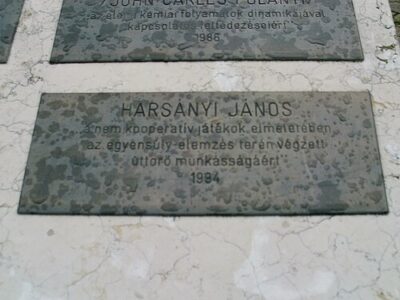
John Harsanyi
John Harsanyi was a Hungarian economist. Born May 29, 1920, in Budapest. Died August 9, 2000, in Berkeley. Educated at Stanford University and Eötvös Loránd University. Awards include Prize in Economic Sciences in Memory of Alfred Nobel, John von Neumann Award and Distinguished Fellow of the American Economic Association.
Facts
32 facts · 2 confirmed by two sources · 10 cited · 20 from one source
Where this comes from
Papalocal keeps its own record. It started from these sources; what each one said is kept here as it was copied, so a change on their side never changes this page by itself. Tap one to read its version.
What Wikidata says · copied November 13, 2026 · revision 2563196382
- Described as
- Hungarian economist (1920-2000)
- Other names
- John Charles Harsanyi
- Born
- May 29, 1920 · 8 references
- Died
- August 9, 2000 · 8 references
- Born in
- Budapest · 1 reference
- Died in
- Berkeley · 1 reference
- Cause of death
- myocardial infarction
- Citizen of
- Hungary; United States
- Occupation
- economist · 1 reference; professor; researcher
- Worked for
- University of California, Berkeley; Wayne State University; Australian National University; University of Queensland · 1 reference
- Education
- Stanford University (–1958); Eötvös Loránd University (–1942); University of Sydney (–1953); Fasori Gimnázium
- Member of
- Hungarian Academy of Sciences; National Academy of Sciences; American Academy of Arts and Sciences; Econometric Society (1968–) · 1 reference
- Awards
- Prize in Economic Sciences in Memory of Alfred Nobel (1994) · 1 reference; John von Neumann Award (1995) · 1 reference; Distinguished Fellow of the American Economic Association; Fellow of the Econometric Society (1968) · 1 reference; honorary doctor of the Renmin University of China (1997) · 1 reference; honorary doctor of Caen University (1995) · 1 reference
- Field
- game theory; economics
- Religion
- atheism; lapsed Catholic · 1 reference
- Wikipedias with a page
- 51
Wikidata item Q272510 (wikidata.org/wiki/Q272510), public domain (CC0). Copied November 13, 2026.
What Wikipedia says · copied November 13, 2026 · revision 1372023408
John Charles Harsanyi (Hungarian: Harsányi János Károly; May 29, 1920 – August 9, 2000) was a Hungarian-American economist who spent most of his career at the University of California, Berkeley. He was the recipient of the Nobel Memorial Prize in Economic Sciences in 1994.
Harsanyi is best known for his contributions to the study of game theory and its application to economics, specifically for his developing the highly innovative analysis of games of incomplete information, so-called Bayesian games. He also made important contributions to the use of game theory and economic reasoning in political and moral philosophy (specifically utilitarian ethics) as well as contributing to the study of equilibrium selection. For his work, he was a co-recipient along with John Nash and Reinhard Selten of the 1994 Nobel Memorial Prize in Economic Sciences.
He moved to the United States in 1956, and spent most of his life there. According to György Marx, he was one of The Martians.
- Born, in its opening lines
- May 29, 1920
- Died, in its opening lines
- August 9, 2000
From the Wikipedia article “John Harsanyi” (en.wikipedia.org/wiki/John_Harsanyi), by its contributors, under CC BY-SA 4.0 (creativecommons.org/licenses/by-sa/4.0/). Copied November 13, 2026; not changed.
Confirmed Two sources agree. Cited One source, and it names where it got it. One source One source, without a reference of its own. Sources disagree The sources disagree. We show the best-supported value and keep theirs below.
